Non-Medical vs Medicare-Certified Home Health Agency: Licensing, Billing and Accounting Differences
Christian Soriaga, CPA11 min read
On this page
Quick answer: A "non medical home health agency" is really a home care agency. Its caregivers help with daily tasks such as bathing and meals, and clients pay privately or through Medicaid or the VA. A Medicare-certified home health agency gives skilled care, bills Medicare and files a yearly Medicare cost report. Licensing, billing and bookkeeping all differ.
The U.S. Bureau of Labor Statistics reports median pay of $35,800 a year for home health and personal care aides (BLS, May 2025). Families paid a median $35 an hour for non-medical caregivers in 2025 (CareScout).
If you're weighing a non medical home health agency against a Medicare-certified one, the gap is bigger than the names suggest. It changes who licenses you, who pays you, what your caregivers may do and what your books must show. This guide is for two owners.
One is opening soon. The other runs a private-pay agency and is thinking about adding skilled nursing and therapy. It's general information, not advice for your agency.
We prepare 50 to 100 Medicare cost reports a year at Soriaga & Associates, LLC. We're a CPA firm with 20+ years in healthcare accounting.
One thing below surprises most owners. Right now, CMS is turning away new Medicare home health applications. We'll get to that in the section on adding skilled care.
Key takeaways
- A non-medical agency sells daily-living help. A Medicare-certified agency sells skilled care that a doctor orders.
- Medicare doesn't pay for personal care when that is the only care a person needs (Medicare.gov).
- Your state licenses both types. Medicare adds a federal layer for home health.
- Medicare pays per 30-day period. A late admission notice costs you 1/30th of the payment for each day (CMS).
- Medicare-certified agencies file a yearly cost report. Non-medical agencies don't, unless a state program asks for one.
- CMS extended the freeze on new Medicare home health enrollments on November 12, 2026 (CMS). Plan around it.
What's the difference between a non-medical and a Medicare-certified home health agency?
A non-medical agency sells hands-on help with daily life and is paid mostly by clients and by Medicaid or VA programs. A Medicare-certified home health agency sells skilled nursing and therapy that a doctor orders, and Medicare pays it. The second type needs federal approval, a yearly cost report and different books.
| Non-medical home care | Medicare-certified home health | |
|---|---|---|
| Care given | Bathing, dressing, meals, errands, companionship | Skilled nursing, therapy, plus an aide when skilled care is also needed |
| Main payers | Private clients, insurers, Medicaid programs, VA | Medicare, plus Medicaid and insurers |
| Licensing | State only, and rules vary by state | State license plus Medicare certification |
| Billing unit | Hours, billed to the client or program | A 30-day period of care |
| Doctor's order | Not needed | Required |
| Yearly cost report | No Medicare cost report | Form CMS-1728-20 |
| Books | Revenue and caregiver cost by payer | The same, plus Medicare cost centers |
The names cause most of the confusion. "Home health" sounds like it covers anything done in a home. It doesn't.
What to do: Write one sentence that says what care you give and who pays for it. Add your state. The rest of this post builds on that sentence.
Who pays for each type of care?
Medicare pays only when a Medicare-certified agency gives skilled care to a homebound patient whose doctor or other provider has ordered it. Personal care alone isn't covered. Non-medical agencies get paid by clients, insurers and state or VA programs instead (Medicare.gov).
Price is where owners get their first number to work with. The national median hourly rate for non-medical caregiver services was $35 in 2025 (CareScout). Median pay for home health and personal care aides was $17.21 an hour in May 2025 (BLS). The $17.79 gap pays for payroll taxes, workers' comp, scheduling and the office (illustrative, since the two numbers come from different surveys).
Medicaid money comes with a proof step. Federal law makes states require electronic visit verification for Medicaid-funded personal care (Medicaid.gov). In plain words, Medicaid wants proof that the caregiver was in the living room.
To see how payer mix moves your margin, read our post on home care agency profit margin.
| Payer | What it pays for | What you must show |
|---|---|---|
| Private clients and insurers | Personal care at the rate you set | Time records and invoices |
| Medicaid programs | Personal care under the state program | Electronic visit verification |
| Medicare | Skilled care for a homebound patient | Doctor's order, assessment, visit notes |
What to do: List every payer you bill today and what share of revenue each one makes up.
Who licenses each one, and what can a caregiver do?
Your state licenses both types, and Medicare adds a federal layer for home health. Illinois, for example, has three licenses under one law. Home health is skilled, home nursing is nurses and aides, and home services is non-medical. A home services worker can help with daily living but can't do skilled care.
The Illinois Department of Public Health (IDPH) separates the three licenses by who does the work (IDPH overview).
| Illinois license | What it covers | Staff |
|---|---|---|
| Home health agency | Skilled nursing plus at least one other home health service | Nurses, therapists, aides |
| Home nursing agency | Skilled nursing and aide services | Nurses, aides |
| Home services agency | Non-medical help: daily living, housekeeping, medication reminding, cooking, shopping, transport, companionship. Skilled services excluded | Home services workers |
The limits for a home services worker are specific. A transfer is allowed only when the client has enough balance and strength to stand and pivot, and to help with the move.
Medication reminding is allowed only for medicines that someone else pre-selected and placed in marked minders. A caregiver who "just helps with the pills" is how agencies meet an inspector.
Other states use other names, and some don't license non-medical care at all. Check yours first. See how to start a home care agency for new-agency licensing and how to start a home health agency for surveys and certification.
What to do: Get your state's definition of "home care" or "home services" in writing. Then compare it with every task on your caregiver job description.
How does billing work for each type?
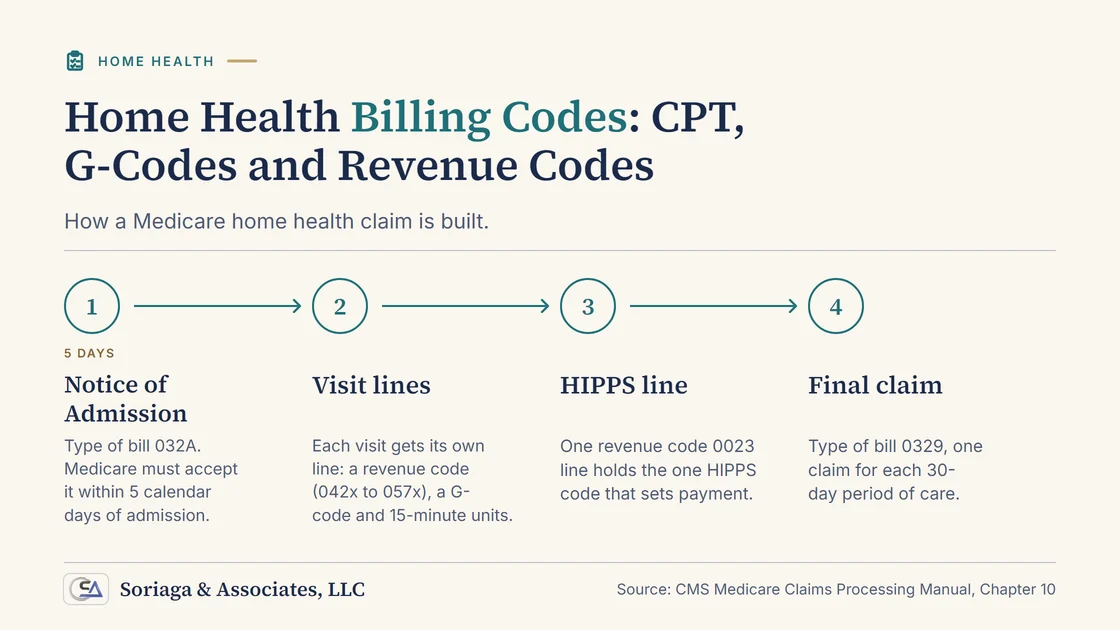
Non-medical agencies usually bill by the hour, every week or two. Medicare pays home health a flat rate for each 30-day period, set by one of 432 case-mix groups. You must file a Notice of Admission within 5 calendar days of the start of care, or Medicare cuts the payment.
| Non-medical home care | Medicare-certified home health | |
|---|---|---|
| What you bill | Hours worked | A 30-day period of care |
| Who sets the rate | You, or the Medicaid or VA program | Medicare, using the Patient-Driven Groupings Model (PDGM) |
| Proof of the visit | Time records; electronic verification for Medicaid | Doctor's order, assessment and visit notes |
| Key deadline | Your invoice terms or the program's rules | Notice of Admission within 5 calendar days |
| Cost of missing it | Slow cash | 1/30th of the period payment for each late day |
| Fastest payment | Per your terms | No earlier than day 14 after a clean electronic claim arrives |
The patient's diagnosis and level of function help set the group (CMS). The late-notice penalty is 1/30th of the period payment for each day until you file (CMS). Medicare can't pay an electronic claim before the 14th day after it arrives (CMS).
Put those together and cash gets tight. Count 30 days of care, then 14 days of waiting.
That's about six weeks from the first visit to the first Medicare deposit (illustrative, if a clean claim goes out the day the period ends). Your caregivers still want pay every week. Our post on PDGM 30-day periods and cash flow walks through the timing.
In my experience, owners are surprised by how important it is to really manage their cash flow. If they don't have enough to cover payroll and contractors, plus other fixed expenses, they can lose money very quickly.
What to do: Ask your biller for the last admission notice they filed. Count the days after the start of care.
How do the books and the cost report differ?
A non-medical agency's books are built around revenue and caregiver cost by payer. A Medicare-certified agency's books also feed the Medicare cost report, Form CMS-1728-20. It sorts costs into set cost centers. It's due on or before the last day of the fifth month after your year ends (eCFR).
The form has named lines, including one for non-Medicare work:
| Line | Cost center |
|---|---|
| 16 | Skilled nursing, registered nurse |
| 17 | Skilled nursing, licensed practical nurse |
| 18 | Physical therapy |
| 24 | Home health aide |
| 41 | Private duty nursing (non-reimbursable) |
Source: CMS Form CMS-1728-20 instructions.
Here's the catch for an agency that does both. Medicare's rule is that costs tied to other patients aren't borne by the program (42 CFR 413.5, quoted in the Federal Register). So rent, the office manager and software must be split between Medicare and private-pay work. The form uses statistical bases for that split.
Say your private-pay caregivers and your Medicare nurses share one office and one scheduler. If the books lump them together, someone has to rebuild the split later. We'd rather see it done monthly.
In my experience, owners often don't calculate the split of shared costs correctly. They need to sit down and really think about what an accurate split is. Usually it's done by income split. A true-use split is more accurate.
Medicare doesn't read your tax return, but it does read your cost centers. Our home health accounting page shows how we set books up for that. The home health cost report page covers the filing.
What to do: Ask your accountant which of your accounts would map to cost centers 16, 17, 18 and 24 today. A blank look is your answer.
Do the tax rules differ?
The tax basics are the same for both types of agency.
A caregiver you control is a W-2 employee. Writing "contractor" on the form doesn't change that. The IRS looks at who controls the work, not the label (IRS).
The real difference is that Medicare wants cost-report books, not only tax books.
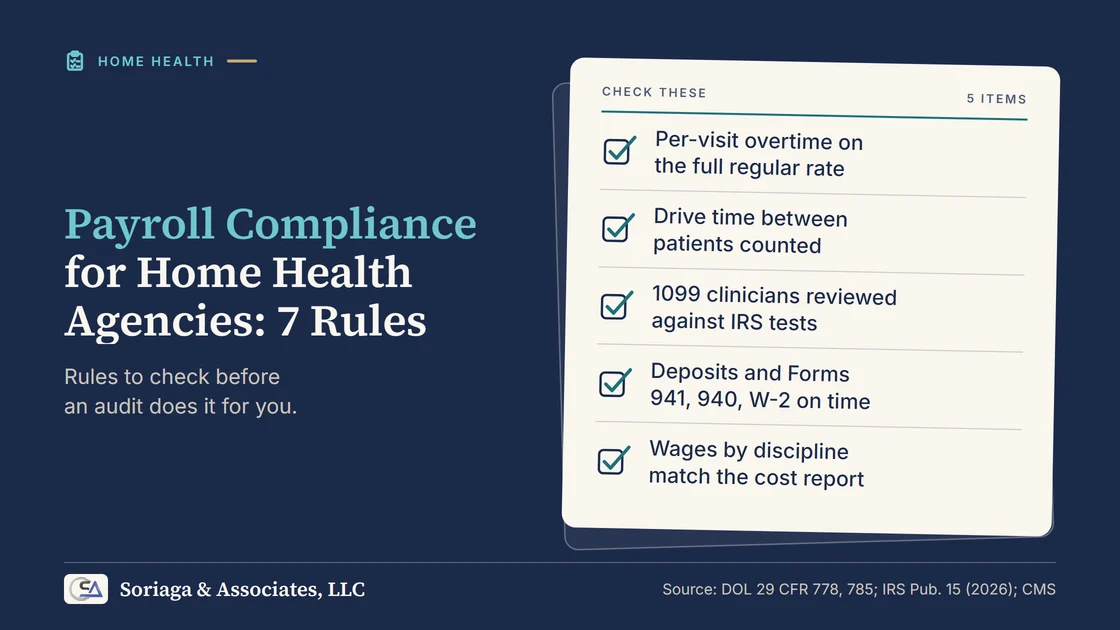
Wage rules matter too. DOL says third-party employers, such as home care agencies, can't claim the companionship exemption (DOL).
| Rule | What it says | Status |
|---|---|---|
| IRS common-law test | Control decides employee or contractor | In force |
| FLSA, third-party employers | Minimum wage and time and a half after 40 hours | In force (DOL) |
| DOL July 2025 proposal | Would bring the companionship exemption back | Still a proposal (DOL) |
State law may be stricter, so plan payroll on today's rule.
Owner pay is where tax and Medicare meet. Medicare follows reasonable cost principles, so pay to owners and related parties can draw questions (CMS). On an S corp? See our post on S corp reasonable salary for a home care agency.
What to do: Check that every caregiver is on W-2 payroll. Check that overtime is paid the way your state requires.
Should a non-medical agency add Medicare-certified home health?
Not this winter, if it would need a new Medicare enrollment. CMS extended its nationwide freeze on new home health enrollments on November 12, 2026, for six months. It can extend again in six-month steps. Use the wait to make your books ready.
CMS says applications for initial enrollment submitted after the extension will be denied while the freeze lasts (CMS moratoria page). A non-medical agency has no Medicare enrollment to add to, so it counts as a new one. The final CY 2027 payment rule also widens CMS's power to deny or revoke enrollment, including retroactively (AHA).
What changes the day you're certified?
Five things change at once.
| Change | What it means |
|---|---|
| Cost report from year one | Medicare requires an annual cost report from home health agencies (CMS) |
| PDGM billing | Every 30-day period needs a doctor's order, an assessment and a timely admission notice |
| Cost-center chart of accounts | Books built around cost centers, not only payers |
| New payer mix | Medicare becomes one large payer with its own rules and audits |
| Cash gap and floor | Three months of reserve funds, not counting Medicare receivables, and at least half non-borrowed (eCFR) |
The first thing I make sure of is that the owner knows to keep the two businesses separate. Non-medical and Medicare-certified agencies handle different types of work at different skill levels. They also bill differently. Keeping the businesses separate keeps the books clean and organized.
Margins look inviting from outside. MedPAC put the fee-for-service Medicare margin for freestanding agencies at 21.2% in 2024.
It recommended a 7% cut to the 2027 base rate (MedPAC). CMS finalized a 2.4% increase for 2027 and kept a 3.0% temporary reduction (AHA). A fat margin and a regulator who knows it make a shaky business plan.
If you run a private-pay agency and want to test the idea with real numbers, we do that in a free call. Book a free 20-minute call and bring last month's payroll and billing reports. Our home care accounting team will show you what a cost-report-ready version of your books would look like.
What can you do while the freeze runs?
Four moves cost little and pay off either way.
| Move | Why it helps |
|---|---|
| Split revenue and caregiver cost by payer every month | Shows which payer earns what |
| Track shared costs, such as rent and office pay, in their own accounts | Makes the Medicare split easy later |
| Model six weeks of payroll with no Medicare money | Sizes the cash gap |
| Have a CPA who files cost reports review your chart of accounts | Catches gaps before they cost you |
What to do: Pick the one that's weakest today and fix it this month.
I'm opening soon. What can I buy before a monthly retainer?
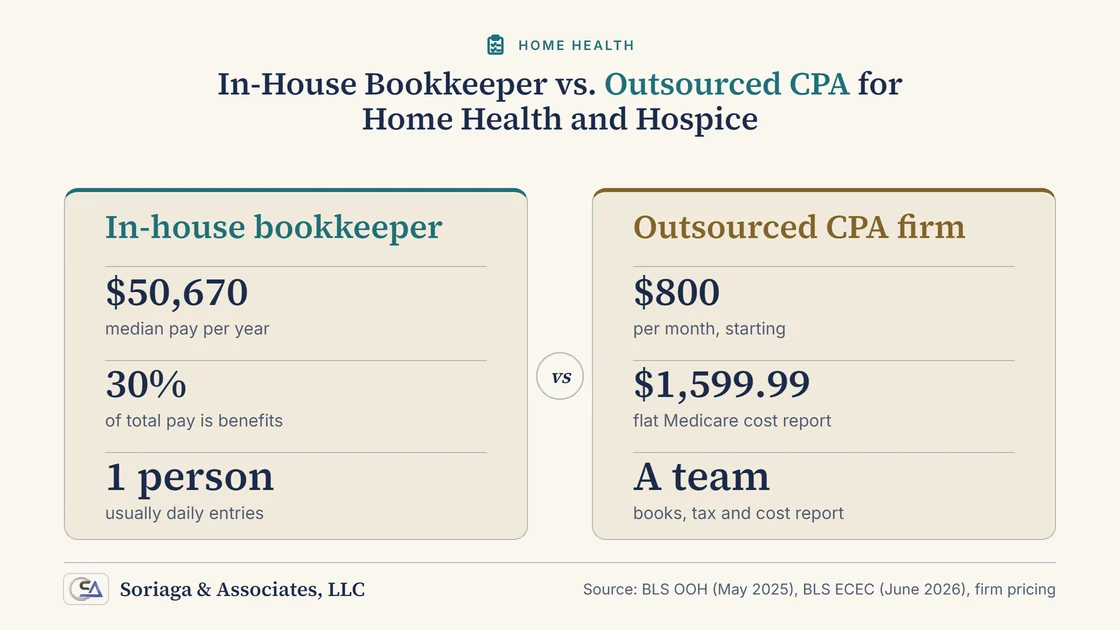
You don't need a monthly retainer on day one, any more than you need a whole toolbox to hang one picture. Two one-time jobs cover the basics: your business tax return, and your first Medicare cost report once you're certified and billing. Our flat fee for a cost report is $1,599.99 for low or full utilization and $500 for no utilization.
| Option | What it covers | Price |
|---|---|---|
| Business tax return | Your entity's return | Quoted after a free call |
| First Medicare cost report | Home health or hospice report, once you're certified and billing | $1,599.99 low or full utilization, $500 no utilization (home health cost report) |
| Monthly retainer | Bookkeeping, payroll processing, business tax returns, consulting and the cost report | From $800 per month, no setup fee for new agencies |
When you're ready for monthly help, our retainer starts at $800 per month, with no setup fee for new agencies. Payroll is one piece of that full back office, and we'd rather run books and taxes with payroll. See our payroll services page.
Opening in the next 90 days? Book a free call and we'll tell you which of these you need now and which can wait.
What to do: Write down your planned opening date and your first Medicare billing date. The gap between them is your cash plan.
What we see in the field
Most agencies come to us because they don't have an accountant yet. They need books set up for the Medicare or IDOA cost report.
| Who we serve | Count |
|---|---|
| Home health agencies | 30+ |
| Hospices | 10+ |
| Home care agencies | 5+ |
| Naperville clients, mostly home health and home care, on full service | 11+ |
Non-medical doesn't always mean no cost report. One Illinois home care client didn't know how to prepare its IDOA cost report or how the outside audit worked. We built the workpapers and sent the auditors what they needed, on time (IDOA cost report).
"We'll sort the books out later" is the most expensive sentence in home care. Agencies that track cost by payer from the start find a Medicare add-on far easier.
Frequently asked questions
What is the difference between a non-medical home care agency and a home health agency?
A non-medical agency gives personal help, paid privately or by Medicaid or the VA. A Medicare-certified agency gives skilled care ordered by a doctor, paid by Medicare. It also files a yearly cost report.
Can a non-medical home care agency bill Medicare?
No. Medicare pays only when a Medicare-certified agency gives home health care (Medicare.gov). It does not cover personal care when that is the only care needed.
Does a non-medical home care agency file a Medicare cost report?
No, unless it is also Medicare-certified. Some file a state report, such as the IDOA cost report in Illinois.
Can I add Medicare-certified home health to my home care agency right now?
Probably not as a new enrollment. CMS extended its freeze on new home health enrollments on November 12, 2026, for six months.
Do caregivers at a non-medical agency need to be employees?
In most cases, yes. The IRS asks who controls the work, not what the contract says. Agencies also owe minimum wage and overtime.
What does an accountant do differently for a Medicare-certified agency?
The books must feed the cost report, which sorts costs into cost centers. Shared costs must be split. To talk it through, book a free call.
Where to start depends on your situation.
| Your situation | Best next step |
|---|---|
| Opening in the next 90 days | A free call, then one-time jobs |
| Private-pay agency eyeing Medicare | A free call with payroll and billing reports |
| Already Medicare-certified | A cost report review |
Next step
Write down which payers you bill and which tasks your caregivers do. Those two lists show which side of the line you're on. They also show how far you'd have to move to cross it.
Book a free 20-minute call and we'll review them with you. You can also read about home care accounting and home health accounting, see pricing, or call (630) 491-1268.
Sources
- Medicare.gov, Home health services coverage
- CMS, Provider enrollment moratoria
- AHA, CMS finalizes CY 2027 home health rule
- CMS, Home Health PPS
- CMS, Claims Processing transmittal on the Notice of Admission
- CMS, Claims Processing transmittal on the payment floor
- eCFR, 42 CFR 413.24
- CMS, Form CMS-1728-20 instructions and Chapter 47 introduction
- Federal Register, CY 2025 home health rule
- eCFR, 42 CFR 489.28
- Illinois Department of Public Health, Overview of home health, home services and home nursing
- Medicaid.gov, Electronic visit verification
- U.S. Bureau of Labor Statistics, Home health and personal care aides
- CareScout, 2025 Cost of Care Survey
- MedPAC, March 2026 report, Chapter 8
- DOL, Fact Sheet 79A and DOL direct care workers page
- IRS, Publication 15-A
- Soriaga & Associates, LLC, read this next: New home health agency accounting setup
Last updated: November 2026.
This article is general information, not legal or tax advice. The worked examples are illustrative.
Soriaga & Associates, LLC is a CPA firm founded in 1985 in Lisle, Illinois, serving home health, hospice, home care, wound care and dental providers nationwide. (630) 491-1268.