New Home Health Agency: Accounting Setup Before and After Medicare Certification
Christian Soriaga, CPA10 min read
On this page
Quick answer: A new home health agency should set up its books as if the first Medicare cost report is already due. That means a chart of accounts by cost center, visit statistics by discipline, a monthly comparison to Medicare payments, and a cash plan that covers the months before Medicare pays you.
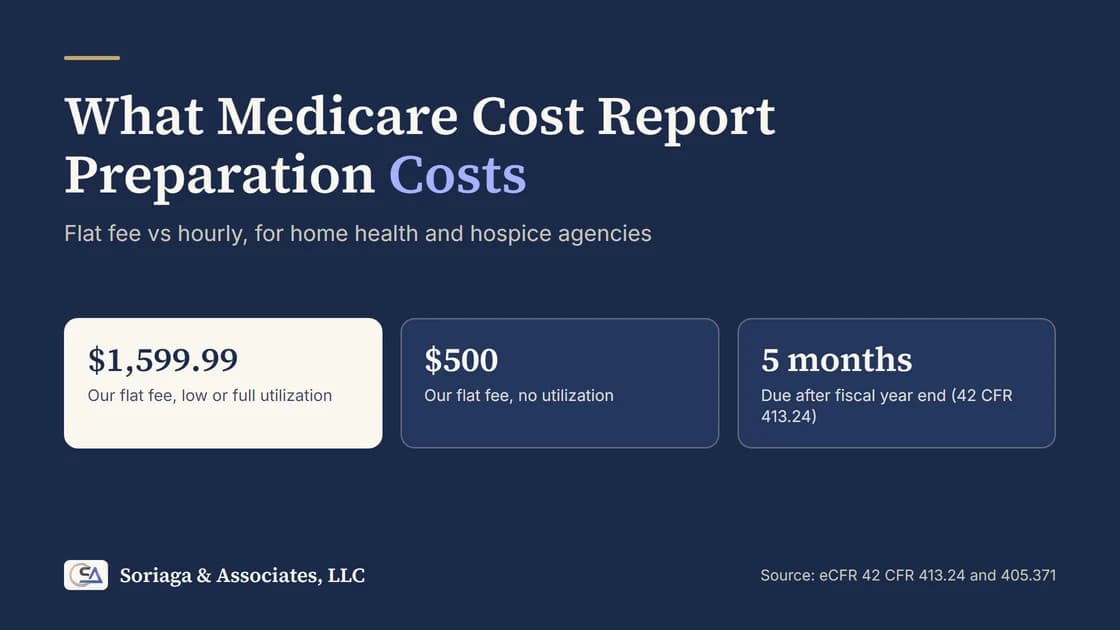
Under 42 CFR 413.24(f)(2), a Medicare cost report is due on or before the last day of the fifth month after the cost reporting period closes, and under 42 CFR 489.28 a home health agency entering Medicare must show initial reserve operating funds covering its first three months (Cornell LII, eCFR text).
Most new home health owners put their energy into licensing, hiring a director of nursing and getting through the survey. That work matters. The accounting side usually waits until the first bills go out, and then the owner discovers that Medicare expects an annual cost report built from records the agency never kept. This guide covers the accounting angle only. For the licensing and certification process, talk to your state agency and a healthcare attorney.
Key takeaways
- The cost report is built from your books. If your records are organized for it from day one, preparation is fast. If not, it becomes a reconstruction.
- You must show reserve funds before Medicare billing starts. 42 CFR 489.28 requires initial reserve operating funds for new agencies, and Medicare receivables do not count.
- First payments take time. Plan to pay staff and rent from your own funds until claims are paid.
- Cost report due date: the last day of the fifth month after your cost reporting period ends (42 CFR 413.24(f)(2)).
- Track visits by discipline (nursing, physical therapy, occupational therapy, speech, aide, social work) from the first patient.
- Reconcile to the PS&R report regularly, not once a year.
- Pick your CPA early. See our home health accounting page.
Setting up a new agency? Book a free 20-minute call and we will review your chart of accounts and timeline before you open.
What accounting should be in place before Medicare certification?
You cannot bill Medicare until you are certified, but the accounting setup starts earlier. Five items are worth getting right before the first patient.
- Entity and tax setup. Form the entity, get your federal EIN, open a business bank account and register as an employer. Keep startup spending in the business account so every dollar is traceable.
- A chart of accounts built for Medicare. Standard small-business categories are not enough. You want expense accounts that can be grouped later into the cost centers the cost report uses: administrative and general, and the patient-care disciplines. Separate nursing, therapy and aide payroll from office payroll, and separate rent, insurance, software and vehicle costs.
- A way to count visits. The cost report allocates costs using statistics. The most basic is visits by discipline. Your clinical system will have them. Agree up front on who exports the visit counts each month and how they are checked.
- A fixed-asset list. Computers, furniture and vehicles are depreciated, and the cost report uses depreciation. Keep invoices, dates in service and amounts.
- Payroll that separates roles. Pay codes by discipline make allocation easy. See our payroll services for how that fits with caregiver and clinical payroll.
None of this requires expensive software. It requires a decision and a habit.
What are initial reserve operating funds?
This is the item that surprises new owners. Under 42 CFR 489.28, a home health agency entering the Medicare program on or after January 1, 1998 must have sufficient initial reserve operating funds. The regulation sets the standard as the greater of two amounts:
- The average actual cost per visit of at least three similar home health agencies, multiplied by the agency's projected visits for its first three months; or
- 22.5 percent (one fourth of 90 percent) of the average visits reported by those comparison agencies.
The funds must be available when you submit the application and throughout enrollment, and they must remain available for the three-month period after Medicare billing privileges are conveyed. Medicare accounts receivable do not count toward the total. The rule also requires proof, such as bank or account statements and an attestation from the bank where offered, and at least 50 percent of the required funds must be non-borrowed.
In plain terms: Medicare wants to see that you can run the agency for about three months without relying on Medicare payments. Your CPA should help you build the projection of visits and costs so the number you present is defensible and consistent with your later books. Confirm the current process with your Medicare Administrative Contractor and enrollment materials, since procedures change.
How much cash do I need before the first Medicare payment?
There is no single number, and we will not invent one. What you can do is build a month-by-month projection based on your own plan:
- Payroll for clinicians and staff that starts before the first visit (training, orientation, office staff).
- Rent, insurance, software and licenses.
- Startup costs such as legal fees, surveys and accreditation fees, computers, branding and recruiting.
- The delay between care and payment. You deliver care, document it, submit claims and then wait. Under PDGM, Medicare pays in 30-day periods rather than 60-day episodes, and a late Notice of Admission reduces the payment by 1/30 for each day it is late (42 CFR 484.205; our post on PDGM and the 30-day period explains the cash-flow effect).
Build the projection with conservative census growth. New agencies usually add patients more slowly than the business plan says, while payroll arrives on schedule. The gap is covered by your reserves, so a realistic forecast protects your certification and your sleep.
Record startup costs carefully. Costs incurred before you open may be handled differently from ongoing operating costs, for tax and for the cost report. Do not guess; keep a separate account or class for pre-opening spending and ask your CPA how each item should be handled.
What does a cost-report-ready set of books look like?
Cost-report-ready does not mean complicated. It means the books can answer these questions without a scramble:
- What did we spend by cost center? Administrative costs separate from patient-care costs, and patient-care costs separate by discipline.
- How many visits did each discipline provide? By month, matched to the clinical system.
- What did Medicare pay us, and does it match the PS&R? The Provider Statistical and Reimbursement (PS&R) report summarizes your Medicare claims and payments, and your cost report must reconcile to it.
- Which costs are not allowable? Some spending (for example, certain personal expenses run through the business) is not allowable in the cost report. Tag these in the books as you go.
- Do our financial statements tie to the trial balance? Worksheet A of the cost report is a trial balance of expenses, so the books must tie out.
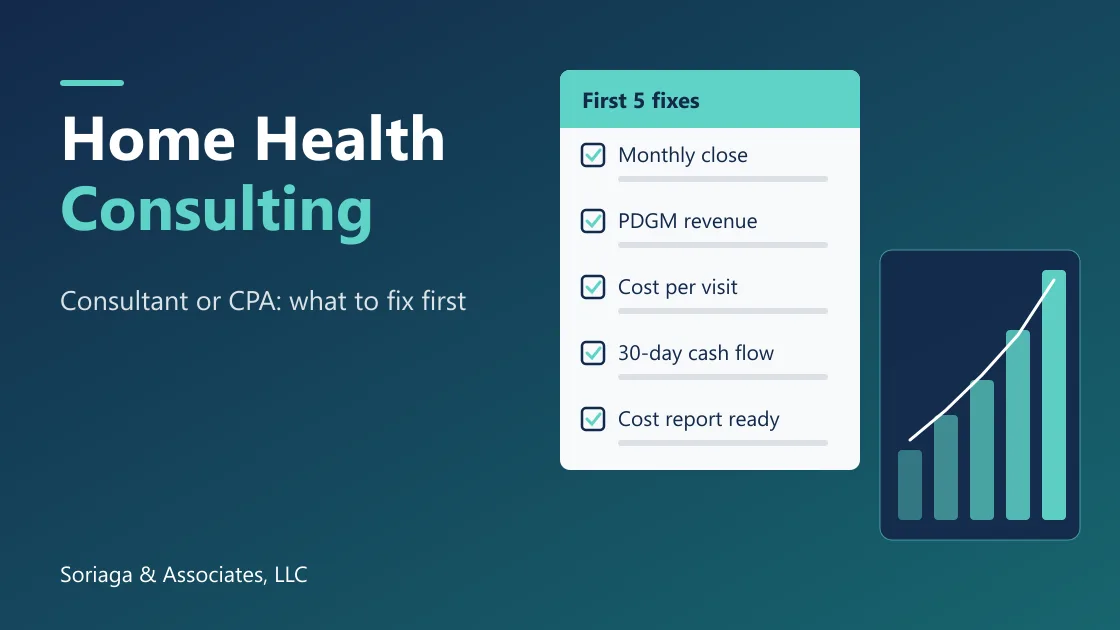
A good habit is a monthly close checklist: reconcile the bank, review payroll by discipline, update visit statistics and compare Medicare payments to the PS&R and remittances. Our home health cost report page lists what we ask for when we prepare the report: the PS&R, trial balance or year-end financial statements, payroll and statistics, the depreciation schedule and prior-year cost report and MAC correspondence.
When is the first Medicare cost report due?
Cost reports cover a cost reporting period, generally a consecutive 12 months of the provider's operations. Under 42 CFR 413.24(f)(2)(i), the report is due on or before the last day of the fifth month after the close of the period. If the period ends on a day other than the last day of a month, it is due 150 days after the last day of the period.
Example: an agency with a December 31 year end owes its report by May 31. An extension is available only in narrow cases, when the MAC finds extraordinary circumstances outside your control, such as a flood or fire (42 CFR 413.24(f)(2)(ii)).
If you miss the deadline, payment to the provider is suspended in whole or in part until an acceptable cost report is filed (42 CFR 405.371(d)(1)). That is why a first-year agency, the one with the least cushion, should treat the date as fixed.
Your first reporting period depends on when your Medicare agreement takes effect and the fiscal year end you choose. Confirm the period and due date with your MAC and with us, and put the due date in your calendar the day you are certified. Our Medicare cost report due-date guide explains the timing rules in more depth.
The report itself is Form CMS-1728-20 for freestanding home health agencies, and it is submitted electronically. We file through MCReF to any Medicare Administrative Contractor.
What will a cost report cost?
Our flat fee is $1,599.99 for a low- or full-utilization home health cost report and $500 for a no-utilization report, quoted before work starts. A new agency that has not yet treated a Medicare patient in the period may qualify as no utilization. The form uses an indicator: F for full, L for low (which requires prior MAC approval) and N for no Medicare utilization. We confirm which applies to you on a free call. For the general question of what drives price, read how much Medicare cost report preparation costs.
Prices for bookkeeping and payroll are quoted separately, because they depend on volume and scope.
How do I choose a CPA for a new home health agency?
Ask five questions:
- How many Medicare cost reports do you prepare each year? We prepare 50 to 100 a year and have prepared them since 2004.
- Do you file with my MAC? We file through MCReF to any MAC.
- Is the fee flat or hourly, and what is excluded?
- Will you help me set up books that feed the cost report, or only prepare the report afterward?
- Who will answer my questions, and in what language? Christian Soriaga, CPA, speaks fluent Spanish.
Soriaga & Associates, LLC has been a CPA firm since 1985 in Lisle, Illinois, with 20+ years in healthcare. Our clients are mainly in California, Illinois, Nevada and North Carolina, and we work with agencies nationwide, remotely. See home health accounting for the full service list.
Frequently asked questions
When is a new home health agency's first Medicare cost report due?
Under 42 CFR 413.24(f)(2), a cost report is due on or before the last day of the fifth month after the close of the cost reporting period, or 150 days after period end if the period does not end on the last day of a month. Confirm your first reporting period and due date with your Medicare Administrative Contractor (MAC).
What is the initial reserve operating funds requirement?
Under 42 CFR 489.28, a home health agency entering Medicare on or after January 1, 1998 must show sufficient initial reserve operating funds, based on the average cost per visit of similar agencies and its projected visits for its first three months. Medicare receivables do not count, and part of the funds must be non-borrowed.
Do I need to set up cost centers before I see my first Medicare patient?
It is much easier to. If your books already track costs by discipline and by administrative function, preparing the cost report is mostly mapping. If they do not, the same work becomes a reconstruction.
What is the PS&R report and why does it matter?
The Provider Statistical and Reimbursement (PS&R) report summarizes your Medicare claims and payments. Your cost report must reconcile to it, so you should compare your books to the PS&R regularly rather than once a year.
What does Soriaga & Associates charge for a home health cost report?
A flat $1,599.99 for a low- or full-utilization report and $500 for a no-utilization report. Cost reports are filed electronically through MCReF to any Medicare Administrative Contractor.
When should a new agency choose a CPA?
Before you open your books, ideally before you apply for certification. The reserve funds, chart of accounts and statistics you set up in the first months are what the cost report is built from.
Next step
If you are weeks or months from opening, this is the cheapest time to get the accounting right. Book a free 20-minute call and we will walk through your chart of accounts, reserve projection and cost report calendar. See home health cost report preparation and home health accounting, or call (630) 491-1268. You can also book online at any time.
Sources
- eCFR, 42 CFR 413.24, Adequate cost data and cost finding (cost report due dates and extensions; text read via Cornell LII)
- eCFR, 42 CFR 489.28, Special capitalization requirements (initial reserve operating funds; text read via Cornell LII)
- eCFR, 42 CFR 405.371, Suspension of payment
- CMS, Provider Reimbursement Manual Part 2, Chapter 47 (Form CMS-1728-20)
- eCFR, 42 CFR 484.205, Basis of payment (PDGM and Notice of Admission) and CMS MM12256
- CMS, MCReF, Medicare Cost Report E-filing
Last updated: October 2026.
This article is general information, not legal or tax advice.
Soriaga & Associates, LLC is a CPA firm founded in 1985 in Lisle, Illinois, serving home health, hospice, home care, wound care and dental providers nationwide. (630) 491-1268.