How to Start a Home Health Agency in 2026: Licensing, Startup Budget and Medicare Certification
Christian Soriaga, CPA11 min read
On this page
Quick answer: To start a home health agency, you form a legal entity and get an EIN and NPI. Then you get a state license, hire staff, treat your first patients and enroll in Medicare with proof of reserve funds. The catch in 2026: CMS has frozen Medicare enrollment of new home health agencies, so the Medicare step is on hold for now.
CMS's nationwide freeze on new home health and hospice enrollment took effect May 13, 2026, for six months. As of October 23, 2026, CMS's moratoria page showed no extension or lifting notice (CMS; Federal Register notice 2026-09717).
This guide on how to start a home health agency gives you the steps in order. It also gives a startup budget with only the dollar figures we could verify at official sources, and what to do while you wait. We use Illinois as the worked example because we are an Illinois CPA firm. Other states differ, so check with your own state health department.
Key takeaways
- Medicare enrollment of new agencies is frozen. The freeze began May 13, 2026, and runs six months, to about November 13, 2026. CMS may extend it in six-month steps (42 CFR 424.570(b)).
- The freeze does not stop the early steps. Entity, EIN, NPI and state licensing are separate.
- Applications the Medicare contractor received before May 13, 2026, are outside the freeze (42 CFR 424.570(a)(1)(iv)).
- Illinois license: $1,500 for two years (210 ILCS 55/4(c)), with a 240-day provisional license first.
- Medicare application fee: $750 for 2026. It is refunded if the application is denied because of a freeze (42 CFR 424.514(d)(2)(v)(C)).
- Reserve funds are the biggest cash item. At least half must be your own money, not borrowed (42 CFR 489.28).
- You treat patients before the survey. CMS requires care to at least 10 patients before the first survey.
- Medicare pays in 30-day periods (42 CFR 484.205). Your cash plan has to carry payroll until claims are paid.
Planning to open an agency? A 20-minute call is enough to test your reserve-funds number and your first-year cash plan. Book a free 20-minute call.
Can you start a home health agency in 2026?
Yes, with a large asterisk. You can start the business. You cannot become a new Medicare-enrolled agency right now.
CMS put the nationwide freeze (a "moratorium") in place on May 13, 2026. The Federal Register notice (document 2026-09717) says it lasts six months. CMS may extend it in six-month steps. Under 42 CFR 424.570(c), the Medicare contractor denies any new application covered by a freeze. CMS's page says the freeze applies to home health agencies and hospices. It also covers a change in majority ownership that needs a new enrollment.
Status as of October 23, 2026. CMS's moratoria page (last changed August 27, 2026) still shows only the first six-month period. We found no Federal Register notice that extends or lifts it. CMS must publish a notice if it does either (42 CFR 424.570(b) and (d)). The scheduled end is about November 13, 2026, so a decision could come any day. For what the freeze blocks, including the ownership-change trap, read our post on the home health enrollment moratorium.
Two details matter if you are mid-process:
- Pending applications. The freeze does not apply to an application the contractor received before May 13, 2026 (42 CFR 424.570(a)(1)(iv)).
- Fee refund. If your application is denied because of the freeze, the fee comes back (42 CFR 424.514(d)(2)(v)(C)).
CMS left Medicaid and CHIP choices to each state. Ask your state Medicaid agency what it requires. We did not check any state's current position.
What to do: Start the steps the freeze does not block, and watch the Federal Register.
What are the steps to start a home health agency?
| Step | What happens | Who controls it | Frozen now? |
|---|---|---|---|
| 1. Entity and EIN | Form the entity, get a free EIN | State filing office, IRS | No |
| 2. NPI | Apply in NPPES | CMS | No |
| 3. State license | Application, fee, provisional license, survey | State health department | No |
| 4. Build the agency | Staff, policies, insurance, space, systems, first patients | You | No |
| 5. Medicare enrollment | CMS-855A in PECOS, fee, screening, reserve funds | Medicare contractor, CMS | Yes |
| 6. Survey | State survey agency or approved accreditor | State, accreditor | Tied to step 5 |
| 7. Certification and billing | CMS certification number, OASIS and claims | CMS, Medicare contractor | Tied to step 5 |
What to do: Put these seven steps on a calendar with an owner for each one.
Step 1: Choose the entity and get an EIN
Pick the legal entity with your attorney and CPA before you sign a lease or hire anyone. The Illinois license application asks for the entity as registered with the Secretary of State. It also asks for an Illinois registered agent. So the entity has to exist first.
Ownership choices matter later. Say you sell within 36 months of your first Medicare enrollment. The buyer usually has to enroll as a new agency and get a new survey (42 CFR 424.550(b)). One exception: an agency that has filed two years in a row of full cost reports. Our post on buying a home health agency covers the buyer's side.
Get your EIN (Employer Identification Number, your business tax ID) from the IRS. The IRS says an EIN is always free. It warns about websites that charge for one.
What to do: Form the entity, then apply for the EIN on IRS.gov under the exact legal name.
Step 2: Get your NPI
The NPI (National Provider Identifier) is the 10-digit ID you use on claims. It comes from NPPES, a CMS system. CMS lists getting an NPI as the first step of enrollment for agencies like yours. You need it for the Medicare application and for every claim.
What to do: Apply in NPPES as soon as the entity and EIN exist.
Step 3: Get your state license (Illinois example)
State rules differ, so confirm yours. Here is how Illinois works, based on the statute and the IDPH application.
A license is required. No one may run or advertise a home health agency in Illinois without one (210 ILCS 55/3).
Fee and term. A license lasts two years. The fee is $1,500 for each license or renewal (210 ILCS 55/4(c)). IDPH says fees are non-refundable.
Provisional license first. A new agency that is not yet operating may get a provisional license for 240 days. In the last 30 days, IDPH inspects. If you meet the rules, you get the full license. The Director may renew the provisional license once, for up to 90 days (210 ILCS 55/4(a)).
Timeline. IDPH reviews the application within 30 days. The application must be completed and approved within 90 days of submission, or it may be denied (IDPH FAQ).
What the application asks for. From IDPH's November 2024 application:
- Liability insurance of at least $1 million per occurrence and $3 million in total.
- Written policies on complaints, staff health and safety, infection control, background checks, supervisory visits, records, training and patient admission.
- Skilled nursing provided by your own staff, plus at least one other service. You may contract nursing only to cover vacations or special skills.
- An RN who is a separate employee from the agency supervisor.
- A service area. IDPH suggests starting with three to five neighboring counties.
What to do: Download your state's current application and list every document it asks for.
Step 4: Build the agency before the survey
The survey tests real operations, so most of your spending happens here. CMS's State Operations Manual says you must have cared for at least 10 patients before your first survey. At least 7 of them must still be in care on survey day. They do not have to be Medicare patients. So you pay staff, insurance and rent with no Medicare revenue yet.
You also need the Medicare Conditions of Participation (42 CFR Part 484) working in practice. That means patient rights, assessments, care plans, infection control, governance and QAPI (your quality improvement program). You must show you can send OASIS data, the patient assessment data Medicare requires. A new agency registers with its state OASIS contact and sends test records before the survey.
Set up your books before the first patient. Our guide to new home health agency accounting setup walks through the chart of accounts, payroll and cost-report-ready records. Our home health accounting page lists what we handle each month.
What to do: Budget payroll for the months you treat patients with no Medicare payments.
Step 5: Enroll in Medicare (blocked right now)
When the freeze lifts, you enroll with form CMS-855A in PECOS, CMS's online enrollment system. Your Medicare Administrative Contractor (MAC, the company that processes Medicare claims for your region) handles it.
- Application fee. The 2026 fee is $750 (Federal Register, Dec. 3, 2025). CMS sets it each year.
- High-risk screening. New home health agencies are screened at the "high" level (42 CFR 424.518(c)). Anyone who owns 5 percent or more gets fingerprinted. There is also a site visit.
- Reserve funds. See the next section. The MAC reviews them twice, once early and once after the survey.
What to do: Have your ownership papers and fingerprint list ready before the freeze ends.
How much reserve cash does Medicare require?
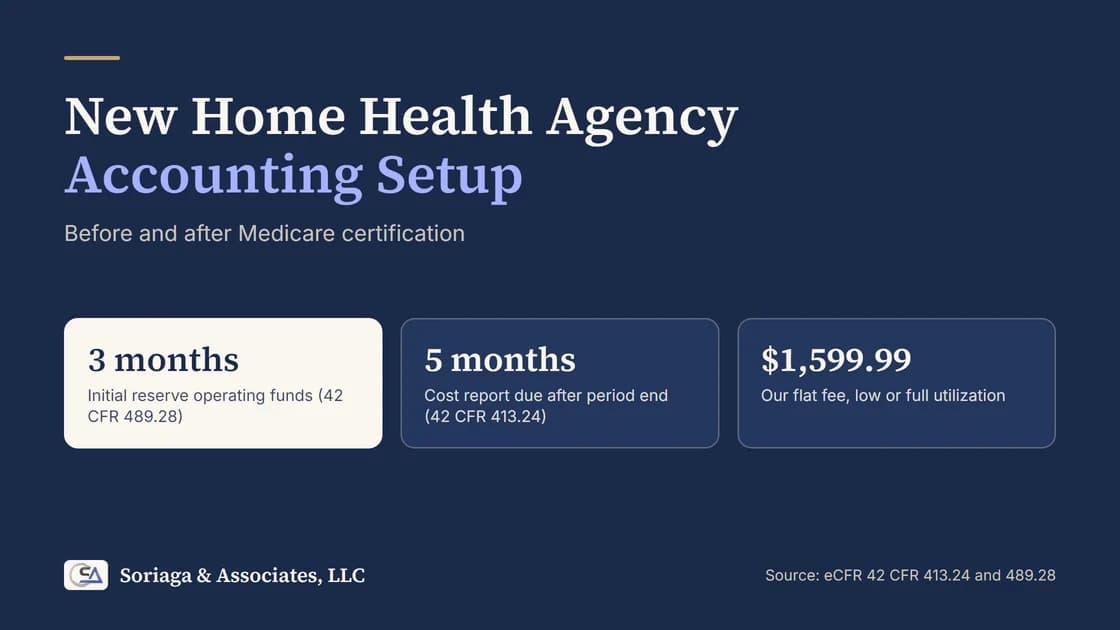
The rule is 42 CFR 489.28. You must have "initial reserve operating funds" when you apply. You must keep them through the first three months after Medicare billing starts. Expected Medicare payments do not count.
How CMS sizes it:
- The MAC finds at least three similar agencies. It looks at location, urban or rural, visit volume, ownership type and whether they are freestanding.
- It divides their total costs by their total visits. That gives an average cost per visit.
- It multiplies that by the visits you expect in your first three months. There is a floor tied to 90 percent of the similar agencies' average.
Other rules:
- Proof. Bank statements plus a letter from a bank officer that the money is available now.
- At least 50 percent not borrowed. The rest can come from a loan or line of credit from an unrelated lender.
- Consequences. CMS may deny billing rights if you fall short. It may revoke them if you do not keep the funds for three months.
Illustrative, not a published figure. Say the similar agencies average $100 per visit. You expect 600 visits in your first three months. The reserve is $100 x 600 = $60,000. At least $30,000 would need to be your own money. Both inputs are made up. The real number comes from your MAC, so model it before you sign a lease.
Want your reserve-funds number modeled before you commit? Bring your expected visits and staffing plan, and we will walk through the 489.28 math with you. Book a free 20-minute call.
What does it cost to start a home health agency?
We do not list market prices for legal, software or consulting work. No neutral government source sets them. Here are the cost groups, with figures only where an official source gives one.
| Cost group | Official figure | Source or note |
|---|---|---|
| Entity formation | Varies by state | Your Secretary of State |
| EIN | $0 | IRS |
| NPI | No fee listed | CMS |
| State license (Illinois) | $1,500 per two-year license | 210 ILCS 55/4(c) |
| Liability insurance | $1M per occurrence, $3M total (limits, not price) | IDPH application |
| Medicare application fee (2026) | $750 | CMS, Dec. 3, 2025 notice |
| Reserve operating funds | Set by your MAC | 42 CFR 489.28 |
| Accreditation (optional) | Set by each accreditor | Get written quotes |
| Payroll before Medicare revenue | Your plan | At least 10 patients before survey |
| Clinical and billing software, OASIS | Vendor quotes | Needed for OASIS |
| Legal, accounting, background checks | Quotes | Owner fingerprinting |
| Working capital after certification | Your plan | 30-day billing periods |
Owners most often underestimate the gap between the first visit and the first Medicare payment. You cannot bill Medicare until your CMS certification number (CCN) takes effect. That comes only after the survey and the second reserve-funds review. Everything before then comes out of your own pocket.
Startup budget tip: If you cannot afford a monthly accountant yet, start with one-time help. We can set up your books, file your first tax return and later prepare your first Medicare cost report ($1,599.99 flat fee; see our home health cost report page).
What to do: Fill in this table with your own quotes, then add six months of payroll.
Survey and certification: state agency or accreditor?
Your MAC sends your application to the State Agency for review and may order a site visit. You can use a CMS-approved accrediting organization instead of a state survey. CMS says accreditation is voluntary and not required to enroll. CMS lists the approved accreditors on its website. Confirm which ones currently cover home health before you sign a contract.
After the survey, CMS reviews the findings, any plan of correction, your enrollment file and the MAC's reserve-funds review. Then it assigns your CCN.
What to do: Get written quotes from at least two approved accreditors and compare them with state survey wait times.
What does Medicare payment look like once you're certified?
Three rules shape your first months:
- Assessment timing. An RN does the first visit within 48 hours of referral, or on the start date the doctor ordered. The full assessment must be done within 5 days of the start of care (42 CFR 484.55).
- OASIS reporting. You must send each finished OASIS assessment within 30 days (42 CFR 484.45).
- 30-day periods. Medicare pays a set amount for each 30-day period of care. It adjusts for short periods with few visits, partial periods and very costly patients (42 CFR 484.205). See our post on PDGM 30-day periods and cash flow.
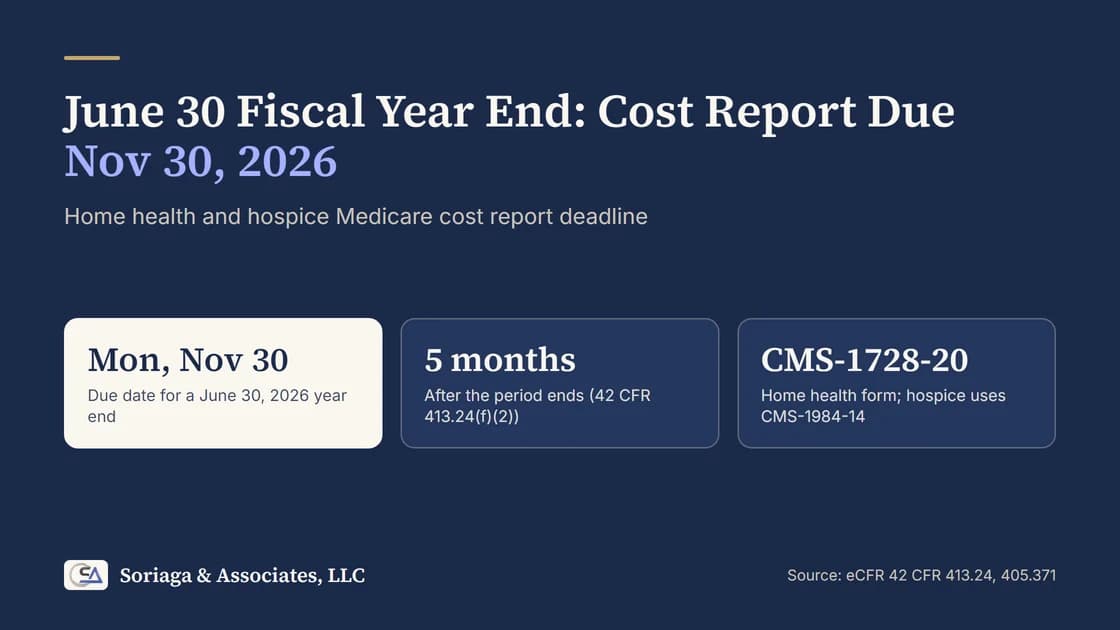
Your first Medicare cost report follows certification. It is due on or before the last day of the fifth month after your cost report period ends (42 CFR 413.24(f)(2)). Clean books from day one keep it cheap to prepare.
What to do: Build a 13-week cash forecast that starts on your first Medicare visit.
What should you do while the freeze runs?
Use the wait on the steps the freeze does not block:
- Form the entity and get the EIN and NPI.
- Apply for your state license. It runs on its own clock.
- Set up the books from day one. Use a chart of accounts and a monthly close before the first dollar moves. Our home health accounting work starts here.
- Model your reserve funds and first-year cash. Run a 13-week cash forecast. Add a worst case where Medicare revenue starts six months late.
- Watch the Federal Register. An extension or lifting notice will appear there.
If you want monthly oversight while you build, our fractional CFO services include CPA review of your books and a monthly financial analysis.
What we see in practice
The owners who struggle are rarely the ones with a weak clinical plan. They are the ones who spent their reserve cash before the survey. The second most common problem is books that cannot support a cost report, because costs were never split by discipline. Both are cheaper to prevent than to fix.
Ready to map your startup budget and timeline? Bring your state, your services and your capital plan. Book a free 20-minute call.
Frequently asked questions
Can I start a home health agency right now if CMS has a moratorium?
You can form the entity, get an EIN and NPI, and apply for a state license. You cannot enroll as a new Medicare home health agency while the moratorium runs. CMS denies new applications submitted after May 13, 2026. The freeze is set to end around November 13, 2026, unless CMS extends it in the Federal Register.
How much money do I need to start a home health agency?
There is no single official number. The fixed government items we could verify are Illinois's $1,500 license fee and CMS's $750 enrollment fee for 2026. The big item is Medicare's initial reserve operating funds under 42 CFR 489.28. CMS sets that amount from the cost per visit of similar new agencies times your projected first-quarter visits.
Do I need Medicare certification to open a home health agency?
A state license lets you operate under state law. Medicare certification is a separate step. It needs enrollment, proof of reserve funds, a survey and care to at least 10 patients first. Many owners aim for Medicare, but make it a deliberate choice, not an automatic step.
How long does it take to start a home health agency?
CMS publishes no start-to-finish timeline. In Illinois, IDPH says an application must be completed and approved within 90 days of submission, and the provisional license lasts 240 days. Medicare enrollment, the survey and the reserve-funds reviews add more time.
What does a home health agency license cost in Illinois?
The Illinois statute sets $1,500 for each home health agency license or renewal, and the license lasts two years. IDPH says its fees are non-refundable. Check the current IDPH application before you mail a check, because forms change.
Next step
Opening in the next six months? Book a free 20-minute call with Christian Soriaga, CPA. Bring your state, your startup budget and your timeline. We will check your reserve-funds plan and your first-year cash, and tell you what to set up now. You can also read our new home health agency accounting setup guide, or call (630) 491-1268.
Sources
- CMS, Provider Enrollment Moratoria (checked October 23, 2026)
- Federal Register notice 2026-09717, nationwide temporary moratoria on enrollment (May 15, 2026)
- eCFR, 42 CFR 424.570, Moratoria on newly enrolling Medicare providers and suppliers
- eCFR, 42 CFR 489.28, Special capitalization requirements for HHAs
- eCFR, 42 CFR 424.514, Application fee
- eCFR, 42 CFR 424.518, Screening levels for Medicare providers and suppliers
- eCFR, 42 CFR 424.550, Prohibitions on the sale or transfer of billing privileges
- eCFR, 42 CFR 484.45, Reporting OASIS information
- eCFR, 42 CFR 484.55, Comprehensive assessment of patients
- eCFR, 42 CFR 484.205, Basis of payment
- Federal Register, Provider Enrollment Application Fee Amount for Calendar Year 2026 (Dec. 3, 2025), document 2025-21877
- CMS, Become an Institutional Provider
- CMS, Accrediting Organizations (AOs)
- CMS, State Operations Manual Chapter 2, The Certification Process (sections 2008B, 2202.10, 2202.10E)
- Illinois Home Health Agency Licensing Act, 210 ILCS 55/3 and 55/4
- IDPH, Home Health Agency Initial Licensure Application (Form 445103, updated 11/2024)
- IDPH, Home Health Agencies Frequently Asked Questions
- IRS, Get an Employer Identification Number
Last updated: October 2026.
This article is general information, not legal or tax advice.
Soriaga & Associates, LLC is a CPA firm founded in 1985 in Lisle, Illinois, serving home health, hospice, home care, wound care and dental providers nationwide. (630) 491-1268.