How to Start a Home Care Agency: Licensing, Startup Costs and Setup
Christian Soriaga, CPA10 min read
On this page
Quick answer: To start a home care agency, choose your model, check your state's licensing rules, form an LLC, get an EIN and insurance, set up caregiver payroll, and raise enough cash to pay caregivers before your clients pay you. Most new agencies run short on cash, not on clients.
This guide is for non-medical home care: personal care, companionship and help with daily tasks. If you want to bill Medicare for nursing and therapy, that is home health, and the steps are different. We cover that path in a separate guide. Below, you will find the steps in order, the money questions, and where a CPA helps most.
Key takeaways
- Pick your model first. Non-medical home care and medical home health have different rules, costs and payers.
- Licensing is a state decision. Check with your state health department before you take a client.
- Set up before you hire. Form the LLC, get an EIN, open a bank account and buy insurance.
- Cash is the real startup cost. You pay caregivers weekly. Payers often pay you weeks later.
- Plan on W-2 caregivers. Misclassification is a costly first-year mistake.
- Know your payer mix. Private pay, long-term care insurance, Medicaid waivers and the VA each pay on a different timeline.
- Bring in a CPA early. Our monthly retainers start from $800 per month.
Planning to launch? Book a free 20-minute call and we will walk through your startup budget, payroll and books.
Should I start a non-medical home care agency or a home health agency?
Start by deciding what kind of care you will give. The choice drives your license, your payers and your startup cash.
| Non-medical home care | Medical home health | |
|---|---|---|
| What you do | Personal care, companionship, meals, errands | Nursing, therapy and other skilled care |
| Who pays | Private clients, long-term care insurance, Medicaid waivers, the VA | Medicare, Medicaid, insurers |
| Rules | Set by your state; some states do not license it | State license plus Medicare rules if you bill Medicare |
| Startup cash | Lower, mostly payroll float | Higher; the medical path has extra rules and a longer start |
Medicare does not pay for custodial care, such as help with bathing and dressing, when that is the only care a person needs (Medicare.gov). That is why most non-medical agencies depend on private pay, insurance, Medicaid programs and the VA.
If your plan includes Medicare-certified nursing and therapy, read our guide on how to start a home health agency.
What to do: Write one sentence that says what care you give, who pays for it and in which state. Everything below builds on that sentence.
What licensing does a home care agency need?
Licensing depends on your state. There is no federal license for non-medical home care. Each state decides whether to license it and how (Vitable Health compliance library). The setups you will see fall into a few types:
- A state license from the health department or a similar agency.
- A lighter registration instead of a full license.
- No state license at all for non-medical care, with rules left to local law or to payer contracts.
States that do license usually look at things like your business details, the people you hire and the policies you keep. We do not list state-by-state rules here, because they change and a wrong answer can cost you a launch date.
Call your state health department and ask three questions:
- Does a non-medical agency like mine need a license or registration?
- What must I file, and how long does approval take?
- Do I need anything else for Medicaid or VA work?
Also ask your attorney about local business licenses and any caregiver screening rules.
What to do: Get the licensing answer in writing before you spend money on marketing.
How do I set up the entity, EIN and insurance?
Most owners form an LLC and keep agency money apart from personal money. Your attorney and CPA can tell you if another entity fits better.
- Form the LLC with your state. Keep the formation papers and operating agreement in one folder.
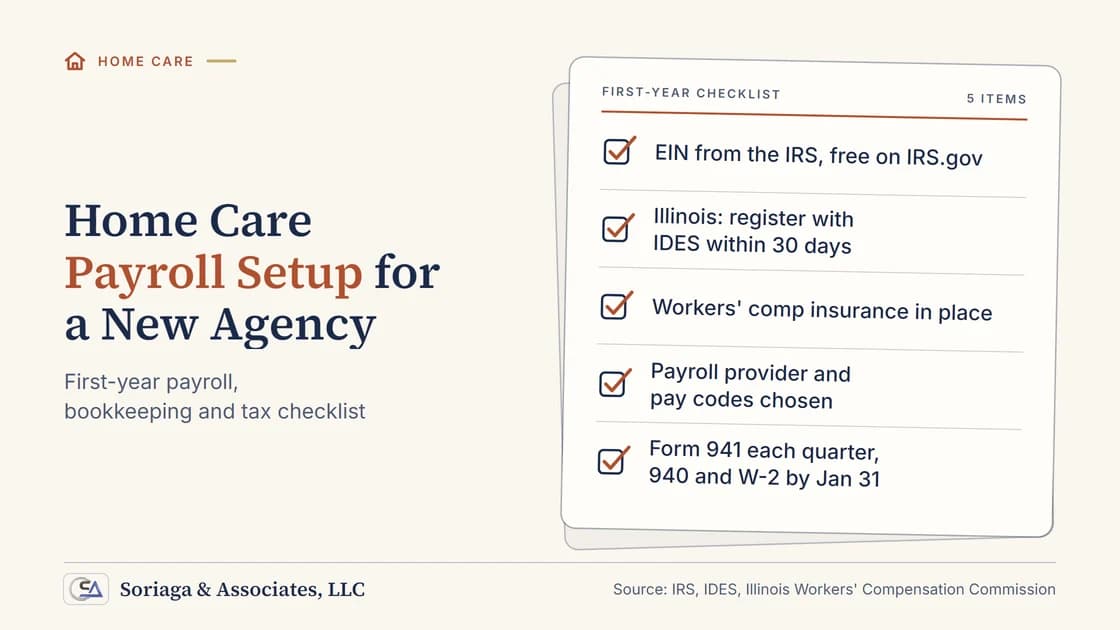
- Get an EIN (Employer Identification Number). The IRS issues it free on IRS.gov, and the online tool works for U.S. entities (IRS). Do not pay a third-party site for one.
- Open a business bank account in the LLC's exact name.
- Register as an employer with your state for payroll tax.
- Buy insurance. Ask your broker about workers' compensation, general liability, professional liability and abuse or molestation coverage, plus a policy that covers caregivers who drive. Many payers and clients ask for proof of coverage.
For the payroll registration steps, see our payroll setup checklist for a new home care agency.
What to do: Do not hire anyone until the EIN, bank account and insurance are in place.
How much does it cost to start a home care agency?
There is no one number. Costs depend on your state, your market and how fast you add clients. The biggest cost for most new agencies is payroll float. That is the cash you need to pay caregivers before payers pay you.
Here is a made-up example to show how it works.
Illustrative example (not a real agency):
| Item | Amount |
|---|---|
| Caregivers | 10 |
| Hours per caregiver per week | 25 |
| Wage per hour | $18 |
| Weekly wages | $4,500 |
| Wages paid before first payments arrive (about 6 weeks) | $27,000 |
That $27,000 is before payroll taxes, workers' comp, rent, software and marketing. If a payer is slow, the gap gets longer. Your own numbers will differ.
Build your budget in these groups:
- One-time costs: formation, licensing, legal, brand and website, software setup.
- Monthly overhead: insurance, software, office or phone, marketing, your admin help.
- Payroll float: wages and employer taxes for the weeks before payers pay.
- Owner pay: what you need to live on until the agency pays you.
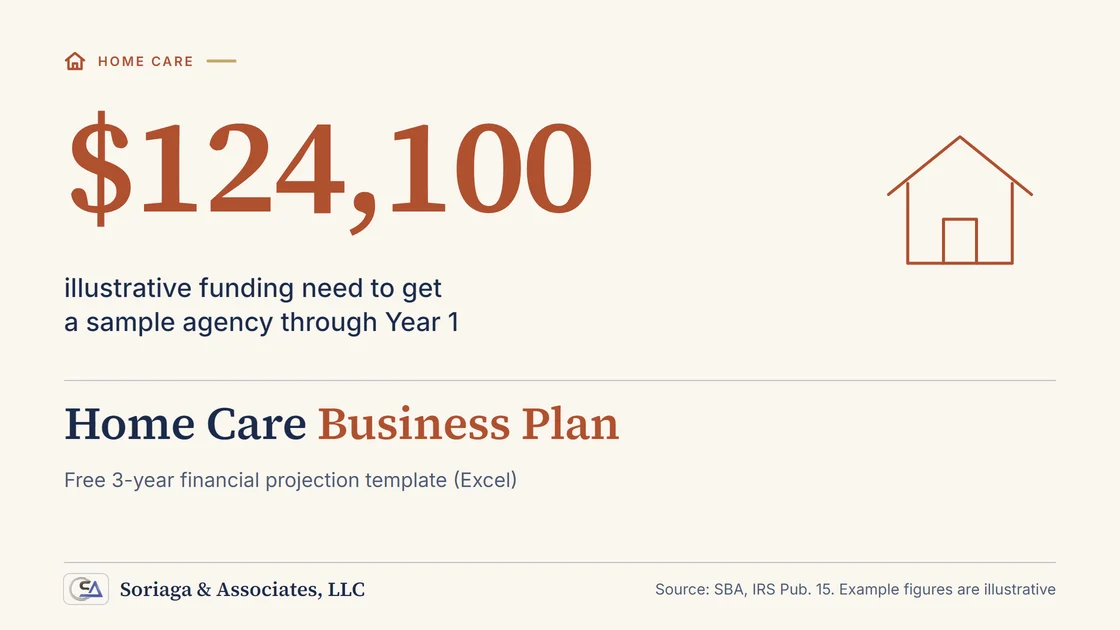
We built a free 3-year home care agency projection template so you can test your own hours, wages and bill rates. For the plan around it, read our post on the home care business plan.
What to do: Calculate your payroll float first. Then add the other costs on top.
Who will pay you? Build your payer mix
Where your clients' money comes from changes how fast you get paid and how much paperwork you carry.
- Private pay. Families pay you directly. This is often the fastest to start and the most flexible on rates.
- Long-term care insurance. Policies usually cover personal help at home, and some add household help when it goes with personal care (ACL). You bill the insurer, or the family does. Each policy has its own rules and waiting periods.
- Medicaid waiver programs. Home and community based services waivers let states pay for services at home, such as personal care and homemaker help. States run these programs and set the rules (Medicaid.gov). Expect enrollment steps, rate schedules and claim rules set by your state.
- The VA. The Homemaker and Home Health Aide program uses aides from organizations that hold a VA contract (VA.gov). That means you need the contract first.
Each payer has a different rate, so check the math before you sign up. Our home care rate calculator builds your cost per billable hour and the bill rate for your target margin. If you plan to serve Medicaid clients, try the Medicaid 80/20 calculator to see if your spending fits program rules.
What to do: Pick one or two payers for year one. Do not try to serve every payer at once.
Should caregivers be W-2 or 1099?
Plan on W-2 employees. The IRS looks at three groups of facts: behavioral control, financial control and the type of relationship. No single factor decides it (IRS). A caregiver who follows your schedule, serves your clients and works at your pay rate looks like an employee.
If you are unsure about one worker, the IRS lets you or the worker file Form SS-8 for an official answer. It can take at least six months (IRS). Most new agencies should not wait on that. Budget for W-2 pay and the taxes that go with it.
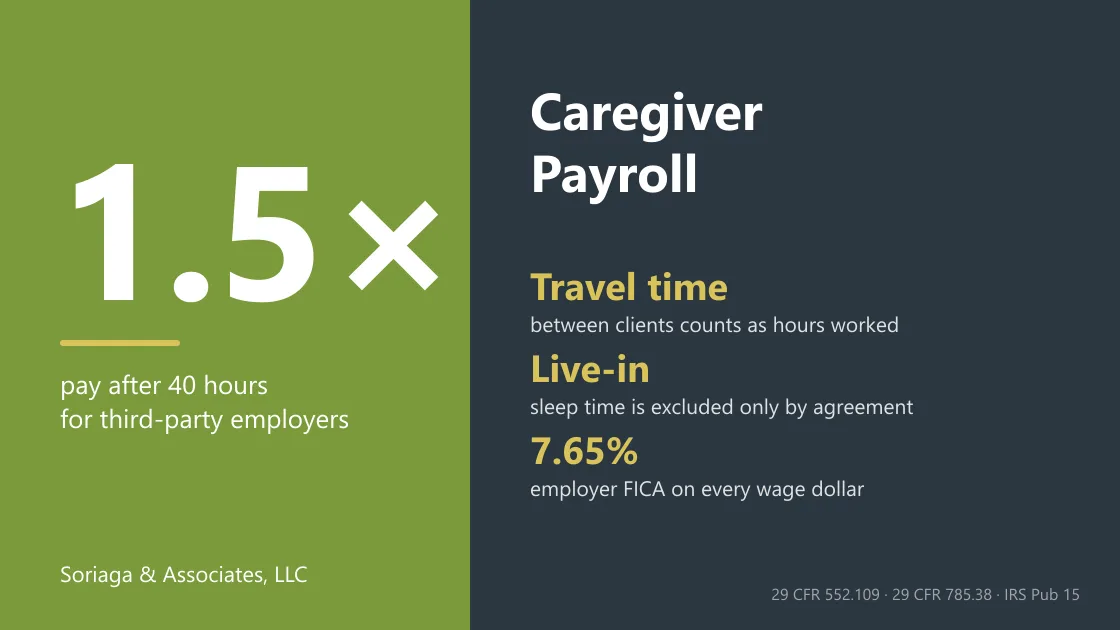
Our guides on home care payroll setup and caregiver payroll cover pay codes, overtime and filings.
What to do: Put every caregiver on your payroll system from day one, and set one weekly rule for how visit time becomes pay.
How should I set up the books in the first year?
Good first-year books answer one question: which payer makes me money?
- Separate accounts by payer. Track private pay, insurance and each Medicaid program on its own.
- Reconcile every month. Match the books to the bank and payroll reports.
- Track receivables. Know who owes you and how old each invoice is.
- Watch caregiver pay as a percent of revenue. It is your largest cost. A rising percentage is an early warning sign.
- Keep a payroll tax account. Withheld tax is not your cash.
- Close the month by day 10. Fast closes catch mistakes while they are small.
Our home care accounting services include monthly bookkeeping built around payers.
What to do: Set a monthly close date now and put it on your calendar.
When should I hire a CPA for a new home care agency?
Before your first payroll. A CPA helps most with choices that are hard to undo:
- How your LLC is taxed and how you pay yourself.
- Payroll setup and worker classification.
- A chart of accounts that shows margin by payer.
- A cash flow forecast for the first twelve months.
Our monthly retainers start from $800 per month. A retainer can cover your books, payroll, tax and reporting support, and we work with agencies in all 50 states, remote. See pricing for what is included, or read about our home care accounting services.
Want a CPA on your launch team? Book a free 20-minute call.
What we see in practice
The most common problem we see is a launch budget with no payroll float. Owners plan for the license, the website and insurance. They forget that caregivers get paid every week, while some payers take a month or more. Build the cash gap into the plan, and you have choices when the first slow payment arrives.
If you want a second opinion on your numbers, the home care accounting services page shows how we work with new agencies.
Frequently asked questions
How do I start a home care agency?
Pick your model (non-medical or medical), check your state's licensing rules, form an LLC and get an EIN, buy insurance, open a bank account, set up payroll for caregivers and build a startup budget with cash for payroll before payers pay you. Then line up your first clients and payers.
Do I need a license to start a non-medical home care agency?
It depends on your state. There is no federal license for non-medical home care. Some states require a license, some use a registration, and some do not license non-medical agencies at all. Call your state health department before you sign a lease or take a client.
How much does it cost to start a home care agency?
It varies by state and by how fast you grow. The biggest cost is usually cash to pay caregivers before clients or payers pay you. Add formation, licensing, insurance, software, marketing and your own living costs. Our free 3-year projection template helps you put your own numbers in.
Can I pay my caregivers as 1099 contractors?
Rarely. If you set the schedule, assign the clients and control how the work is done, the IRS tests usually point to employee status. Plan your budget around W-2 employees. If you are unsure about a worker, ask a CPA or an employment attorney.
Does Medicare pay for non-medical home care?
No. Medicare does not pay for custodial care, such as help with bathing and dressing, when that is the only care needed. Most home care agencies are paid by private clients, long-term care insurance, Medicaid waiver programs or the VA.
What is the difference between a home care agency and a home health agency?
A home care agency gives non-medical help, such as personal care, meals and companionship. A home health agency gives skilled care, like nursing and therapy, and can bill Medicare when it is certified. The medical path has more rules, more cost and a longer start.
When should a new home care agency hire a CPA?
Before your first payroll. Setup choices on entity tax, worker classification and the chart of accounts are cheap to get right on day one and costly to fix later. Our monthly retainers start from $800 per month.
What bookkeeping does a new home care agency need in year one?
Keep your books separate by payer, reconcile the bank and payroll every month, track who owes you and how old each invoice is, and watch caregiver pay as a percent of revenue. A monthly close takes the guesswork out of cash.
Next step
Book a free 20-minute call with Christian Soriaga, CPA. Bring your launch plan, and we will check your startup budget, payroll plan and books. You can also see our pricing first or call (630) 491-1268.
Sources
- IRS, Apply for an Employer Identification Number (EIN) online (free, U.S. entities)
- IRS, Independent contractor (self-employed) or employee? (three categories, Form SS-8)
- Medicare.gov, Long-term care coverage (Medicare does not pay for custodial care)
- Administration for Community Living, What long-term care insurance covers
- Medicaid.gov, Home and community based services 1915(c) waivers
- VA, Homemaker and Home Health Aide care
- Vitable Health, Home care compliance library: licensure (no federal license; states differ)
Last updated: October 2026.
This article is general information, not legal or tax advice. Check your state's rules before you launch.
Soriaga & Associates, LLC is a CPA firm founded in 1985 in Lisle, Illinois, serving home health, hospice, home care, wound care and dental providers nationwide. (630) 491-1268.