S Corp Reasonable Salary for Home Care and Home Health Agency Owners
Christian Soriaga, CPA11 min read
On this page
Quick answer: An S corp reasonable salary is the wage a similar agency would pay for the work you do. You take it before any profit as a distribution. The IRS gives factors, not a formula. If you manage the agency but give no care, base it on the management job. If you also work as the RN or director of nursing, it should reflect both jobs.
For 2026, the Social Security wage base is $184,500, and employer and employee each pay 6.2% Social Security and 1.45% Medicare on wages (ssa.gov, irs.gov).
An S corporation can lower payroll tax, because only your salary is hit with those taxes, not the full profit. That is why the salary you pick matters so much. Pick it too high and you give up the saving. Pick it too low and the IRS can step in. This post is for home care and home health agency owners who already have profit and are deciding what to pay themselves. For the general S corp math, see our post on the S corp election for dentists. Here we focus on the agency owner.
Key takeaways
- Wages come before distributions. An S corp must pay a shareholder-employee reasonable compensation before non-wage distributions (irs.gov).
- There is no formula. The IRS gives factors such as training and experience, duties and responsibilities, and dividend history, not a percentage.
- Your role drives the number. An owner-administrator and an owner who is also the RN or director of nursing are paid for different work.
- Document it every year. Duties, hours and what you would pay a hired replacement are your file if the IRS asks.
- Salary moves payroll tax in a straight line. Under the 2026 wage base, each extra $1,000 of salary adds $153 of combined payroll tax.
- Health insurance has its own rule. Premiums for a 2-percent shareholder-employee are reported in Box 1 of the W-2 (irs.gov).
- Too low is the risk. The IRS can reclassify distributions as wages.
Want your salary tested against your real books? Book a free 20-minute call and bring last year's profit and loss.
What does reasonable salary mean for an agency owner?
The IRS says an S corporation must pay a shareholder-employee reasonable compensation for services before it makes non-wage distributions. The IRS fact sheet on officers adds that an officer of a corporation is generally an employee. The same fact sheet admits there are "no specific guidelines for reasonable compensation" in the Code or regulations.
So reasonable is a judgment, and you need to be able to defend it. For an agency owner, the first question is simple. What work do you do each week?
- Owner-administrator. You run the office, hire and schedule caregivers, deal with the state and payers, and watch cash. Think of what you would pay a person to do that job.
- Owner and RN or director of nursing. You also supervise care, do assessments or sign plans of care. That is a second job with its own pay. If you quit, you would need to hire both.
- Passive owner. You own the agency but do little. Your salary could be small, but be honest about it. Few owners of a funded, growing agency fit here.
Example: an owner who manages the office and also covers the director of nursing role cannot point to an administrator-only wage. The salary has to cover both seats.
Action: list every job you did last year and who would do it if you left.
How do the IRS factors apply to an agency?
The IRS lists factors for reasonable compensation, including training and experience, duties and responsibilities, and dividend history. Here is how we read them for an agency, plus two checks of our own.
- Training and experience. A licensed RN with years of home health leadership has a stronger case for higher pay than a first-time owner with no clinical background.
- Duties and responsibilities. Agency size matters. Ten caregivers is a different job than 150 caregivers across two counties and three payers.
- Dividend history. If you take large distributions and little salary year after year, that pattern stands out.
- Time and effort (our check). Full time and part time are different. Write down your real hours.
- Agency size and results (our check). Pay should fit what the agency earns.
We use outside pay data as a cross-check only. You can look up wages for managers and nurses in your area and compare them to your salary. Treat that as one data point. It does not replace your duties and hours.
Example: an owner who works 25 hours a week on administration and 15 hours as the supervising nurse has two roles to price, not one. Splitting the hours makes the file clear.
Action: write a one-page job description and an hours log for each role you hold.
How do you document the salary?
Keep a short file each year. It does not need to be long. It needs to show how you got to the number.
- Job duties. List what you do in each role.
- Hours. Note a typical week, and any change during the year.
- Replacement cost. Write down what you would pay a hired administrator, and a hired RN or director of nursing if you fill that seat.
- Agency results. Note revenue, profit and headcount for the year.
- The decision. Put the salary, the date and who approved it.
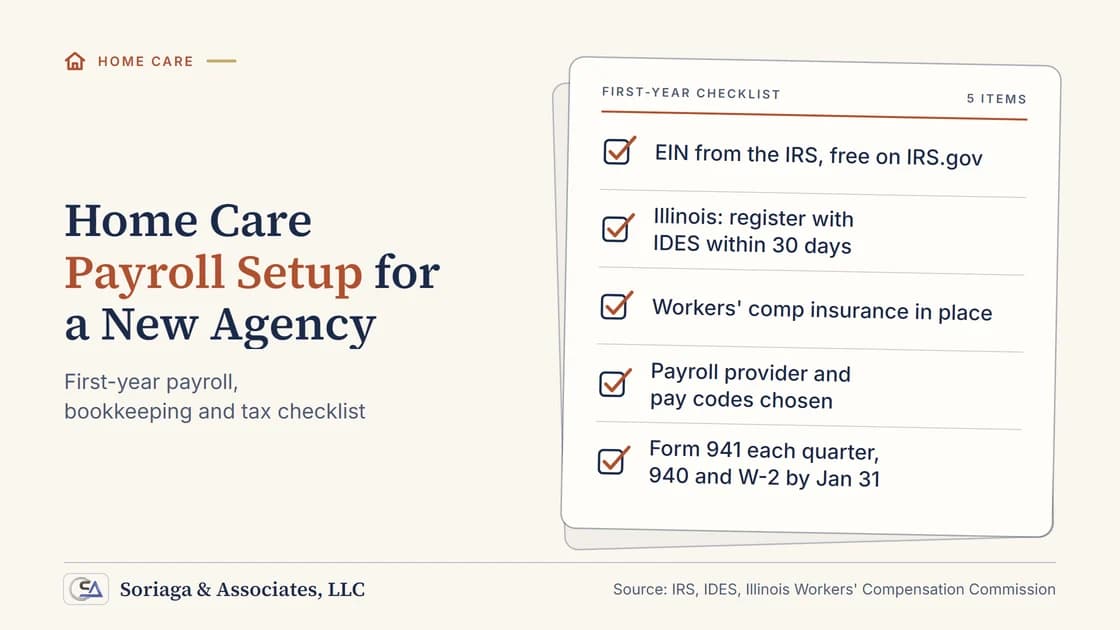
Then pay the salary on a regular schedule through payroll. Do not pay yourself a salary in December just to catch up. Our payroll services run owner payroll next to caregiver payroll, so one team files both. If your agency is new and your payroll is not set up yet, start with our home care payroll setup checklist.
Action: save the file each January, and update it if your role changes in the year.
What does the payroll tax math look like?
Under the 2026 wage base, the math on salary is simple. The IRS says Social Security tax is 6.2% for the employer and 6.2% for the employee, up to $184,500 of wages. Medicare is 1.45% each, with no wage limit. That is 7.65% each side, or 15.3% combined. The IRS also says employers withhold an extra 0.9% Medicare tax on an employee's wages above $200,000, with no employer match.
Here is an illustrative example. It is not a client result and not a promise. It does not tell you what your salary should be.
Assumptions (illustrative): a home care agency with $300,000 of profit before any owner pay, in Illinois. The owner is an administrator who also runs the nursing side. We assume $2,500 a year of added cost for owner payroll and the S corp return. Income tax is left out. Federal unemployment tax is left out. We compare two salary levels against the same agency taxed as a sole proprietor.
| Sole proprietor or LLC | S corp, $90,000 salary | S corp, $140,000 salary | |
|---|---|---|---|
| Self-employment tax | $30,912.45 | n/a | n/a |
| Payroll tax on salary (both sides, 15.3%) | n/a | $13,770.00 | $21,420.00 |
| Illinois replacement tax (1.5%) | n/a | $3,009.23 | $2,201.85 |
| Added S corp cost (assumed) | n/a | $2,500.00 | $2,500.00 |
| Total | $30,912.45 | $19,279.23 | $26,121.85 |
| Difference vs. sole proprietor | $11,633.22 lower | $4,790.60 lower |
How we built it. Self-employment tax is 15.3% on 92.35% of net earnings, with the 12.4% Social Security part stopping at the wage base. On $300,000, that is $22,878 plus $8,034.45, or $30,912.45. Both salaries sit under the $184,500 wage base, so payroll tax is 15.3% of salary. The Illinois tax is 1.5% of profit after salary, the employer's half of payroll tax and the added cost.
Read the table this way. The $50,000 jump in salary adds $7,650 of payroll tax. The only thing that moved was the salary. The table does not say which salary is reasonable. That is a facts-and-documents question, and a salary that is too low for your duties does not become safe because the math looks good. Our S corp tax calculator runs this comparison with your own profit.
Action: run your profit through the calculator at two or three salary levels, then test the one you can defend.
How does owner health insurance work in an S corp?
Health insurance is a common trap. For a 2-percent shareholder-employee, the IRS says premiums the S corporation pays are reportable as wages on Form W-2. They go in Box 1 (Wages) but not in Boxes 3 and 5. The IRS also says the owner may be eligible for an above-the-line deduction for those premiums, subject to its conditions.
In plain words, the agency pays or reimburses the premium, payroll reports it on your W-2, and you may deduct it on your personal return. If the W-2 is wrong, the deduction can be wrong too.
Example: a $12,000 yearly premium is added to the owner's Box 1 wages. It does not raise the payroll tax base, but it does need to be on the W-2.
Action: tell your payroll team about owner health insurance before the first payroll of the year.
Do Illinois tax and Form 2553 timing change the decision?
Yes, on both. The Illinois Department of Revenue says partnerships and S corporations owe replacement tax of 1.5% on income taxable to Illinois. A sole proprietor does not pay it. In the table above, it takes about $3,000 off the saving at the lower salary. Other states differ, so check yours.
For timing, the Form 2553 instructions set a deadline. File no more than 2 months and 15 days after the tax year starts, or at any time during the year before. For a calendar-year agency that wants the election for 2027, the window closes March 15, 2027. Late relief exists for reasonable cause. It generally requires filing within 3 years and 75 days of the intended date. It is not automatic.
If you want help on taxes for the agency, see our home care accounting services. Home health owners can read about our home health accounting work.
Action: pick your target year-end now, and put the Form 2553 date on your calendar.
What happens if the salary is too low?
The IRS says it has the authority to reclassify payments made to shareholders from non-wage distributions to wages. Wages carry employment taxes. That can mean back payroll tax, plus the penalties and interest that go with it.
The pattern that gets noticed is easy to picture. An owner who runs the agency full time takes a tiny salary and large distributions every year. The IRS fact sheet says officers' pay for services should be treated as wages and not as distributions of cash and property.
The fix is not guessing at a safe percentage. Anyone who gives you one is guessing. The fix is a salary you can explain, with a file to back it up.
Action: if your salary is far below a replacement's pay, raise it now and ask your CPA about prior years.
Not sure your salary would hold up? Run your numbers in the S corp tax calculator, then book a free 20-minute call and we will check them against your books.
What we see in practice
The most common problem we see is a salary set once and never revisited. The agency grew, the owner took on more work, and the pay stayed the same. The second most common is no paper trail. The owner had a reason for the number but never wrote it down.
We also see owners pick a salary to hit a tax number and then work backward. It is better to start with the job, set the pay, and then look at the tax result. Salary, payroll, health insurance and retirement plan contributions should be decided together. If you want that review each year, book a free 20-minute call.
Frequently asked questions
What is an S corp reasonable salary for a home care agency owner?
It is the pay a similar agency would give someone for the work you do, paid as wages before you take profit as distributions. The IRS gives factors, not a formula. They include training and experience, duties and responsibilities, and dividend history. Write down your duties, hours and comparable pay each year.
Is the salary different if I am the administrator and not a nurse?
It can be. The salary should match the jobs you do. An owner who only manages the agency is paid for management. An owner who also works as the RN or director of nursing is doing a second job, and that work should be reflected in wages too.
What happens if I pay myself too little?
The IRS says it can reclassify payments to shareholders from non-wage distributions to wages. Wages carry employment taxes, so you could owe back payroll taxes, plus penalties and interest. Documentation of how you set the salary is your best protection.
Are my health insurance premiums treated differently in an S corp?
Yes. For a 2-percent shareholder-employee, the IRS says premiums the S corporation pays are reported as wages in Box 1 of Form W-2, but not in Boxes 3 and 5. The owner may then qualify for an above-the-line deduction, subject to the IRS conditions.
When do I have to file Form 2553 to be an S corp?
No more than 2 months and 15 days after the start of the tax year the election takes effect, or at any time during the tax year before it. For a calendar-year agency electing for 2027, that window runs through March 15, 2027. Late relief exists but is not automatic.
Next step
Book a free 20-minute call with Christian Soriaga, CPA. Bring last year's profit and loss and a list of the jobs you do. We will test a salary range against your numbers and tell you if the S corp is worth it for your agency. Learn more about our home care accounting services.
Sources
- IRS, S corporation compensation and medical insurance issues (reasonable compensation, factors, reclassification, owner health insurance; page reviewed March 3, 2026)
- IRS, Fact Sheet FS-2008-25, Wage compensation for S corporation officers (August 2008, marked historical by the IRS)
- IRS, Topic no. 751, Social Security and Medicare withholding rates (6.2%, 1.45%, $184,500, 0.9% Additional Medicare)
- SSA, Contribution and Benefit Base determination (2026 base of $184,500; confirmed through SSA search results, the page itself blocked our fetch)
- IRS, Instructions for Form 2553 (filing deadline and late relief)
- IRS, S corporations (payroll reporting, Form 1120-S)
- Illinois Department of Revenue, Pass-through information (1.5% replacement tax)
Last updated: October 2026.
This article is general information, not legal or tax advice. The worked example is illustrative.
Soriaga & Associates, LLC is a CPA firm founded in 1985 in Lisle, Illinois, serving home health, hospice, home care, wound care and dental providers nationwide. (630) 491-1268.