S Corp Election for Dental Practice Owners: When It Pays and What Reasonable Salary Means
Christian Soriaga, CPA9 min read
On this page
Quick answer: An S corporation election can lower payroll taxes for a dental practice owner, because only the salary is hit with Social Security and Medicare tax, not the full profit. The catch is that the IRS requires a reasonable salary first, and payroll, a separate return and some states' entity-level taxes add cost. It pays at higher profits and often does not at lower ones.
For 2026, the Social Security wage base is $184,500, and self-employment tax is 15.3% (12.4% Social Security plus 2.9% Medicare) on 92.35% of net earnings (ssa.gov, irs.gov).
Dentists hear about the S corporation from colleagues, financial advisors and online ads, usually with the words "save thousands." Some practices do. Others would pay more. This post explains where the saving comes from, what a reasonable salary means, where Illinois and other states change the math, and when the election does not pay. It is general information, not advice for your situation.
Key takeaways
- The saving is on payroll tax, not income tax. Profit taken as distributions is not subject to self-employment tax or FICA, but wages are (irs.gov).
- The IRS requires reasonable compensation first. A shareholder who works in the practice must be paid reasonable wages before non-wage distributions (irs.gov).
- There is no formula for reasonable salary. The IRS lists factors; it does not give a percentage.
- State rules can shrink the saving. Illinois charges S corporations a 1.5% replacement tax on income taxable to Illinois (Illinois Department of Revenue).
- It often does not pay at lower profits. Payroll, the extra return and entity-level taxes can exceed the saving.
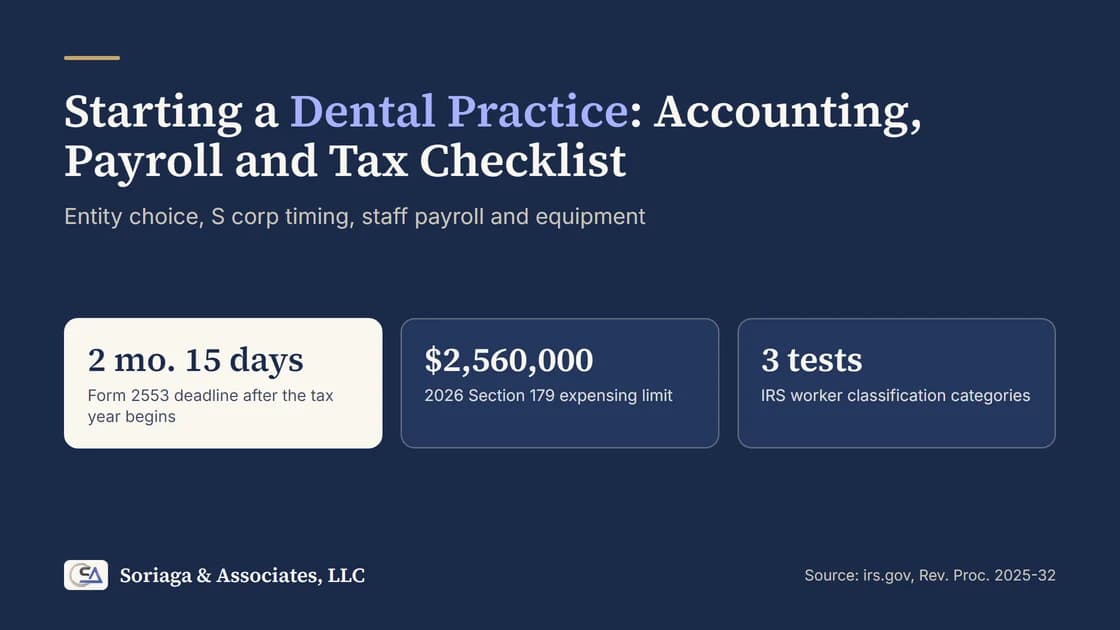
- Timing matters. Form 2553 is due 2 months and 15 days after the start of the tax year it takes effect (irs.gov).
Want your numbers modeled? Bring last year's profit and your state. Book a free 20-minute call.
Where does the S corporation saving come from?
A dental practice owner taxed as a sole proprietor, single-member LLC, or partner generally pays self-employment tax on the practice's profit. The IRS says the rate is 12.4% for Social Security plus 2.9% for Medicare, applied generally to 92.35% of net earnings from self-employment (irs.gov, Topic no. 554). The Social Security portion stops at the annual wage base, which is $184,500 for 2026 (ssa.gov). The Medicare portion does not stop.
An S corporation owner who works in the practice is an employee of the practice. The practice and the owner each pay 7.65% on the salary (6.2% Social Security up to the same wage base and 1.45% Medicare), plus federal unemployment tax at a net 0.6% on the first $7,000 of wages. Profit above the salary is passed through as a distribution, and distributions are not subject to self-employment tax or FICA. The S corporation files its own return, Form 1120-S, and shareholders report their share on their personal returns (irs.gov, S corporations).
So the idea is: lower the amount subject to payroll tax by paying a salary smaller than the profit. That is why the IRS watches salary so closely, and why it is not free money.
Our S corp tax calculator runs this comparison with 2026 rates. It is not a full tax return. It leaves out income tax, the deduction for half of self-employment tax and the qualified business income deduction.
What is a reasonable salary for a dentist?
The IRS says S corporations must pay reasonable compensation to a shareholder-employee in return for services before non-wage distributions. Its approach looks at where the practice's receipts come from. Receipts from the shareholder's own services point to wages, while receipts from non-shareholder employees, capital or equipment point to distributions (irs.gov, S corporation compensation and medical insurance issues).
That matters for dentists. In a solo or small practice, much of the production comes from the owner's own chair time. The part of profit that is truly return on the practice's equipment, associates or hygiene department is different from the owner's own clinical work. A salary that ignores the first part is the pattern the IRS looks for.
The IRS lists factors used to decide reasonable compensation, including:
- Training and experience
- Duties and responsibilities
- Time and effort devoted to the business
- Dividend history
Other common considerations include what comparable practices pay for similar services and whether non-owner dentists in your practice are paid for similar work. There is no fixed percentage, such as "40% of profit," and anyone who gives you one is guessing. The IRS also states that it has the authority to reclassify payments made to shareholders from non-wage distributions to wages, which are subject to employment taxes.
What we do with clients: write down how the salary was set each year (duties, hours, comparable pay information, the practice's results), keep payroll running on schedule, and revisit it when production changes. That file is what you want if the IRS ever asks.
What does it look like in numbers? (Hypothetical example)
The following is a hypothetical example, not a client result and not a prediction. It uses the same method as our calculator and 2026 rates.
Assumptions: a dental practice with $300,000 of profit before any owner pay. The owner takes a $150,000 salary as an S corporation. The owner estimates $2,500 per year of extra cost for payroll processing and the S corporation tax return (an assumption: your cost will differ). Income tax is not included in either column.
| Sole proprietor or single-member LLC | S corporation (Illinois) | S corporation (no state entity tax) | |
|---|---|---|---|
| Self-employment tax | $30,912.45 | n/a | n/a |
| FICA on salary (employer + employee) | n/a | $22,950.00 | $22,950.00 |
| Federal unemployment tax | n/a | $42.00 | $42.00 |
| Illinois replacement tax | n/a | $2,039.75 | n/a |
| Extra S corp costs (assumed) | n/a | $2,500.00 | $2,500.00 |
| Total | $30,912.45 | $27,531.75 | $25,492.00 |
| Difference vs. sole proprietor | $3,380.70 lower | $5,420.45 lower |
How the self-employment tax figure is built: $300,000 x 92.35% = $277,050, of which $184,500 is subject to the 12.4% Social Security rate ($22,878) and all $277,050 to the 2.9% Medicare rate ($8,034.45). The total is $30,912.45. On the S corporation side, the $150,000 salary is below the wage base, so FICA is 7.65% x 2 x $150,000 = $22,950. The Illinois replacement tax is 1.5% of profit after salary, the employer's share of payroll tax, federal unemployment tax and the extra costs.
Two notes on this example:
- The saving is a fraction of the profit. It depends heavily on the salary. A higher salary means less saving, and the IRS decides what is reasonable, not the practice.
- Income tax is a separate calculation. The wages, the deduction for half of self-employment tax, the qualified business income deduction and your bracket all change the final result.
When does the S corporation election not pay?
Be skeptical of any advice that says every dentist should elect. It often does not pay when:
- Profit is low or just starting. A new practice often has little profit in year one, and the fixed costs of payroll and a separate return can exceed the saving. Using the same method with $60,000 of profit and a $45,000 salary in Illinois, the sole-proprietor self-employment tax is $8,477.73 and the S corporation total, with the same $2,500 assumption, is $9,562.23. In that hypothetical, the S corporation costs $1,084.50 more.
- The reasonable salary is close to the profit. If most of the profit is the owner's own clinical work, little remains for distributions.
- Your salary is already above the Social Security wage base. Once wages pass $184,500, the 12.4% Social Security tax stops either way, so the saving shrinks to the Medicare side.
- Your state taxes S corporations at the entity level. Illinois does, as described below.
- Other plans depend on a higher compensation figure. See the retirement plan note below.
A fair decision looks at several years of projected profit, not just this year.
How do Illinois and other states change it?
The Illinois Department of Revenue says partnerships and S corporations owe replacement tax at 1.5% (0.015) on income taxable to Illinois (Illinois Department of Revenue, Pass-through information). A sole proprietor does not pay it. In the example above, that single line takes about $2,000 off the saving.
Other states differ. Some have no entity-level tax on S corporations, some charge franchise or minimum taxes, and some offer an elective pass-through entity tax. We do not apply Illinois rules to your state. Our calculator treats a non-Illinois state as no entity-level tax, so check your state's rules before relying on it. We serve dental practices nationwide, fully remote.
How does the S corporation interact with a retirement plan?
Only in general terms, because the rules depend on the plan. The IRS describes a 401(k) as a plan in which employees can choose to defer some of their salary into the plan. For an S corporation owner, the salary is the starting point. That means a lower salary can limit what the owner can contribute through salary deferrals, and the salary you set for payroll tax reasons also shapes your retirement plan options. Plans such as a SEP IRA or a defined benefit plan have their own contribution rules.
So salary, payroll tax and retirement contributions should be decided together, not one at a time. Ask your CPA to model them as one plan. Our dental accounting services include owner pay and retirement planning for dental practices.
When does the election have to be filed?
Form 2553 must be filed no more than 2 months and 15 days after the beginning of the tax year the election takes effect, or at any time during the tax year before that (irs.gov, Instructions for Form 2553). An LLC that meets the S corporation tests is treated as a corporation as of the election's effective date and does not need to file Form 8832 separately.
If you miss it, relief exists under Rev. Proc. 2013-30 for reasonable cause, if Form 2553 is filed within 3 years and 75 days of the intended effective date. It is not automatic and should not be your plan. If you are opening a new practice, see starting a dental practice: accounting, payroll and tax checklist.
Also remember the practical side: once the election takes effect, you must run payroll for yourself, file the S corporation return and keep the books clean enough to support the salary. Our dental bookkeeping services handle that monthly work.
Not sure which side of the line you are on? Run your numbers in the S corp tax calculator, then book a free 20-minute call and we will check them against your actual books.
Frequently asked questions
Should my dental practice be an S corporation?
It depends on profit, the salary you can defend as reasonable, your state's taxes and the added cost of payroll and a separate return. At higher profits it often saves payroll tax. At lower profits the extra costs can cancel the savings. Use the calculator for a first estimate, then ask a CPA to model your actual numbers.
What is a reasonable salary for a dentist who owns an S corporation?
There is no fixed percentage or formula. The IRS says S corporations must pay a shareholder-employee reasonable compensation for services before non-wage distributions, and it lists factors such as training and experience, duties and responsibilities, time and effort devoted to the business, and dividend history. Because much of a solo dentist's income comes from the dentist's own clinical work, expect that work to be reflected in wages.
What happens if an S corporation owner pays too little salary?
The IRS says it has the authority to reclassify payments to shareholders from non-wage distributions to wages, which are subject to employment taxes. That can mean back payroll taxes, plus the penalties and interest that go with them. Document how you set the salary each year. If you are unsure where your salary should land, book a free call.
Do S corporations pay Illinois replacement tax?
Yes. The Illinois Department of Revenue says partnerships and S corporations owe replacement tax at 1.5% on income taxable to Illinois. Other states have their own rules, from no entity-level tax to franchise taxes or elective pass-through entity taxes, so check your state.
When is the deadline to elect S corporation status?
Form 2553 must be filed no more than 2 months and 15 days after the beginning of the tax year the election takes effect, or at any time during the tax year before it takes effect (irs.gov). Late-election relief is available in some cases under Rev. Proc. 2013-30, but it is not automatic.
Want to see what owning a practice pays compared with working as an associate? Try our free dental associate vs owner income calculator.
Sources
- SSA, Contribution and Benefit Base
- IRS, Topic no. 554, Self-employment tax
- IRS, S corporations
- IRS, S corporation compensation and medical insurance issues
- IRS, Instructions for Form 2553
- IRS, Topic no. 759, Form 940, Employer's Annual Federal Unemployment (FUTA) Tax Return
- IRS, Depositing and reporting employment taxes
- IRS, 401(k) plan
- Illinois Department of Revenue, Pass-through information
Last updated: October 2026.
This article is general information, not legal or tax advice. The worked example is hypothetical.
Soriaga & Associates, LLC is a CPA firm founded in 1985 in Lisle, Illinois, serving home health, hospice, home care, wound care and dental providers nationwide. (630) 491-1268.