Home Care Payroll and Bookkeeping Setup for a New Agency: First-Year Checklist
Christian Soriaga, CPA9 min read
On this page
Quick answer: Home care payroll is the first system a new agency has to get right. Caregivers are paid weekly, while clients and payers pay later. Before your first paycheck, you need an EIN, state employer registrations and workers' comp. You also need a payroll provider, a clean path from visit times to payroll, and books that track payroll against revenue.
In Illinois, a new employer must register with IDES within 30 days of start-up. The IRS issues an Employer Identification Number at no charge (IDES; IRS).
New home care owners usually know how to deliver care. What nobody hands you is the payroll and bookkeeping system that goes with your first caregiver. This checklist covers setup and the first-year filings, in roughly the order to do them. It does not repeat the overtime, travel-time and live-in rules, which we cover in our caregiver payroll guide. It is written for private-duty (non-medical) home care, and where Illinois rules matter it says so. For other states, confirm local rules.
Key takeaways
- Set up before you hire. EIN, state unemployment registration and workers' comp come before the first payroll.
- Treat caregivers as employees in your budget. Misclassification is the costliest new-agency mistake.
- Pick a payroll provider you can grow with, and decide how visit time reaches payroll.
- File Form 941 every quarter, plus Form 940 and W-2 by January 31, and your state returns.
- Track payroll as a percent of revenue every month, by payer.
- Separate your books by payer so you can see margin on each.
- Bring in a CPA early. See our payroll services.
Want a second set of eyes on your setup? Book a free 20-minute call and we will walk through your payroll, books and tax filings for a new agency.
What do I need in place before my first caregiver is paid?
The legal requirements to operate depend on your state and your attorney. From the accounting side, these items have to exist before payroll:
- The LLC, formed with your state. Keep formation documents and the operating agreement where your CPA can see them.
- An EIN. The IRS issues it free on IRS.gov. Be wary of sites that charge for it.
- A business bank account in the LLC's name. Never run agency money through a personal account.
- State employer registration. In Illinois, IDES says a new business must register within 30 days of start-up. The Illinois Department of Revenue also uses MyTax Illinois for business registration.
- Workers' compensation insurance. The Illinois Workers' Compensation Commission says the law requires coverage for almost every worker hired or working in Illinois. Caregivers lift, drive and work alone in homes, so this is not the place to economize.
- A decision on who runs payroll and who keeps the books.
How should I set up home care payroll?
Good home care payroll is mostly decisions made once, early.
Choose a payroll provider (or a CPA firm that runs it). Ask whether it handles weekly pay, multiple pay rates per caregiver, mileage reimbursement, tax deposits and filings, state unemployment reports, and year-end W-2s. Ask what happens when you grow from five caregivers to fifty. Switching later is possible but disruptive. Our payroll services cover payroll runs, tax filings and year-end forms for home care agencies, and payroll is quoted on a free call.
Pick a pay schedule you can fund. Weekly or bi-weekly is common. Choose one you can cover even when a client pays late.
Decide how visit time becomes payroll. Caregiver hours come from somewhere: a scheduling app, an electronic visit verification (EVV) system or timesheets. Under the 21st Century Cures Act, states must require EVV for Medicaid personal care services. Medicaid.gov lists that deadline as January 1, 2020. Home health care services followed on January 1, 2023. If you serve Medicaid clients, your visit data may come from an EVV system your state requires. Whatever the source, set one rule: approved visit time flows to payroll once a week, with one person responsible for reviewing exceptions before the run.
Set up pay codes. Separate regular hours, overtime, paid travel, paid time off and mileage. Clean codes make overtime and cost reports easier. For how overtime and travel time are calculated, see the caregiver payroll guide.
Classify workers correctly from day one. Caregivers who work your schedule, for your clients, at pay rates you set generally look like employees under the IRS and Department of Labor tests. Plan the budget around W-2 employees.
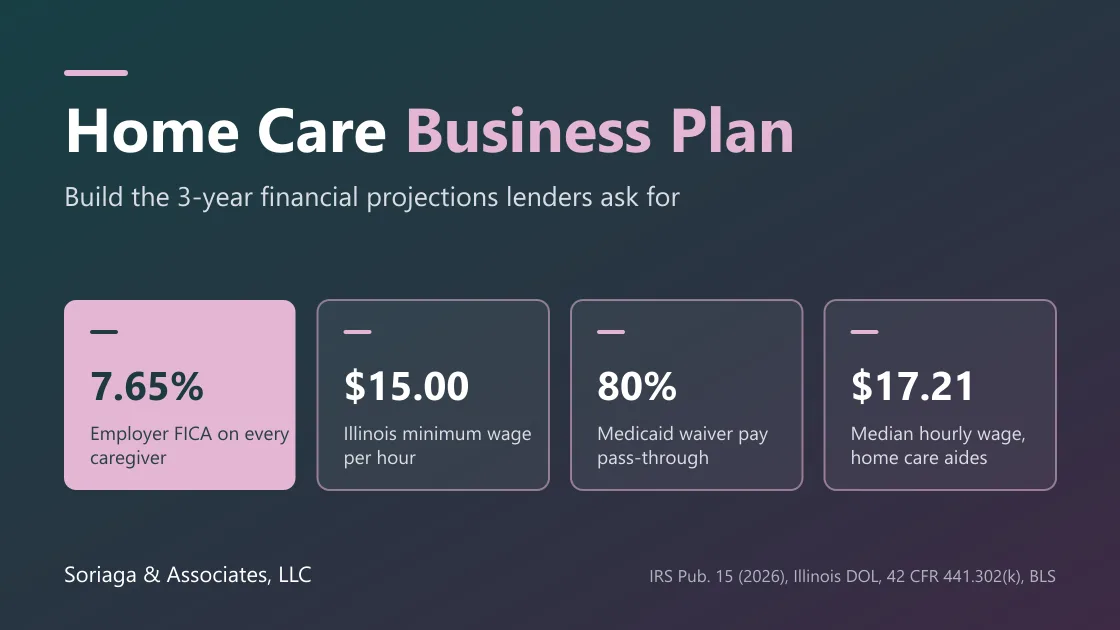
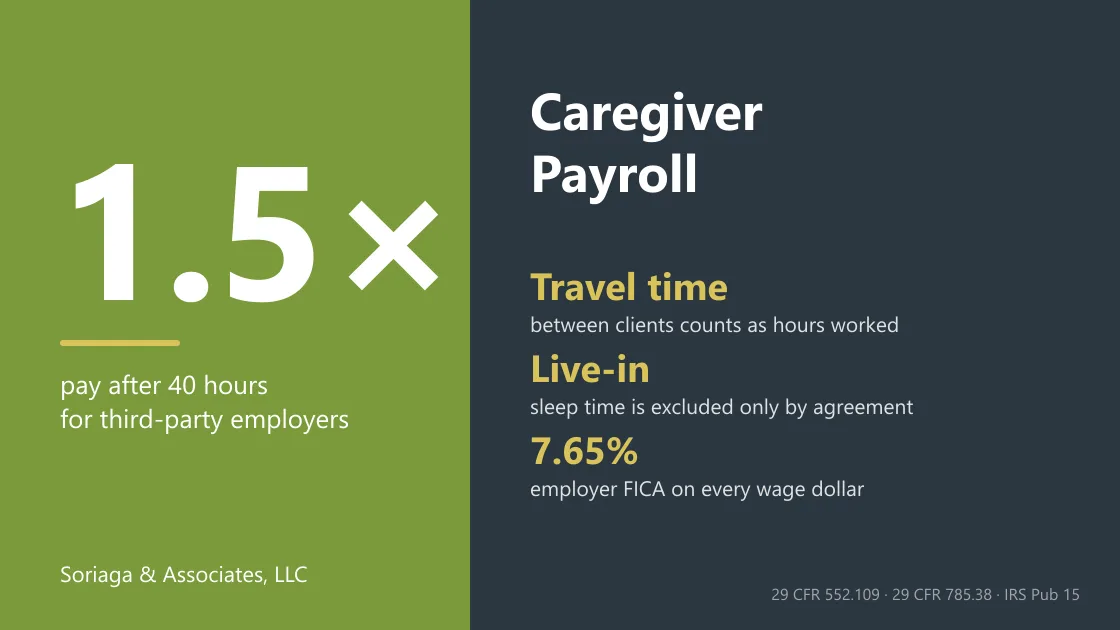
Budget for employer payroll costs. On top of each wage dollar, you pay 7.65% for Social Security and Medicare (6.2% and 1.45% per IRS Publication 15). You also pay federal and state unemployment tax, plus workers' comp. State rates depend on the state and, over time, on your own experience, so use estimates until you receive your rate notice.
Which payroll tax filings does a new agency make?
- Form 941 (quarterly). Reports wages, withholding and Social Security and Medicare taxes. Due April 30, July 31, October 31 and January 31 for the prior quarter. You get 10 extra days if you deposited all taxes on time.
- Form 940 (annual). Reports federal unemployment tax, due January 31, with the same 10-day grace if deposits were on time.
- Form W-2 (annual). Employees get copies by January 31, and the Social Security Administration receives the file with Form W-3 by that date.
- State filings. Expect quarterly unemployment wage reports and any state withholding returns.
You also make payroll tax deposits between filings. Your deposit schedule depends on the size of your tax liability, so your payroll provider or CPA should tell you which one applies.
The most common new-agency problem is not a missed form. It is withheld payroll tax spent on operating costs. Many owners keep a separate payroll tax account for exactly this reason. Treat withheld tax as the government's money the day you withhold it.
How do I track payroll as a percent of revenue?
For a home care agency, caregiver payroll is the largest cost, so it is the number to watch. Each month, calculate:
- Caregiver wages and employer taxes divided by billed revenue, in total and by payer.
- Billable hours versus paid hours. Paid travel, training and time off are paid but not billed.
- Overtime hours as a share of total hours.
When the percentage drifts up, the cause is usually one of those three. Set the target from your own pricing, not from a rule of thumb. Our free home care rate calculator builds a fully loaded cost per billable hour (wage, overtime, paid time off, employer taxes, workers' comp and overhead) and the bill rate for your target margin, so you know what percentage you are aiming for before you sign a client.
How should I set up the books for a new home care agency?
Keep separate accounts. One operating account and, ideally, a second for payroll taxes.
Build the chart of accounts around payers. Split revenue into private pay, long-term care insurance if you bill it, and Medicaid or state-program clients tracked by program. Split expenses into caregiver wages, payroll taxes, workers' comp, insurance, mileage, software and office costs.
Track receivables. Keep a list of who owes what and how old each invoice is, because you pay caregivers before most payers pay you.
Reconcile monthly. Match the books to the bank and payroll reports to catch duplicates and mistakes while small.
Keep records by funding source. Timesheets, visit logs by client, payroll by employee and invoices. If you receive state program funding, ask your contract manager what they expect.
What about Illinois Community Care Program funding?
If you plan to serve clients through the Illinois Department on Aging's Community Care Program (CCP), 89 Ill. Adm. Code Part 240 requires in-home service providers to show that at least 77% of revenues due from the Department went to direct service worker costs, leaving 23% for administrative and program support. Providers also file an annual audit report prepared by an independent licensed CPA. Set up accounts that separate direct caregiver costs from administrative costs now, and confirm current requirements with IDoA or your contract manager. See our home care accounting services page.
When should I bring in a CPA?
Before your first payroll is ideal, and no later than the end of your first quarter. A CPA helps most with decisions that are hard to undo:
- Entity taxes. How the LLC is taxed affects how you pay yourself and what you owe.
- Payroll setup, including classification and pay codes.
- Chart of accounts and monthly close, so your books answer "which payer makes me money?"
- Cash flow planning, since caregivers are paid weekly and payers pay later.
- Quarterly estimated taxes for you as the owner.
- Cost reports and program filings if you serve state-funded clients.
Soriaga & Associates, LLC is a CPA firm that has served clients since 1985 from Lisle, Illinois, with 20+ years of healthcare and home care experience. Christian Soriaga, CPA, speaks fluent Spanish, so owners and staff can work in English or Spanish. Our clients are mainly in California, Illinois, Nevada and North Carolina, and we work remotely nationwide.
Frequently asked questions
Do I need an EIN before I run home care payroll?
Yes. An agency with employees needs an Employer Identification Number to run payroll and file employment tax returns. The IRS issues EINs free of charge, and you apply on IRS.gov under the LLC's exact legal name.
How do I register for Illinois unemployment insurance?
A new Illinois employer must register with the Illinois Department of Employment Security (IDES) within 30 days of start-up, and registration can be done through MyTax Illinois. Other states have their own agency and timing, so check before your first hire.
Do I have to carry workers' compensation insurance for caregivers?
In Illinois, the Workers' Compensation Commission says the law requires employers to provide workers' compensation insurance for almost everyone who is hired, injured or whose employment is localized in the state. Treat coverage as a day-one item and check the rule in any other state where you hire.
Should I pay caregivers as 1099 contractors to save money?
Rarely. Caregivers who follow your schedule, serve your clients and work at your pay rates usually look like employees under IRS and Department of Labor tests. Misclassification puts back wages and payroll taxes on you.
Which payroll forms does a new home care agency file?
Form 941 each quarter (due April 30, July 31, October 31 and January 31), Form 940 and Form W-2 by January 31, plus your state's unemployment wage reports and any state withholding filings.
When should a new home care agency hire a CPA?
Before your first payroll. Payroll setup, worker classification, the chart of accounts and entity tax treatment are cheap to get right on day one and expensive to unwind later.
Next step
You do not need everything figured out to start. Book a free 20-minute call and we will go through your launch list, your payroll plan and your books. Run the home care rate calculator first if you want numbers in hand, then see our payroll services and home care accounting services, or call (630) 491-1268. You can also book online any time.
Sources
- IRS, Apply for an Employer Identification Number (EIN) online
- IRS, Employment tax due dates (Forms 941, 940 and W-2)
- IRS, Publication 15, Employer's Tax Guide (2026) (Social Security and Medicare rates)
- IDES, Are You a New Employer? and Illinois Department of Revenue, Business Registration
- Illinois Workers' Compensation Commission, Insurance and 820 ILCS 305/4
- Medicaid.gov, Electronic visit verification (21st Century Cures Act section 12006(a))
- Illinois Administrative Code, Title 89, Part 240, Community Care Program (sections 240.2020, 240.2040, 240.1520)
- Illinois Department on Aging, Community Care Program
Last updated: October 2026.
This article is general information, not legal or tax advice.
Soriaga & Associates, LLC is a CPA firm founded in 1985 in Lisle, Illinois, serving home health, hospice, home care, wound care and dental providers nationwide. (630) 491-1268.