Tax Deductions for Dentists: Equipment, Retirement Plans and Owner Pay (2026)
Christian Soriaga, CPA9 min read
On this page
Quick answer: The biggest tax deductions for dentists are equipment, retirement plan contributions and the 20% qualified business income (QBI) deduction. For 2026, you can expense up to $2,560,000 of equipment under Section 179 and put $24,500 into a 401(k) from your own pay. QBI starts to shrink for dentists above $201,750 of taxable income if single or $403,500 if married filing jointly.
This guide covers the tax deductions for dentists that move the most money, with 2026 limits from irs.gov. It also shows what to finish by December 31. It is general information, not advice for your situation.
Key takeaways
- Equipment: Section 179 allows up to $2,560,000 in 2026. The limit shrinks once you place more than $4,090,000 in service (Rev. Proc. 2025-32).
- Bonus depreciation: The IRS describes a permanent 100% first year deduction for qualified property acquired after January 19, 2025.
- Timing: Equipment must be placed in service, meaning ready for use, by December 31.
- 401(k): $24,500 employee deferral for 2026, with catch-ups of $8,000 or $11,250 for ages 60 to 63.
- Total plan limit: $72,000 for a defined contribution plan. The SEP maximum is also $72,000.
- QBI: Dentistry is a specified service business. The deduction phases out between $201,750 and $276,750 for single filers.
Want your year-end moves checked? Book a free 20-minute call before December 15.
How do equipment write-offs work for dentists?
Dental equipment is expensive. A chair, a scanner or an X-ray unit is not a one-year cost, so tax law normally spreads the deduction over several years. Two rules let you take more of it up front.
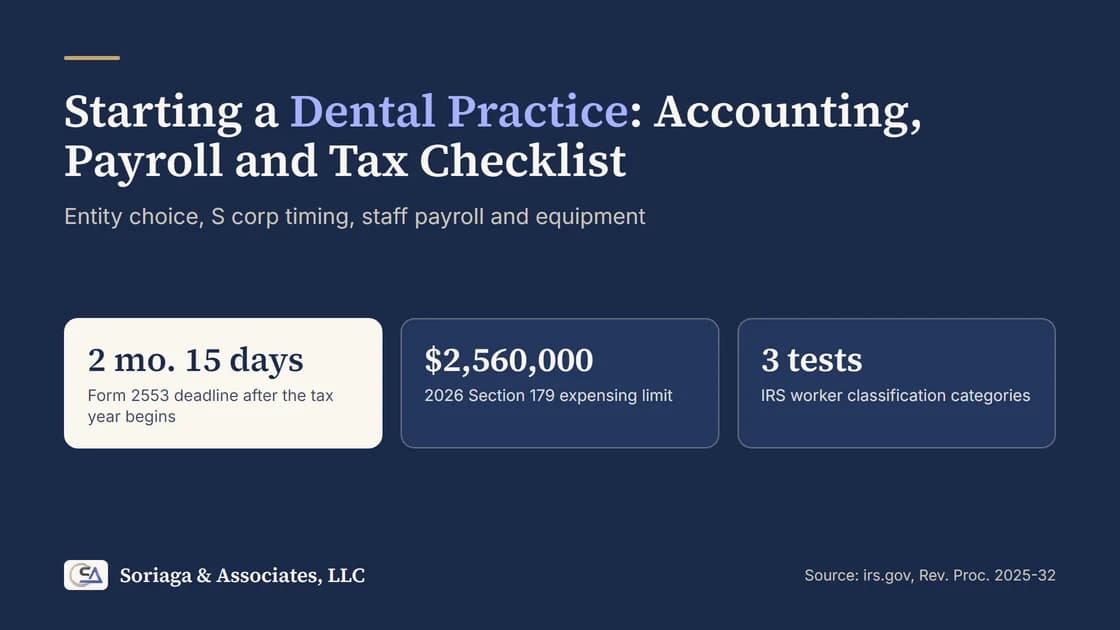
Section 179 lets you expense the cost of qualifying property in the year you place it in service. For tax years beginning in 2026, the limit is $2,560,000. It drops dollar for dollar once the cost of qualifying property placed in service exceeds $4,090,000 (Rev. Proc. 2025-32). The IRS also says the deduction is limited to the taxable income from your active business (Publication 946). It cannot create a loss.
Bonus depreciation is a first year deduction on top of regular depreciation. The IRS describes a permanent 100% additional first year deduction for qualified property acquired after January 19, 2025 (Notice 2026-11). You can elect a smaller percentage in some cases.
What this looks like (illustrative, not a client result): you buy $150,000 of equipment and place it in service in December. Assume a 32% combined tax rate. A full write-off cuts this year's tax by $48,000 ($150,000 x 32%). But you give up depreciation in later years. The deduction moves forward in time. It does not disappear.
We also see practices buy equipment only for the deduction. A write-off saves a share of the cost. It does not pay for the rest.
What to do: Send your CPA the equipment list and the date each item was ready for use before you sign any financing. Our starting a dental practice checklist covers the financing side.
What must happen by December 31?
The equipment must be placed in service in 2026. The IRS says property is placed in service when it is ready and available for a specific use, even if you are not using it yet (Publication 946).
That means a late order is a risk. A unit that ships in January, or sits uninstalled in a box, belongs to the next tax year. Keep the invoice, the delivery date and the install or setup date in one folder.
A short list for December:
- Confirm each purchase is delivered and ready by December 31.
- Keep invoices, financing papers and installation records.
- Check your estimated taxable income. The Section 179 deduction cannot exceed it.
- Decide on retirement contributions that need to be set up before year end.
What to do: Set a December 15 cutoff for any new equipment you want counted in 2026.
Which retirement plan deductions matter most?
Contributions to a 401(k) or SEP IRA reduce your taxable income, and they are often the largest deduction a dentist controls. The IRS 2026 limits are:
| Item | 2026 limit |
|---|---|
| 401(k) employee deferral | $24,500 |
| Catch-up, age 50 and older | $8,000 |
| Catch-up, ages 60 to 63 | $11,250 |
| Total defined contribution plan limit | $72,000 |
| SEP maximum contribution | $72,000 |
| Compensation counted for contributions | $360,000 |
A dentist who is 52 could defer $24,500 plus the $8,000 catch-up, or $32,500, from their own pay (illustrative). At age 61, the same dentist could defer $24,500 plus $11,250, or $35,750. Employer contributions are on top of those amounts, up to the total plan limit.
A plan also has costs and rules for your team. If you have employees, you may have to include them in the plan. A dental practice with hygienists and assistants should price that in before choosing a plan type. Defined benefit and cash balance plans have their own limits, which we do not quote here. Ask your CPA to model them.
What to do: Tell your CPA by early December how much you can spare. Ask which setup deadline applies to the plan type you choose.
How does your entity change your deductions?
Your entity decides how owner pay is deducted and taxed. A sole proprietor takes profit as personal income. An S corporation owner takes a salary plus distributions.
That matters for retirement plans. Contributions are based on your pay, so the salary you set affects what you can put away. It also affects the QBI deduction, because wages are not QBI.
We cover the full comparison, including reasonable salary and state taxes, in our guide to the S corp election for dentists. Use that post to decide if the election pays. Then come back here to plan the deductions that follow.
What to do: If you are thinking of electing S corporation status, decide before you pick a retirement plan. The two choices affect each other.
Do dentists get the QBI deduction?
Yes, with a limit. The QBI deduction lets many owners of pass-through businesses deduct up to 20% of qualified business income (irs.gov). A pass-through business is one whose profit is taxed on the owner's personal return.
Dentistry is a specified service business. The tax rules define the field of health to include dentists (26 CFR 1.199A-5). Below a taxable income threshold, that label does not limit you. Above it, the deduction phases out.
For 2026, the thresholds are in Rev. Proc. 2025-32:
| Filing status | Full deduction below | Phase-out ends at |
|---|---|---|
| Single (all other returns) | $201,750 | $276,750 |
| Married filing jointly | $403,500 | $553,500 |
Inside the range, you get a shrinking share. Above the top of the range, no QBI from a specified service business can be taken into account (26 CFR 1.199A-5). The IRS tests taxable income, not practice profit. Your retirement deductions can lower taxable income, which may bring you back into the range.
Illustrative only: a single dentist with $240,000 of taxable income is $38,250 into a $75,000 range. That is about 51% of the way through the phase-out. The exact calculation has more steps, so treat this as a sign to model it.
What to do: Ask your CPA for your taxable income estimate in November. It shows where you sit in the QBI range.
Which everyday deductions do dentists miss?
Large items get the attention. The smaller ones add up, and they are easier to lose when the books are behind.
- Continuing education. Course fees, travel and lodging for training that maintains your skills.
- Licenses and dues. State dental board fees, DEA registration and association dues.
- Lab fees and supplies. Crowns, aligners, gloves, burs and disposables. These often run through your lab and supplier accounts.
- Software and subscriptions. Practice management, imaging and billing tools.
- Vehicle miles. For 2026, the IRS business rate is 72.5 cents per mile for January to June and 76 cents per mile for July to December. Use of the standard rate is optional. Keep a mileage log with dates, places and purpose.
What we see in practice: missing records cost more deductions than missing knowledge. A deduction you cannot document is hard to defend. If your books are months behind, see our page on dental accounting services. Cleanup work is quoted after a free call, never a fixed fee.
What to do: Pull December's receipts into your bookkeeping system by the 10th of January.
What to do before the year ends
Use this order in November and December:
- Review profit. Ask for a year-to-date profit and loss report and a taxable income estimate.
- List equipment. Mark each item delivered and ready by December 31.
- Choose a retirement plan. Confirm the plan type, the contribution and any setup deadline.
- Check your entity. Decide whether an S corporation election should be on the table for next year.
- Update your records. Close the books through November so the numbers are reliable.
- Meet your CPA. Set a mid-December date to make final moves.
Our dental accounting services include tax planning for owners. For filing, see our tax preparation services.
What to do: Book a free 20-minute call and bring your profit and loss report.
Frequently asked questions
What are the biggest tax deductions for dentists?
For most owners they are equipment, retirement plan contributions and the qualified business income (QBI) deduction. Everyday costs such as continuing education, licenses, lab fees, supplies and business mileage add up too. What you can deduct depends on your entity, your income and your records.
How much dental equipment can I write off in 2026?
For tax years beginning in 2026, the Section 179 limit is $2,560,000. It is reduced once the cost of qualifying property placed in service passes $4,090,000 (Rev. Proc. 2025-32). The IRS also describes a permanent 100% additional first year depreciation deduction for qualified property acquired after January 19, 2025. Your deduction cannot exceed your business taxable income under Section 179, so check the details with your CPA.
Does equipment have to be installed by December 31?
It must be placed in service in the tax year. The IRS says property is in service when it is ready and available for its specific use (Publication 946). Buying a chair or scanner on December 30 that is not ready until January does not count for the old year.
How much can a dentist put in a 401(k) for 2026?
The employee deferral limit is $24,500. The catch-up is $8,000 at age 50 and older, or $11,250 for ages 60 to 63. The limit on total contributions to a defined contribution plan is $72,000 (IRS). Your plan terms and pay also matter.
Do dentists qualify for the QBI deduction?
Yes, but dentistry is a specified service business in the field of health (26 CFR 1.199A-5). For 2026, the full deduction is available below $201,750 of taxable income for single filers and $403,500 for joint filers. It phases out above those amounts and ends at $276,750 and $553,500.
Can I deduct the miles I drive for my practice?
Business miles, such as trips to a second office, a bank or a supply run, can be deducted. The IRS 2026 business rate is 72.5 cents per mile for January to June and 76 cents per mile for July to December. Use of the standard rate is optional, and you should keep a mileage log.
Next step
Book a free 20-minute call with Christian Soriaga, CPA, a CPA firm with 20+ years in healthcare accounting. Bring your year-to-date profit and loss report and your equipment list, and we will map your deductions for 2026.
Sources
- IRS, Rev. Proc. 2025-32 (2026 Section 179 limit and phase-out, QBI threshold amounts)
- IRS, Publication 946, How To Depreciate Property (placed in service, taxable income limit)
- IRS, Treasury and IRS issue guidance on the additional first year depreciation deduction (Notice 2026-11)
- IRS, 401(k) limit increases to $24,500 for 2026
- IRS, COLA increases for dollar limitations on benefits and contributions (SEP and defined contribution limits)
- IRS, Qualified business income deduction
- eCFR, 26 CFR 1.199A-5, Specified service trades or businesses
- IRS, Standard mileage rates
Last updated: November 2026. Figures checked October 30, 2026 on irs.gov. Tax rules change, so confirm with your CPA.
This article is general information, not legal or tax advice.
Soriaga & Associates, LLC is a CPA firm founded in 1985 in Lisle, Illinois, serving home health, hospice, home care, wound care and dental providers nationwide. (630) 491-1268.