Starting a Dental Practice: Accounting, Payroll and Tax Checklist
Christian Soriaga, CPA9 min read
On this page
Quick answer: When you are starting a dental practice, you usually form an LLC, and the real decisions come next: how the IRS will tax it (an S corporation election on Form 2553 has a deadline), how you classify and pay your team, how your practice management software ties to your books from the first day, and how you plan equipment purchases. Get these right at the start and you avoid a cleanup later.
For taxable years beginning in 2026, the Section 179 limit is $2,560,000, and it phases out dollar for dollar once qualifying property placed in service passes $4,090,000 (IRS Rev. Proc. 2025-32).
Starting a dental practice means a lease, buildout, equipment financing, hiring and credentialing, all at once. The accounting setup feels like something to do later. It is the one item that is much harder to fix later. This post walks through the setup decisions in the order they come up, in plain English, with IRS sources.
It is general information, not advice for your situation. Your state, your financing and your plans change the answers.
Key takeaways
- An LLC is a legal wrapper, not a tax classification. By default the IRS treats a one-member LLC as separate from its owner for income tax and a multi-member LLC as a partnership. An LLC can elect to be taxed as a corporation (irs.gov).
- The S corporation election has a deadline. Form 2553 is due no more than 2 months and 15 days after the start of the tax year it takes effect, or any time in the prior year (irs.gov).
- Classify staff before you hire them. The IRS weighs behavioral control, financial control and the type of relationship. The label in the contract does not decide it (irs.gov).
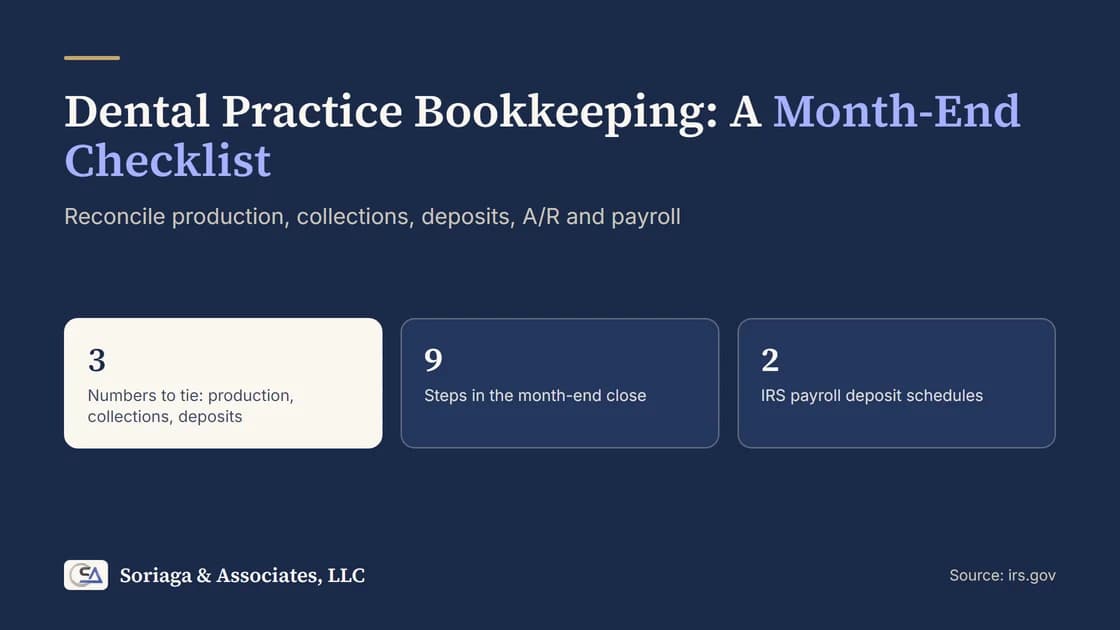
- Tie the practice management software to the books from month one. Production, collections and deposits should reconcile every month.
- Equipment deductions have a 2026 limit and rules. Section 179 is $2,560,000 for taxable years beginning in 2026, with a phase-out above $4,090,000 (Rev. Proc. 2025-32).
- Talk to a dental CPA early. Before the entity is formed and the financing is signed is the cheapest time.
Starting a dental practice? Bring your timeline and the entity you are considering. Book a free 20-minute call.
How should I choose an entity when starting a dental practice?
Most new practices are formed as an LLC or a professional entity, depending on state rules. State law decides what you can form and what liability protection you get, and an attorney should handle that part. Many states have special rules for licensed professional practices, so do not assume an LLC is available, or the best fit, in yours.
The tax side is a separate question, and it is where a CPA helps. The IRS explains that a domestic LLC with two or more members is classified as a partnership for federal income tax unless it elects otherwise, and a single-member LLC is treated as separate from its owner for income tax, so its activity goes on the owner's return. Either can elect to be taxed as a corporation using Form 8832 (irs.gov, Limited Liability Company). The IRS also notes that a single-member LLC is still treated as a separate entity for employment tax purposes.
In practice, you will choose among these tax outcomes:
| Tax treatment | How it works in general terms |
|---|---|
| Sole proprietorship (default for a one-owner LLC) | Profit is reported on your personal return and is generally subject to self-employment tax |
| Partnership (default for a multi-owner LLC) | The practice files a partnership return and profit passes through to the owners |
| S corporation (by election) | Owners who work in the practice are paid wages, and profit after wages passes through to shareholders |
| C corporation | A separate taxpayer with its own tax return, which we rarely see as a starting point for a small practice |
We do not recommend one for everyone. The S corporation path adds payroll and a separate return, so it tends to be worth it only above a certain profit level. See our post on the S corporation election for dental practice owners and the S corp tax calculator for the math.
When does the S corporation election need to be filed?
This is the deadline new owners miss most often. To be taxed as an S corporation, the entity files Form 2553. According to the IRS instructions, the election must be filed no more than 2 months and 15 days after the beginning of the tax year the election is to take effect, or at any time during the tax year before that (irs.gov, Instructions for Form 2553).
The IRS example is useful: a new corporation whose first tax year begins on January 7 must file by March 21, and an election made before January 7 is not valid. A brand-new entity cannot file early. The clock starts when its first tax year starts.
Two more points from the IRS instructions:
- An eligible entity, such as an LLC, that meets the S corporation tests is treated as a corporation as of the election's effective date and does not need to file Form 8832 separately.
- Late relief exists but is not automatic. Under Rev. Proc. 2013-30, a late election can be relieved for reasonable cause if Form 2553 is filed within 3 years and 75 days of the intended effective date. Outside those limits, the entity generally has to request a private letter ruling and pay a user fee.
The S corporation also has eligibility rules: no more than 100 shareholders, only certain types of shareholders, and one class of stock. If you plan to bring in an associate buy-in later, check those rules before you plan the ownership split.
Do not rely on relief as a plan. Put the date on a calendar the day the entity is formed.
How do I set up payroll for hygienists, assistants and the front desk?
You are an employer the day you hire your first employee, so payroll setup is part of opening day, not a later project.
Employee or independent contractor?
The IRS groups the evidence into three categories (irs.gov, Independent contractor, self-employed or employee):
- Behavioral control: does the practice control or have the right to control what the worker does and how?
- Financial control: who controls the business side, such as how the worker is paid, who reimburses expenses and who supplies the tools?
- Type of relationship: are there written contracts or employee-type benefits, is the relationship ongoing, and is the work a key part of the business?
The IRS says no single factor decides it and recommends documenting the factors you considered. Its page on common-law employees says what matters is the right to control the details of how the services are performed, not what the arrangement is called.
Hygienists, assistants and front desk staff who work your schedule, in your office, with your equipment and clinical protocols tend to look like employees. Associate dentists are where owners have the most questions, because compensation is often a percentage of production or collections and the arrangement can look like a contractor on paper. The test above still applies, and state tests can differ from the IRS test, so involve your attorney. If the facts are unclear, the IRS lets either side file Form SS-8, but the IRS says a determination may take at least six months.
What payroll setup includes
For employees, payroll covers:
- Withholding, and the employer's share of Social Security and Medicare
- Federal deposits on a monthly or semiweekly schedule, with quarterly Form 941 returns (irs.gov, Depositing and reporting employment taxes)
- Federal unemployment tax reported on Form 940, plus state registrations for withholding and unemployment
- Workers' compensation insurance, which your insurance agent handles
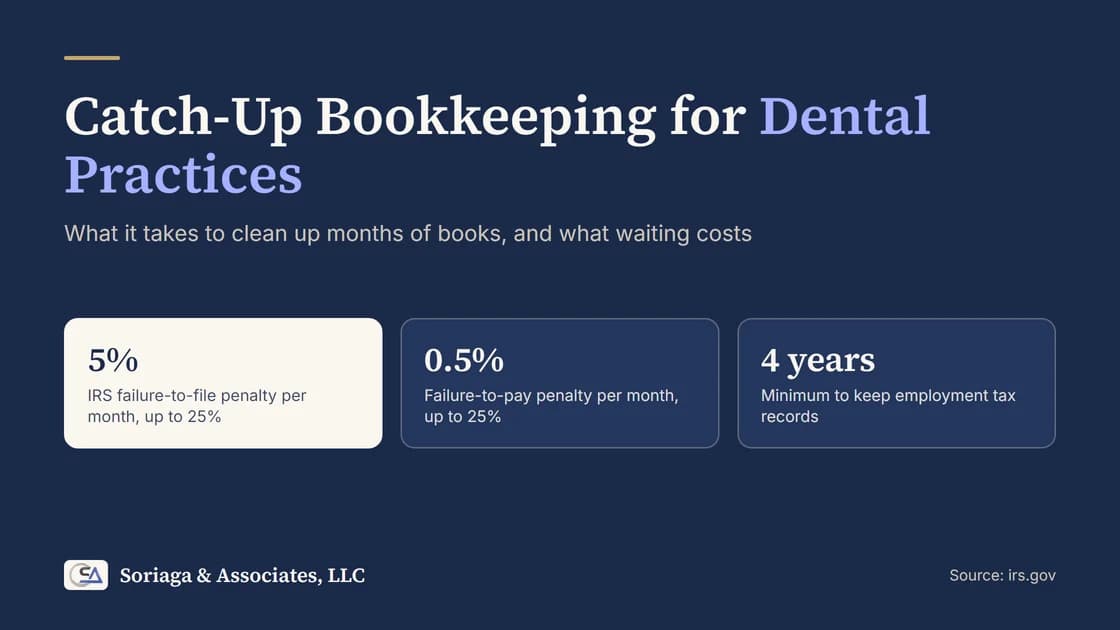
Federal tax deposits must be made electronically, and the IRS lists EFTPS, Direct Pay and your business tax account as options. Late deposits carry penalties, which we cover in our post on catch-up bookkeeping for dental practices. Our payroll services and dental accounting services, a CPA for dentists team, include payroll setup for new practices.
How should the bookkeeping be set up from day one?
A new practice has two systems that must agree: the practice management software and the books. The software knows production, collections, adjustments and patient balances. The books know bank activity, expenses, loans and payroll. Month after month, they should tie.
Set these up in the first month:
- A separate business bank account and card in the entity's name, before the first deposit or purchase. Mixing personal spending in is the most common source of messy books.
- A chart of accounts that fits a dental practice, with separate lines for lab, supplies, dental software, merchant fees and equipment financing.
- Production and collections reporting from your software on a fixed schedule, so deposits can be matched to collections.
- Loan tracking that splits interest from principal for buildout and equipment financing.
- A monthly close routine. See our month-end checklist for dental practice bookkeeping.
Startup costs deserve their own treatment. Costs incurred before you open, such as legal, licensing and early consulting, are handled differently from equipment you buy and from ordinary operating expenses. Keep receipts and label them by purpose from the first purchase, and ask your CPA how each category is treated on your return.
Our dental bookkeeping services set up this structure for new practices and run it monthly. If you open and the books fall behind, our catch-up bookkeeping service exists for that, but it is easier to start right.
What about equipment financing and Section 179?
Operatories, imaging, sterilization and furniture are the largest early purchases, and they are usually financed. Two separate questions follow: how the loan is booked, and how the equipment is deducted.
The loan. Each payment has interest and principal. Interest is an expense. Principal reduces the loan balance. Booking the whole payment as an expense overstates cost and hides the debt.
The deduction. Section 179 lets a business deduct the cost of qualifying property in the year it is placed in service instead of depreciating it over several years. For taxable years beginning in 2026, the aggregate cost you can expense is limited to $2,560,000, and that limit is reduced dollar for dollar by the amount that qualifying property placed in service during 2026 exceeds $4,090,000 (IRS Rev. Proc. 2025-32).
Three cautions:
- Placed in service matters. Equipment that is bought but not yet in use at year-end is treated differently from equipment installed and ready.
- Qualifying property and business-use rules apply, as does the rest of the depreciation framework described in IRS Publication 946.
- Taking the full deduction is not always the right move. It can create a large first-year loss, or use up deductions you would rather have in later years. We model both before you decide.
Equipment decisions should come from a tax projection, not from a salesperson's pitch. Our dental accounting services include that planning.
When should I hire a CPA for dentists?
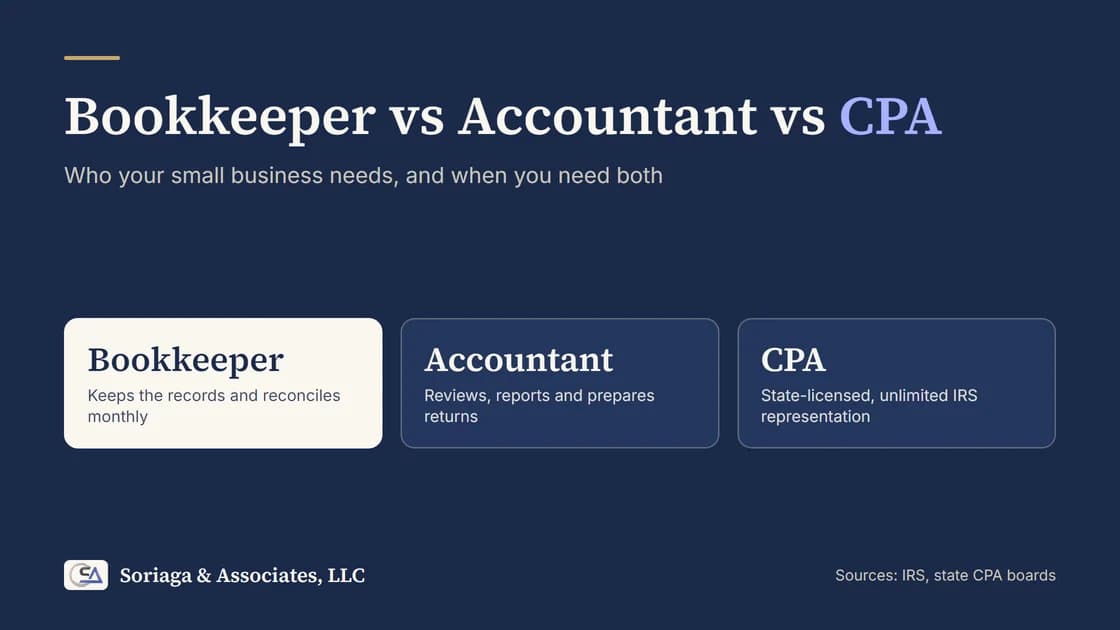
Earlier than most owners expect. An accountant for dentists who knows practice management software and dental payroll can set this up once instead of repairing it later. The order that works best:
- Before you form the entity: talk through LLC versus other forms, and whether you expect to elect S corporation status.
- Before you sign equipment financing or a lease: so the books, the loan terms and the tax plan fit together.
- Before the first hire: so classification and payroll are set up correctly.
- Before the first month closes: so the chart of accounts and reconciliation routine are in place.
We are a CPA firm founded in 1985 in Lisle, Illinois, with 20+ years in healthcare, and we serve dental practices nationwide, fully remote. We do not quote bookkeeping, payroll or tax work from a price list. We scope it after a free call.
Ready to set up the practice correctly? Book a free 20-minute call and tell us where you are in the opening timeline.
Frequently asked questions
Should a new dental practice be an LLC or an S corporation?
It is not either-or. An LLC is a state-law entity, and the IRS then classifies it for tax purposes: by default as a sole proprietorship (one member) or partnership (two or more). An LLC can elect to be taxed as an S corporation by filing Form 2553 if it meets the requirements. Whether that makes sense depends on profit, state taxes and the added payroll work, so run the numbers with a CPA first.
When is the deadline to elect S corporation status?
Form 2553 must be filed no more than 2 months and 15 days after the beginning of the tax year the election takes effect, or at any time during the tax year before it takes effect (irs.gov). A brand-new entity cannot elect before its first tax year begins. The IRS offers late-election relief under Rev. Proc. 2013-30 in some cases, if Form 2553 is filed within 3 years and 75 days of the intended effective date.
Are dental hygienists and assistants employees or independent contractors?
The IRS looks at the whole relationship across behavioral control, financial control and the type of relationship, and no single factor decides it. Staff who work your schedule, use your equipment and follow your clinical protocols usually point toward employee status. The label in a contract does not control. If it is unclear, the IRS offers Form SS-8, but it can take months to get an answer. Raise it with your CPA and attorney before you hire.
How much can a dental practice deduct for equipment under Section 179 in 2026?
For taxable years beginning in 2026, the Section 179 limit is $2,560,000, reduced dollar for dollar once qualifying property placed in service exceeds $4,090,000 (Rev. Proc. 2025-32). Not everything qualifies, and the deduction has other rules, such as business use. Check them with your CPA before you sign a financing agreement, not after.
When should a new dental practice owner hire a dental CPA?
Before you form the entity, if you can. Entity choice, the timing of an S corporation election, payroll setup and how the books are structured are all easier to set up correctly than to repair later. A short call before you sign a lease or equipment financing can save a rebuild.
Sources
- IRS, Limited Liability Company (LLC)
- IRS, Instructions for Form 2553
- IRS, Independent contractor (self-employed) or employee?
- IRS, Employee (common-law employee)
- IRS, Depositing and reporting employment taxes
- IRS, Rev. Proc. 2025-32
- IRS, Publication 946, How to Depreciate Property
Last updated: October 2026.
This article is general information, not legal or tax advice.
Soriaga & Associates, LLC is a CPA firm founded in 1985 in Lisle, Illinois, serving home health, hospice, home care, wound care and dental providers nationwide. (630) 491-1268.