Medicare Overpayment Demand Letter: What Home Health and Hospice Owners Do in the First 30 Days
Christian Soriaga, CPA10 min read
On this page
Quick answer: A Medicare overpayment letter is a demand for money back from your MAC (the company that pays your Medicare claims). Interest starts on day 31 if you haven't paid. Recoupment, where Medicare keeps part of your next payments, can start on day 41. Your first appeal is due within 120 days.
CMS set the interest rate on Medicare overpayments at 11.875%, effective October 21, 2026 (CMS Transmittal 14006).
If a Medicare overpayment letter just landed on your desk, you have two questions. Is the number right, and can we still make payroll? This guide answers both. It covers where overpayments come from, the clocks, interest, recoupment, the appeal levels and the 60-day rule.
We're a CPA firm with 20+ years in healthcare accounting, and we prepare 50 to 100 Medicare cost reports a year. This is general information, not legal advice.
Key takeaways
- The letter starts several clocks at once. Day 15 is the rebuttal deadline, day 30 is the last day to pay without interest, and day 41 is when recoupment can start.
- Interest is 11.875%. It's simple interest, and CMS adds it from day 31.
- An appeal can pause recoupment, not interest. That holds for most claim overpayments, and only at the first two levels.
- There are five appeal levels. Each has its own deadline, and two have a minimum dollar amount.
- Overpayments you find yourself have a 60-day clock. Keeping one past the deadline carries False Claims Act risk.
- Monthly books catch the problem early. A smaller deposit doesn't send you an email.
Holding a demand letter right now? Book a free 20-minute call. Bring the letter and your last bank statement.
What is a Medicare overpayment, and where does it come from?
A Medicare overpayment is a payment larger than the amount due under Medicare law and rules. CMS says an identified overpayment becomes a debt owed to the federal government. Your MAC mails a demand letter for any overpayment of $25 or more (CMS MLN fact sheet). The envelope is rarely good news.
CMS lists four causes: incorrect coding, insufficient documentation, medical necessity errors, and processing or administrative errors. For an agency, the letter usually arrives by one of four routes.
| Source | How you find out | What starts your clock |
|---|---|---|
| Claim denied after a records review (an ADR, TPE or other review) | A denial notice, then a demand letter | The date on the demand letter |
| Credit balance or duplicate payment you find yourself | Your own books | 60 days after you identify it |
| Cost report settlement | A Notice of Program Reimbursement (NPR) with a demand | 180 days to appeal; interest from the final determination |
| Hospice cap | Your cap filing or a MAC determination | See our hospice cap overpayment guide |
Records reviews are the biggest source. For fiscal year 2025, CMS's error testing put the home health improper payment rate at 6.9% and non-hospital hospice at 5.9%. In home health, 49.4% of the improper dollars were insufficient documentation and 30.4% were medical necessity.
In non-hospital hospice, 50.3% were medical necessity and 29.0% were insufficient documentation. (CMS data, November 2025)
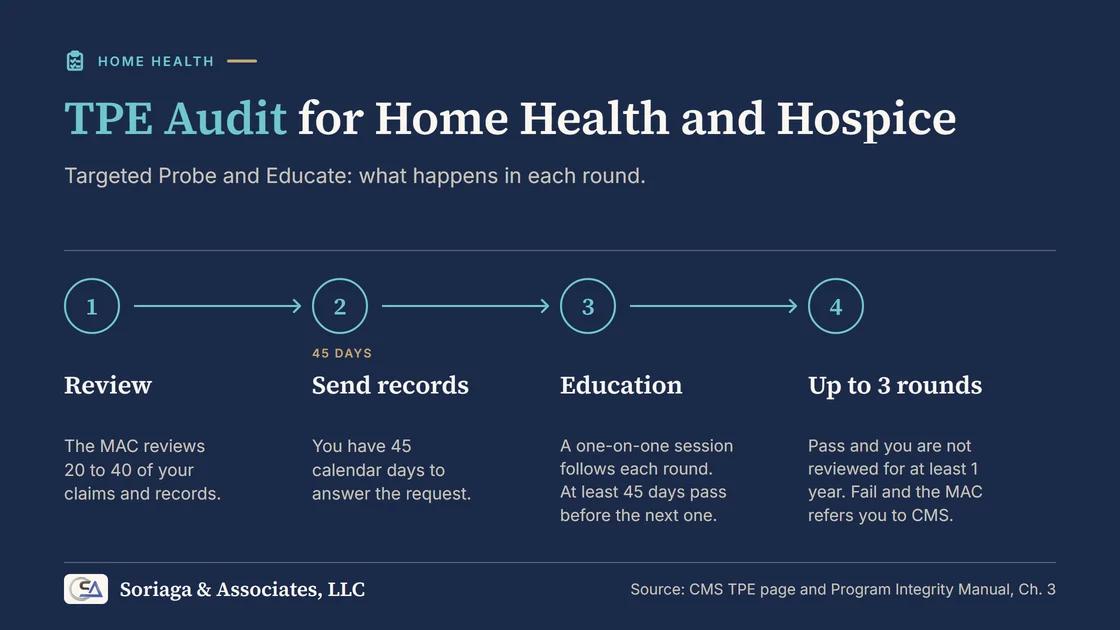
The letter is the end of a story that began earlier. For the start, see our guides to the hospice ADR letter and the TPE audit.
What to do: Find the source of your letter in the table. It tells you which clock and which appeal path apply.
What happens on day 1, 15, 30, 41 and 120?
Several clocks start together. The CMS fact sheet sets this schedule for claim overpayments (CMS MLN fact sheet). None of them has a snooze button.
| Day | What happens |
|---|---|
| 1 | Your MAC sends the demand letter, within 7 calendar days of the determination |
| 15 | Last day to send a rebuttal |
| 16 | Immediate recoupment starts, if you asked for it |
| 30 | Last day to pay in full and avoid interest |
| 31 | Interest starts on any unpaid balance |
| 41 | Standard recoupment starts, unless a recoupment-limit appeal is pending |
| 61 to 90 | Intent to refer letter on a debt that's still unpaid |
| 120 | Last day to file a redetermination, the first appeal |
| 126 to 150 | The MAC refers an unpaid debt to the U.S. Treasury |
Two details matter. The 120 days run from the day you receive the notice of the initial determination. The rule presumes you got it 5 days after the notice date (42 CFR 405.942). And the practical window is far shorter than 120 days, because interest and recoupment start first.
What to do: Write the day 15, 30 and 41 dates on the calendar the day the letter arrives.
Should I pay, recoup, rebut, appeal or ask for a payment plan?
You have five choices, and you can combine some of them. Silence is also a choice. It's the one that ends with a Treasury referral.
| Option | What it does | Deadline | Effect on interest |
|---|---|---|---|
| Pay in full | Ends the debt | Day 30 | Waived if you pay in full within 30 days of the final determination (42 CFR 405.378(f)) |
| Immediate recoupment | Your MAC takes the money from your next claim payments | Recoupment starts by day 16 | Not subject to interest, says CMS (CMS MLN fact sheet) |
| Rebuttal | You explain, with evidence, why recoupment shouldn't happen. It isn't an appeal and doesn't stop recoupment | 15 days from the date of the letter | No change |
| Appeal | Five levels, below | Day 120 for the first level | Keeps running |
| Extended repayment schedule | Installments, if you can show hardship | Before the debt is referred to Treasury (CGS Medicare) | Keeps running |
Unless you mark the request one-time, it covers all current and future debts.
A letter can include a mistake. If the claim list doesn't match your PS&R (Medicare's report of what it paid you), say so in writing. Our guide to the PS&R report shows how to read it.
In my experience, the biggest items are missing claims and claims rejected because of improper notes.
If the amount is large, owners usually try to contest it. If it's very small, they just accept the overpayment. Contesting a claim can be very labor- and time-intensive, and they're already drowning in work.
If you want a CPA to check the numbers before you pick, book a free 20-minute call. We'll compare the letter to your home health accounting records.
What to do: Decide by day 15 whether you agree with the number. That choice decides which option fits.
What does Medicare overpayment interest cost?
Interest is charged at 11.875%, an annual rate, effective October 21, 2026 (CMS Transmittal 14006). Treasury sets the rate each quarter. CMS charges simple interest on the unpaid balance for each 30-day period, starting on day 31 (CMS MLN fact sheet).
Illustrative example (not a real agency): You owe $60,000 and pay nothing for a year. Your MAC computes the exact figure.
| Item | Amount |
|---|---|
| Balance owed | $60,000 |
| Rate, effective October 21, 2026 | 11.875% a year |
| Simple interest for one year | $7,125 |
| About per month | $590 |
Three more rules matter:
- Payments and recoupments go to accrued interest first, then to principal (42 CFR 405.378(g)).
- An extended repayment schedule request doesn't stop interest, according to CGS Medicare.
- Interest on an overpayment generally isn't an allowable cost on your cost report. The same goes for interest on money you borrow just to repay one (42 CFR 405.378(h)).
That last rule is the quiet one. The interest doesn't come back to you through settlement, and it never asks for a meeting first.
What to do: If you agree with the number and have the cash, pay by day 30.
What are the five appeal levels, and how long do I have?
There are five levels. The first is a redetermination by your MAC, due 120 days after you receive the notice. The last is federal court. Deadlines shrink as you climb, and two levels carry a minimum dollar amount.
Five levels sounds like a video game. At each level the boss is a deadline.
| Level | Who decides | Deadline to file | Minimum amount |
|---|---|---|---|
| 1. Redetermination | Your MAC | 120 days from receipt of the notice | None (405.940) |
| 2. Reconsideration | A Qualified Independent Contractor (QIC) | 180 days from receipt of the redetermination (405.962) | None (405.960) |
| 3. Administrative law judge hearing | OMHA | 60 days from receipt of the QIC decision (405.1002) | $200 in 2026 |
| 4. Medicare Appeals Council | The Council | 60 days from receipt of the ALJ decision (405.1102) | None |
| 5. Federal district court | A federal judge | 60 days from receipt of the Council decision (405.1130) | $1,960 in 2026 |
The 2026 thresholds come from the Federal Register notice. For an overpayment appeal, the amount counted is the amount in the demand letter. For a sampled and extrapolated overpayment, it's the total extrapolated amount (42 CFR 405.1006(d)(4)). Receipt is presumed 5 days after the notice date at each level.
Does an appeal stop recoupment? Often yes, at the first two levels (42 CFR 405.379).
| Stage | Recoupment |
|---|---|
| Before day 41 | Can't begin |
| Timely, valid redetermination request | Must stop, or not start |
| QIC reconsideration request | Must stop |
| Judge, Council or court | Stays in effect |
| Cost report overpayment | No pause |
CMS adds a timing trap. File the redetermination by day 30 to stop recoupment from starting on day 41.
File later, and the MAC must stop once it validates your appeal. But it won't refund money already taken until the redetermination is decided (CMS MLN fact sheet). Interest runs either way.
Appeals turn on legal and clinical points. Involve your healthcare counsel and your clinical director. We prepare the numbers.
What to do: Put the day 30 date and the 120-day date on your calendar. File early, not on the last day.
Can I get an extended repayment schedule?
You can ask, but approval isn't automatic. The rules are in 42 CFR 401.607, and CGS Medicare shows how one MAC handles requests (CGS Medicare).
| Item | Rule |
|---|---|
| Hardship | Your unpaid overpayments equal 10% or more of your Medicare payments for your latest cost report period |
| Hardship term | At least 6 months. Missing one payment is a default |
| Extreme hardship term | 36 to 60 months |
| What CGS wants | A signed letter, a financial checklist, the listed documents within 15 days, and a good faith payment |
| Smallest payment (CGS) | At least 1/60th of the total owed each month |
| Interest | Keeps running |
Other MACs have their own forms. You must also prove the hardship, which means your books must be current. Hand a MAC six months of unreconciled bank statements and the answer will be slow. For the cash-flow math on a plan, see our hospice cap overpayment guide.
What to do: Build a 13-week cash forecast with the payments in it before you call your MAC.
What is the 60-day rule for overpayments you find yourself?
If you find an overpayment, you must report and return it by the later of two dates. One is 60 days after you identified it. The other is the date the matching cost report is due (42 CFR 401.305). Finding the mistake yourself starts a clock, which feels unfair for a good deed.
Here's how the rule works today. CMS changed it effective January 1, 2025 (Federal Register).
| Part of the rule | What it says |
|---|---|
| "Identified" | You knowingly received or kept the money, using the False Claims Act meaning of "knowingly" |
| Pause to investigate | The deadline is suspended for up to 180 days while you look into related overpayments with the same cause |
| Payment plan request | Also suspends the deadline, until CMS rejects it or you break its terms |
| Lookback | Six years from the date you received the money |
| Late | Keeping the money past the deadline is an "obligation" under the False Claims Act |
You report it through a claims adjustment, a credit balance report, a self-reported refund, or your MAC's process. If you used statistical sampling, you must describe the method. A serious case can also go through the OIG Self-Disclosure Protocol, and that decision belongs to your healthcare counsel.
Credit balances matter here too. The CMS credit balance report, form CMS-838, is due within 30 days after each calendar quarter. The manual lists late filers for payment suspension (CMS Financial Management Manual, chapter 12). Providers with extremely low Medicare use are exempt, so ask your MAC whether it applies to you.
What to do: Review your credit balances every month. Do not wait for the quarterly form.
What about cost report and hospice cap overpayments?
Overpayments from a cost report follow different rules. Your MAC issues a Notice of Program Reimbursement (NPR) and may demand money.
| Claim overpayment | Cost report overpayment | |
|---|---|---|
| Appeal | Five levels, first due in 120 days | Hearing request within 180 days (42 CFR 405.1835) |
| Recoupment | Pauses at levels 1 and 2 | Goes ahead even if you request a hearing (42 CFR 405.1803(c)) |
| Reopening | Not covered here | A request must reach the MAC within 3 years (42 CFR 405.1885) |
If your own cost report shows an amount due, interest runs from the due date. You can stop it by paying in full with the report. Or you and your MAC can agree in advance to repay through lower interim payments over the next 30 days (42 CFR 405.378(e)).
Hospice cap overpayments follow the cost report path. We cover the cap in full in our hospice cap overpayment guide.
What to do: Check the date on your NPR. Count 180 days forward.
How do monthly books catch a Medicare overpayment early?
They show the gap while you can still act. The CMS manual says withheld amounts appear on your remittance advice, the payment detail that comes with each deposit (CMS manual, chapter 12).
A deposit that's smaller than expected doesn't announce itself. A bookkeeper who posts every deposit as revenue never sees it.
When an owner calls me about a letter, we first ask when it was sent and how large the amount is. Then we ask how accurate the billing documents in their billing software are. If the billing and notes aren't accurate, it will be very hard to contest the overpayment.
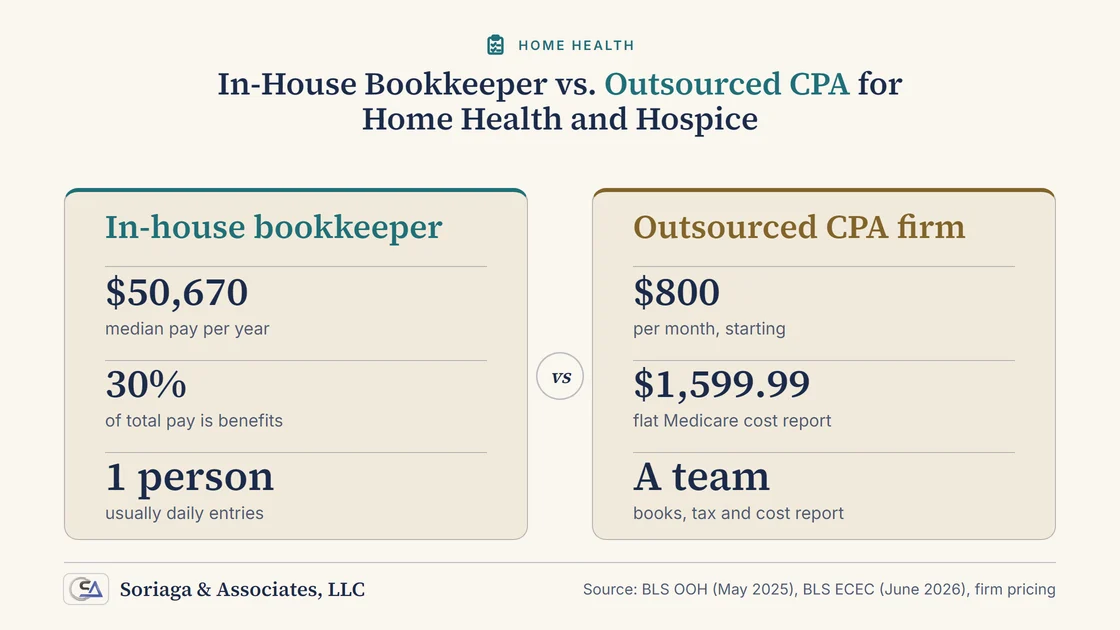
A general bookkeeper can tell you the deposit was smaller. A CPA who prepares Medicare cost reports can tell you why, and what it does to your cost report. We work with 30+ home health agencies and 10+ hospices, and our monthly accounting starts at $800 per month. The Medicare cost report is included for home health and hospice clients on the retainer.
See our home health accounting and hospice accounting services pages.
Here's what we set up for an agency that gets a letter, or wants to avoid one:
| Set up | What it does |
|---|---|
| A line for each claim status | Held, paid, denied, appealed and written off each get their own line |
| A recoupment log | Shows the date, the remittance, the amount and which demand it pays down |
| A payable for the demand | Tracks the principal, the interest and the payment dates |
| A monthly credit balance check | So the 60-day clock never starts in secret |
| A monthly PS&R match | So your books and Medicare's numbers agree |
| A 13-week cash forecast | Shows the lowest cash week before payroll |
What to do: Ask your bookkeeper whether recoupments have their own line. If not, start there.
Frequently asked questions
What is a Medicare overpayment?
It's a payment above the amount Medicare rules allow. CMS says an identified overpayment is a debt owed to the federal government.
How long do I have to respond to a Medicare overpayment letter?
Act inside 30 days. Interest starts on day 31 and standard recoupment on day 41. A rebuttal is due in 15 days and a first appeal in 120.
Does an appeal stop Medicare from taking the money back?
For most claim overpayments, a timely redetermination or reconsideration request stops recoupment (42 CFR 405.379). Interest keeps running. It doesn't stop recoupment of a cost report overpayment.
Can I pay a Medicare overpayment over time?
You can ask for an extended repayment schedule: at least 6 months for hardship, 36 to 60 months for extreme hardship (42 CFR 401.607). Approval isn't automatic.
What is the 60-day rule for Medicare overpayments?
Report and return an overpayment you find. The deadline is the later of 60 days after you identified it or the cost report due date (42 CFR 401.305).
Do you handle the appeal itself?
No. Appeals turn on legal and clinical points, so involve healthcare counsel. We check the numbers and build the cash plan. To talk it through, book a free call.
Next step
Find the date on your letter and use the table.
| Day | Do this |
|---|---|
| 15 | Decide whether to send a rebuttal |
| 30 | Pay, or file your redetermination to stop day-41 recoupment |
| 41 | Standard recoupment can start |
| 120 | Last day to file a redetermination |
Book a free 20-minute call with Christian Soriaga, CPA. We will check the number, map your options and set up monthly tracking. You can also read about our Medicare cost report filing and late cost report help, or call (630) 491-1268.
Sources
- CMS MLN Fact Sheet, Medicare Overpayments
- CMS Transmittal 14006, interest rate for FY 2027 first quarter
- CMS, 2025 Medicare FFS supplemental improper payment data
- CMS Financial Management Manual, chapter 12
- eCFR, 42 CFR 401.305, 401.607, 405.378, 405.379
- eCFR, appeals: 405.940, 405.942, 405.960, 405.962, 405.1002, 405.1006, 405.1102, 405.1130
- eCFR, cost reports: 405.1803, 405.1835, 405.1885
- Federal Register, Medicare appeals amount in controversy thresholds for calendar year 2026
- Federal Register, CY 2025 physician fee schedule final rule
- HHS-OIG, Health Care Fraud Self-Disclosure Protocol
- CGS Medicare, Extended Repayment Schedule
Last updated: November 2026.
This article is general information, not legal or tax advice. The worked example is illustrative.
Soriaga & Associates, LLC is a CPA firm founded in 1985 in Lisle, Illinois, serving home health, hospice, home care, wound care and dental providers nationwide. (630) 491-1268.