TPE Audit for Home Health and Hospice: How It Works and What to Do
Christian Soriaga, CPA10 min read
On this page
Quick answer: A TPE audit is a Medicare review called Targeted Probe and Educate. Your MAC (Medicare Administrative Contractor, the company that pays your claims) reviews 20 to 40 claims and their records. You get education if claims fail. The cycle can run up to three rounds (CMS).
You have 45 calendar days to send records after a MAC request. If the records do not arrive in time, reviewers deny the claim (CMS Program Integrity Manual, Chapter 3).
A TPE notice is urgent, but it is manageable. This guide covers how a TPE audit works for home health and hospice agencies. It also covers what happens to your cash while claims are under review, and what our CPA team does on the money side.
Key takeaways
- What it is: Targeted Probe and Educate. A MAC reviews a small sample of your claims, then teaches you what failed.
- Sample size: 20 to 40 claims per round, per service (CMS).
- Rounds: Up to three, though CMS can direct more.
- Record deadline: 45 calendar days to answer a MAC request. Late records mean denied claims.
- Education: After each round, the MAC offers a one-on-one session. At least 45 days must pass before the next round.
- Good outcome: If you pass, you will not be reviewed again for at least 1 year on that topic.
- Bad outcome: If errors stay high after three rounds, the MAC refers you to CMS for next steps.
- Money: Held claims slow your cash. Denied claims cut revenue. Track both by claim from day one.
Got a TPE notice? Book a free 20-minute call and we will map the cash impact with you.
What is a TPE audit?
Targeted Probe and Educate (TPE) is a Medicare review program. A MAC looks at a sample of your claims and the records behind them. If problems show up, the MAC teaches you how to fix them and checks again later.
CMS says MACs use data analysis to find providers with high claim error rates or unusual billing. Providers whose claims follow Medicare policy are not chosen.
TPE can be a prepayment review or a postpayment review. Prepayment means the MAC checks the claim before it pays. Postpayment means the MAC checks after it paid, and any denial becomes an overpayment you may have to repay (CMS Program Integrity Manual).
You usually learn about TPE from a letter. The manual says the MAC's notice letter must explain the process, tell you how to get one-on-one education, and warn that non-response to a records request can lead to a referral. It also reminds you that CMS can revoke billing privileges for a pattern of claims that fail Medicare rules.
What to do: Read the notice today. Write down the review topic, the service line, the date of the letter and the MAC contact.
How many rounds are there, and what happens in each?
Each round follows the same pattern, according to CMS and the Program Integrity Manual.
- Review. The MAC picks 20 to 40 claims and asks for the records.
- Records. You send the records within 45 calendar days of the request.
- Results. The MAC sends a letter that lists the claims reviewed and the errors found.
- Education. The MAC offers a one-on-one session. It can be a phone call or a webinar.
- Wait. At least 45 days pass before the MAC picks new claims. You use that time to fix the problems.
The cycle can repeat up to two more times, for three rounds in total. CMS says a round should not take much longer than about 6 months, and the manual allows a different sample size only with CMS approval.
Here is what the outcomes look like:
| Result | What happens |
|---|---|
| Error rate is low or improves | The MAC removes you from TPE. You are not reviewed on that topic for at least 1 year. |
| Errors stay high after round 3 | The MAC refers you to CMS for further action. |
| CMS acts on the referral | Options include more rounds, 100 percent prepayment review, extrapolation, a Recovery Auditor referral or revocation. |
Extrapolation means the reviewer applies the error rate from a sample to a much larger group of claims. That can turn a few denials into a large repayment demand. It is on the CMS list of possible next steps, so treat every round as important.
One MAC, CGS, says on its home health and hospice page that no response to a records request counts as an error when it calculates your error rate. It also says a review can stop early if the error rate falls below its target. Other MACs may use different targets, so ask yours.
Illustrative example (not a real agency): Round 1 reviews 30 claims. The MAC denies 9. You attend the education session, fix your process and wait out the 45 days. Round 2 reviews 30 new claims, and 3 are denied. If the MAC finds the error rate has improved enough, you leave TPE. If not, you move to round 3.
What to do: Put every date on one calendar: the ADR date, the 45-day deadline, the education session and the earliest start of the next round.
What is the ADR response window?
An ADR (Additional Documentation Request) is the letter that asks you for records. Under 42 CFR 405.903 and the Program Integrity Manual, you have 45 calendar days to send them in response to a MAC request.
The manual says contractors may accept late records for good cause. That means things like natural disasters or other extenuating circumstances that the contractor accepts. Do not plan on it. The same manual says reviewers deny claims when the records do not arrive in time.
After you send the records, the MAC has 30 calendar days to make and record its decision on a prepayment review.
For the full ADR steps for a hospice, read our post on how to respond to a hospice ADR letter. The 45-day rule applies the same way to home health.
What to do: Send records well before day 45. Keep proof of the date the MAC received them.
What does a TPE audit do to your cash?
This is the part owners feel first. Here is how the money moves.
Held claims. On a prepayment review, the MAC does not pay the claim until it decides. In the worst case, you wait up to 45 days to send records and then up to 30 days for the decision. That is about 75 days.
Denied claims. A denied claim does not pay. If it was a postpayment review, a denial creates an overpayment. The MAC can take that money back.
Recoupment. Recoupment means the MAC withholds the money from your future claim payments. Under 42 CFR 405.379, a contractor can start recoupment no earlier than 41 days from the date of the initial demand. It must stop when it gets a timely and valid request for redetermination. The rule lists cases where recoupment can start again.
Illustrative example (not a real agency): Your MAC holds 30 claims averaging $2,400 each. That is $72,000 of cash on hold. If the MAC denies 6 of them, you lose $14,400 unless you win an appeal. The other $57,600 pays late, not never. If your payroll is $55,000 every two weeks, that late cash matters.
You can appeal a denial. A redetermination request must be filed within 120 calendar days of receiving the initial determination. Receipt is presumed 5 days after the notice date (42 CFR 405.942). Your clinical team and healthcare counsel decide whether to appeal. We prepare the dollar numbers.
What to do: List every claim in the sample with its billed amount, expected payment and status. Update it weekly.
What do we do on the financial side?
We do not review charts. Your clinical director, or a clinical consultant, owns the record review and the education follow-up. We make sure the money side is under control while they work.
Here is what that looks like in a home health accounting engagement:
- Monthly books that separate claims by status. Held, paid, denied, appealed and written off each get their own line. Your owner sees the effect of TPE on revenue in one place.
- A 13-week cash forecast. We move the held claims out to the later date and show you the lowest cash week. That tells you early if payroll or a loan covenant is at risk.
- A denied revenue tracker. Each denied claim shows the amount, the reason, the appeal deadline and the result. This gives you a running total of what you recovered and what you wrote off.
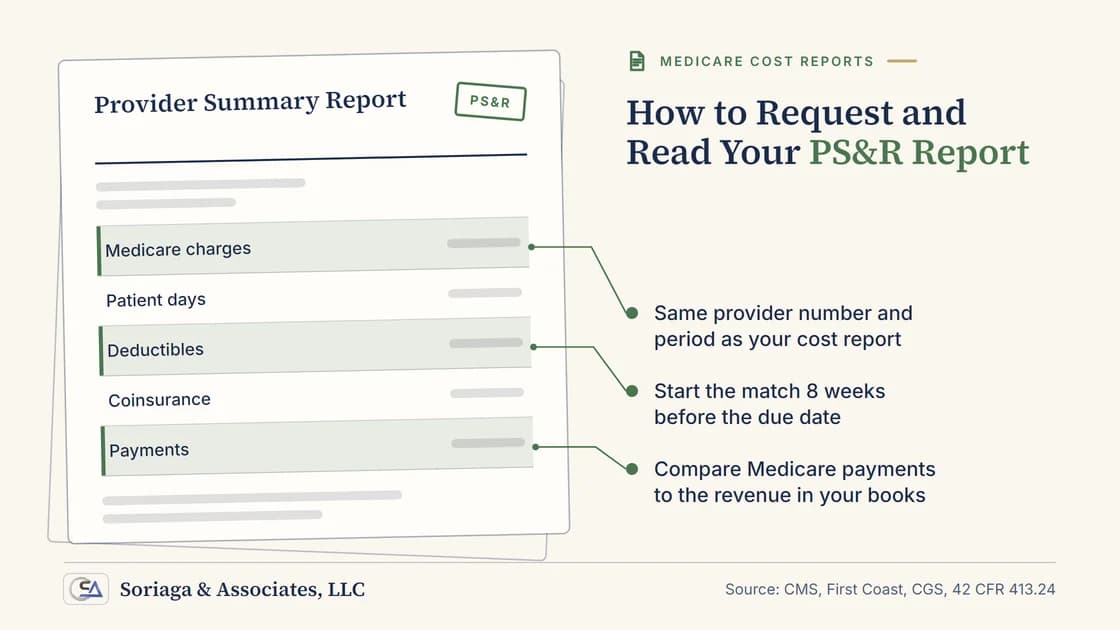
- A clean link to the PS&R. The PS&R (Provider Statistical and Reimbursement report) shows what Medicare says it paid you. We match your books to it each month. Our guide on how to read your PS&R shows how.
- Cost report effects. Revenue, denials and overpayments that come out of TPE can change the numbers on your cost report. We flag them early so they do not surprise you at filing time. See our guide to a home health cost report audit.
A hospice has the same needs. Our hospice accounting services include claim tracking, cap tracking and a cash plan.
What to do: Ask your bookkeeper whether held and denied claims are separate lines today. If not, start with that.
What should you do in the first week?
- Read the letter and calendar every date.
- Tell your clinical director and your owner or board the same day.
- Pull the sample claims. Check the records are complete, signed and in order.
- Build the claim list with amounts and status.
- Run the cash forecast with the held claims moved out.
- Ask for the education session. The manual says the MAC must offer one after each round. Declining it is on the record.
- Fix the process, not just the claims. The MAC checks new claims next round.
The common problem we see is waiting. Owners treat the notice as a clinical issue and look at cash only when the bank balance drops. A forecast built in week one gives you choices, such as timing a line of credit or slowing a purchase.
Want a CPA to build the claim tracker and cash forecast with you? Book a free 20-minute call.
Frequently asked questions
What is a TPE audit?
TPE stands for Targeted Probe and Educate. Your Medicare Administrative Contractor (MAC) reviews 20 to 40 of your claims and records, then offers one-on-one education if claims are denied. CMS says it can repeat for up to three rounds in total.
How long do I have to answer an ADR?
CMS says providers have 45 calendar days to send records in response to a MAC request. CMS manual language says reviewers deny claims when the records do not arrive on time. Your ADR letter shows the exact date, so count from the date on your letter.
Does a TPE audit mean I did something wrong?
No. CMS says MACs pick providers using data analysis, such as high claim error rates or billing that differs from peers. A notice means your data stood out. It is not a finding of fraud.
What happens if I fail all three rounds?
The MAC refers you to CMS. The CMS manual lists possible next steps, including more TPE rounds, 100 percent prepayment review, extrapolation, referral to a Recovery Auditor and referral for revocation.
Can I appeal a denied TPE claim?
Yes. A redetermination request must be filed within 120 calendar days of receiving the notice of the initial determination (42 CFR 405.942). Receipt is presumed 5 days after the notice date. A late request needs good cause.
Can you help with the clinical documentation?
No. Chart and OASIS or hospice record review belongs to your clinical director or a clinical consultant. We handle the money side: tracking held and denied claims, the cash forecast and cost report effects.
Next step
Book a free 20-minute call with Christian Soriaga, CPA. We are a CPA firm with 20+ years in healthcare accounting, including home health and hospice. Bring your TPE letter, and we will map the cash impact and set up the tracker. For the monthly books and the forecast together, see our home health accounting services.
Sources
- CMS, Targeted Probe and Educate (TPE) (20 to 40 claims, up to three rounds, 45 days, one year, referral to CMS)
- CMS Medicare Program Integrity Manual, Chapter 3 (section 3.2.5 TPE; 45-day documentation window; 30-day review decision; denial when records are late)
- CGS Medicare, Targeted Probe and Educate process (home health and hospice) (one MAC's description of rounds, error rate and referral)
- eCFR, 42 CFR 405.942, Time frame for filing a request for a redetermination
- eCFR, 42 CFR 405.379, Limitation on recoupment of provider and supplier overpayments
Last updated: October 2026.
This article is general information, not legal or tax advice.
Soriaga & Associates, LLC is a CPA firm founded in 1985 in Lisle, Illinois, serving home health, hospice, home care, wound care and dental providers nationwide. (630) 491-1268.