Hospice ADR Letter: What to Do in the First 45 Days
Christian Soriaga, CPA9 min read
On this page
Quick answer: A hospice ADR (additional documentation request) is a notice that a reviewer needs more records to pay a claim. You usually have 45 calendar days to send them to a MAC, RAC or SMRC. Use the due date in your letter. If the records do not arrive on time, the reviewer denies the claim.
Medicare's Program Integrity Manual gives providers 45 calendar days to answer a MAC, RAC or SMRC documentation request, and 30 calendar days to answer a UPIC request (CMS, PIM Chapter 3, section 3.2.3.2). Those terms are explained below. This guide covers the first 45 days, what reviewers ask for, and the money side.
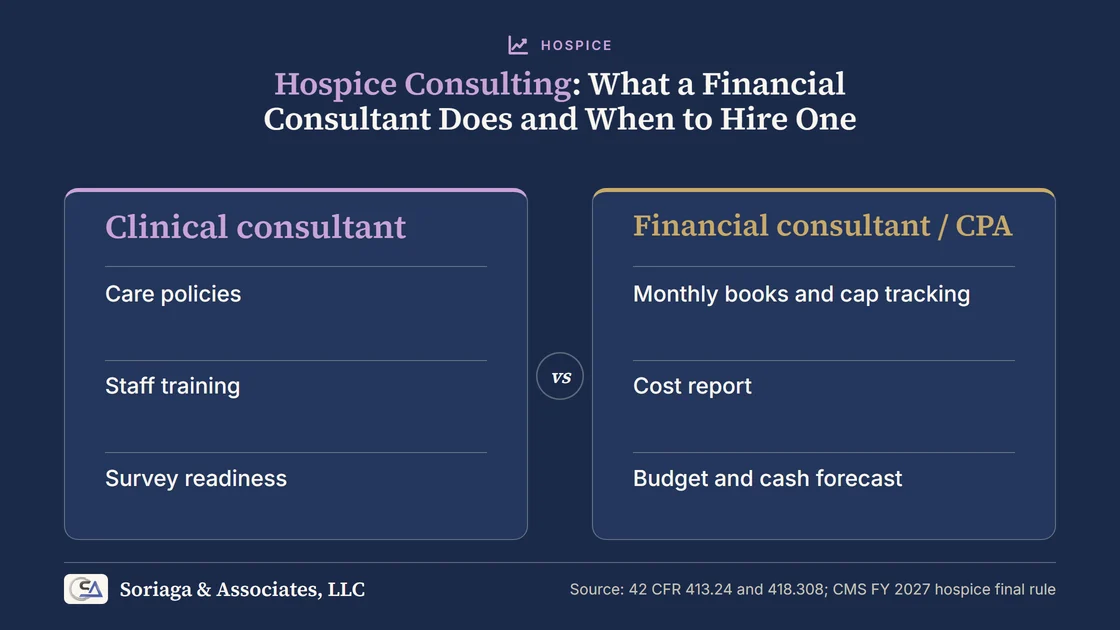
We are a CPA firm, so we do not build your medical record packet. Your clinical team does that. We help with the cash and the books while the review runs, through our hospice accounting services. Start with the checklist, then read the rest.
Key takeaways
- ADR means additional documentation request. A reviewer wants records before paying, or to support a claim already paid.
- The deadline is in your letter. The manual says 45 calendar days for a MAC, RAC or SMRC and 30 for a UPIC.
- Missing it means denial. The reviewer denies the claim as not reasonable and necessary (PIM Chapter 3).
- Send what proves eligibility: election statement, certification, face-to-face when needed, plan of care and visit notes (CGS checklist).
- Appeals have a clock too: 120 calendar days to ask for a redetermination (42 CFR 405.942).
- Cash is the hidden problem. Held or denied claims can hit payroll in weeks.
- We handle the money side. Book a free 20-minute call if an ADR just arrived.
Just got an ADR? Book a free 20-minute call and we will build your cash forecast while your clinical team builds the records.
What is a hospice ADR, and who sends it?
An ADR is a request for records. CGS, one of the MACs (Medicare Administrative Contractors, the companies that pay Medicare claims), says an ADR is generated when documentation is needed to decide a claim. You may get it by mail at the address on your Medicare enrollment, or in the MAC's portal.
Several groups can send one. The Program Integrity Manual names MACs, RACs (Recovery Audit Contractors), the SMRC (the Supplemental Medical Review Contractor), UPICs (Unified Program Integrity Contractors) and CERT (the contractor that measures improper payments). CGS says it may also send ADRs on behalf of UPICs, RACs and SMRCs, and then you follow the instructions in the letter.
An ADR is not a finding of fraud. It is a review step. But a denied claim is real money.
Illustrative example (not a real hospice): An ADR covers 12 claims of $9,000 each. If all 12 are held or denied, $108,000 in expected cash does not arrive. That could be most of a payroll cycle for a small hospice.
What to do: Log the date on the letter the day it arrives. Write down who sent it and the due date.
How long do I have to respond to a hospice ADR?
Use the date in the letter. The manual sets these time frames:
| Who sent the request | Time to respond | Source |
|---|---|---|
| MAC, RAC or SMRC | 45 calendar days | 42 CFR 405.903, 405.929; PIM Ch. 3 |
| UPIC | 30 calendar days | PIM Ch. 3 |
CGS says a medical review ADR must be received within 45 calendar days of the request. If nothing arrives by day 46, the claim denies. CGS also lists one exception for hospices. A request about an untimely notice of election gets 30 calendar days. If nothing arrives by day 31, the claim processes as submitted, and noncovered days or charges can apply.
Count from the date of the request, not the day you opened the mail. Send the records so they are received by the due date. Allow time for shipping, or use the electronic option your MAC offers.
The manual says contractors may accept late records for good cause. Good cause means things like natural disasters or other extenuating circumstances. That is the contractor's decision. Plan as if there is no extension.
What to do: Set an internal deadline 10 days before the official one. Use it for the final review.
What records do reviewers ask for in hospice?
Your letter lists what to send. CGS gives hospices a preferred order for a medical review response:
- The ADR letter and contact form
- The signed election statement, with any addenda
- The plan of care, with the physician certification and recertifications
- Face-to-face documentation, for the third and later benefit periods
- Physician orders
- Interdisciplinary group (IDG) reviews and plan of care updates, for each 15-day period in the billing period
- The initial assessment for the billing period
- Visit notes from nursing, social work, the chaplain and others
- Physician visit notes
- Other support, such as the admission assessment
The rules behind those items matter. The election statement must include items such as the hospice and attending physician, and the signature of the patient or representative (42 CFR 418.24). The written certification must be on file before you submit a claim. It must say life expectancy is 6 months or less if the illness runs its normal course. It must also have a short narrative of the clinical findings (42 CFR 418.22). A hospice physician or nurse practitioner must see the patient face to face before the third benefit period recertification, no more than 30 days before it (42 CFR 418.22).
Your clinical director and medical records staff put the packet together. Ask them to check signatures, dates and page order before sending.
What to do: Give your clinical team the list above today. Ask for a draft packet in one week.
What happens if I miss the deadline?
The reviewer denies the claim. The manual says the contractor denies it, in full or in part, as not reasonable and necessary. The remittance advice shows remark code M127, missing patient medical record.
For a claim that was already paid, a denial creates an overpayment. CGS says the money is then recouped, meaning taken from your future claim payments. A late response may still change the outcome, but it is no longer the clean path.
What to do: If your deadline passed, call your MAC at once. Ask what options remain, and start the appeal clock below.
How do I appeal a denial?
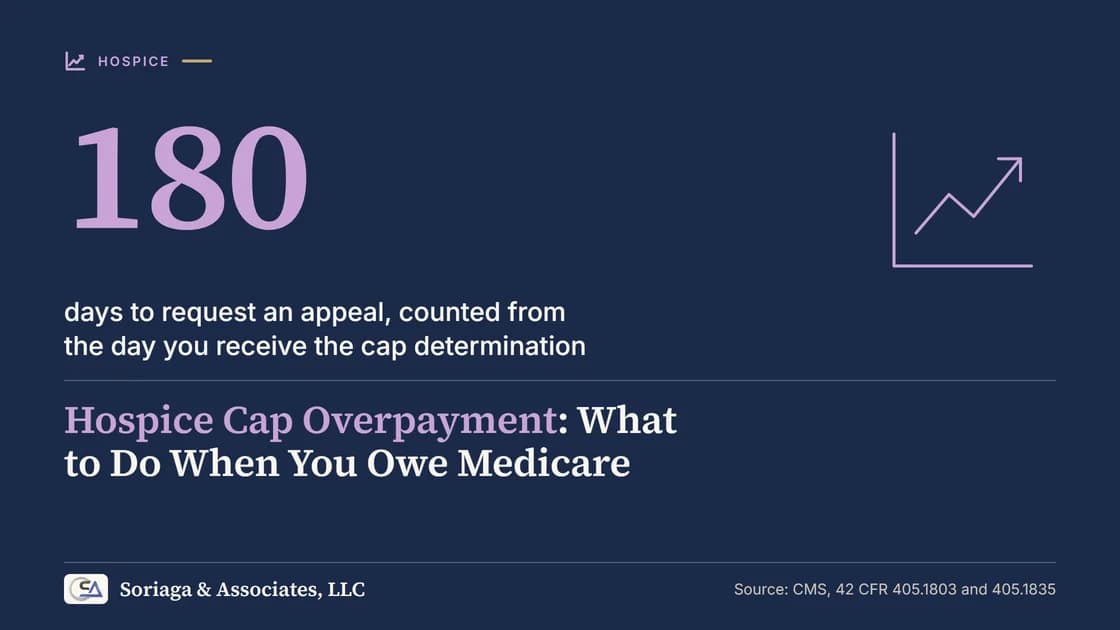
The first appeal level is a redetermination. You must file it within 120 calendar days from the date you receive the notice of the initial determination. Medicare presumes you got it 5 days after the notice date. A contractor can allow more time for good cause (42 CFR 405.942).
CGS also notes that a denial for missing documents can be reopened within 120 days of the denial. Ask your MAC which route fits your letter.
Keep the packet you sent and proof of the date it was received. A redetermination may use the same records, plus anything that fixes the gap.
Appeals can turn on legal and clinical points. Involve your healthcare counsel and your clinical director. We prepare the numbers.
What to do: Put the 120-day date on the calendar the day the denial arrives.
What is the money side of an ADR?
This is where we work. A review pulls cash out of your month in four ways.
- Claims on hold. Payment waits while the reviewer reads your records.
- Denials. Revenue you expected does not arrive.
- Recoupments. Medicare takes back money from later payments.
- Staff time. Your team stops other work to build the packet.
Here is what we set up for an owner with an open ADR:
- A 13-week cash forecast with the held claims removed and the possible denials flagged.
- A tracker for held and denied revenue, by claim, patient and due date.
- A recoupment log. It shows what Medicare took, from which payment, and why.
- Monthly books that stay current, so you see the effect while it happens.
- A cap and cost report check. Both use your Medicare payments. If payments change, the cap and the cost report change. The cap filing is due 5 months after the cap year ends (42 CFR 418.308), so we rerun it after the final result.
Our hospice accounting services include that monthly view. For the cap, see our hospice cap calculator. It is a planning tool, not a filing.
What to do: Ask your billing team for a list of every claim in the ADR, with amounts. Everything else builds from that list.
What should I do in the first week?
Use this order.
- Day 1: Log the date, sender and due date. Tell your administrator and clinical director.
- Day 2: Pull a list of the claims in the request, with amounts.
- Days 3 to 5: Your clinical team gathers the records in the CGS order.
- Day 5: Build the cash forecast with the held claims taken out.
- Day 7: Review a draft packet for signatures and dates.
- Before day 35: Send the packet, and keep proof of receipt.
Our most common finding at this stage is that the owner has no forecast yet. The records get attention, but the cash does not, until payroll week.
Want a CPA to build the cash forecast and track the claims? Book a free 20-minute call.
Frequently asked questions
What is a hospice ADR?
ADR stands for additional documentation request. It is a letter or portal notice that says a reviewer needs more records before Medicare pays a claim, or to support a claim it already paid.
How long do I have to respond to a hospice ADR?
For a MAC, RAC or SMRC request, Medicare's Program Integrity Manual says 45 calendar days. For a UPIC request it is 30 calendar days. The date in your letter controls, so use it.
What happens if I miss the ADR deadline?
The reviewer denies the claim, in full or in part, as not reasonable and necessary, with remark code M127 (missing patient medical record). A contractor may accept late records for good cause, but do not count on it.
Can I get an extension on an ADR?
The Program Integrity Manual lets contractors accept late records for good cause, such as a natural disaster or other extenuating circumstances. It is the contractor's call. Ask in writing, early.
How do I appeal a denied hospice claim?
File a redetermination request within 120 calendar days from the date you receive the notice. Medicare presumes you received it 5 days after the notice date (42 CFR 405.942).
Does an ADR change my hospice cap or cost report?
It can. The cap and the cost report use your Medicare payments. If a claim is denied, or paid money is taken back, those payments change. We recheck both after the final result.
Do you assemble the medical records for an ADR?
No. Your clinical team assembles the records. We handle the financial side: cash forecast, tracking held and denied revenue, recoupments, and the cap and cost report effects.
Next step
Book a free 20-minute call with Christian Soriaga, CPA. Bring the ADR letter and your last bank statement. We will build the cash view and set up tracking for the claims under review.
Sources
- CMS, Medicare Program Integrity Manual, Chapter 3 (sections 3.2.3.2 and following: time frames, good cause, no-response denials, contractor types)
- CGS Medicare, Additional Documentation Request (ADR) Overview (ADR definition, 45 and 30 day rules)
- CGS Medicare, Medical Review ADR Process: Postpayment Review (hospice document checklist, recoupment)
- eCFR, 42 CFR 405.942, Time frame for filing a request for a redetermination
- eCFR, 42 CFR 418.22, Certification of terminal illness
- eCFR, 42 CFR 418.24, Election of hospice care
- eCFR, 42 CFR 418.308, Limitation on the amount of hospice payments
Last updated: October 2026.
This article is general information, not legal or tax advice.
Soriaga & Associates, LLC is a CPA firm founded in 1985 in Lisle, Illinois, serving home health, hospice, home care, wound care and dental providers nationwide. (630) 491-1268.