Caregiver Payroll: Overtime, Travel Time and Live-In Rules for Home Care Agencies
Christian Soriaga, CPA13 min read
On this page
Quick answer: Caregiver payroll for a home care agency is a weekly overtime calculation, not a monthly pay run. Every hour a caregiver works, including paid travel between clients, counts toward the 40-hour line, and every payroll tax dollar rides on top of that wage.
Under 29 CFR 552.109, a third-party home care agency cannot claim the companionship or live-in overtime exemptions, and the employer side of a payroll dollar starts at 7.65% FICA plus 0.6% net FUTA on the first $7,000 per employee (IRS Publication 15, 2026).
Home care payroll looks simple until a caregiver covers three clients, drives between two of them and works a 24-hour shift in the same week. This guide covers what a private-duty (non-medical) agency owes under federal wage rules, what is still unsettled, and how to run payroll that survives an audit.
Key takeaways
- Overtime: under the 2013 rule (29 CFR 552.109), third-party agencies owe 1.5 times the regular rate after 40 hours in a workweek.
- Enforcement is paused, the rule is not repealed. DOL's July 25, 2025 bulletin (FAB 2025-4) tells its own investigators not to enforce the 2013 rule. The regulation is unchanged, and DOL's proposal to rescind it (RIN 1235-AA51) is not final as of October 2, 2026; a final rule is projected for November 2026.
- Travel between clients is paid time and counts toward overtime. Normal commuting to the first client does not.
- Sleep time: shifts under 24 hours are paid in full. On 24-hour shifts and live-in assignments, up to 8 hours of sleep can be excluded only with an agreement and proper sleeping facilities. Under 5 hours of sleep and the whole period is paid.
- Multiple clients, one week: hours are added up across all clients for the same agency, and different pay rates blend into a weighted-average regular rate.
- Contractor status: DOL has stopped applying its 2024 rule in its own investigations, but the rule still governs private lawsuits, and a February 27, 2026 proposal to replace it is not final.
- Payroll taxes: employer FICA is 7.65% and net FUTA is 0.6% on the first $7,000 per employee in 2026. SUTA varies by state and experience rating.
- Records: keep payroll records at least three years, time records at least two, and the sleep-time agreement for any live-in worker.
If your caregiver payroll runs on spreadsheets and memory, book a free 20-minute call and we will trace how a week flows from time records to paychecks.
Caregiver payroll starts with the 40-hour workweek
The Fair Labor Standards Act measures overtime one workweek at a time. DOL's regulation says each workweek stands alone and hours cannot be averaged over two or more weeks (29 CFR 778.104). A caregiver who works 52 hours one week and 28 the next is owed overtime for the first week, full stop.
Where the federal overtime rule stands
Status as of October 2, 2026:
| Item | Status | Source |
|---|---|---|
| 2013 domestic service rule (29 CFR 552.109): third-party employers cannot claim companionship or live-in overtime exemptions | Final rule, still in the regulations | eCFR, 29 CFR 552.109 |
| FAB 2025-4 (July 25, 2025): WHD suspends enforcement of the 2013 rule until the effective date of any final rule | In effect; internal guidance, does not change the regulation | DOL FAB 2025-4 |
| Proposal to rescind the 2013 rule and return to the 1975 regulations | Proposed rule, published July 2, 2025 (90 FR 28976); comments closed September 2025 | Federal Register 2025-12316 |
| Final rule (RIN 1235-AA51) | Not published as of October 2, 2026. DOL's 2026 Regulatory Plan (August 14, 2026) lists it at the final rule stage with a target of November 2026 | Federal Register search; 2026 Regulatory Plan |
A projected date on the regulatory agenda is a target, not a commitment.
Why to budget for overtime anyway
FAB 2025-4 is a federal enforcement position, not a change in the law. It says it is internal guidance that "does not alter any statutory or regulatory requirements," and it ends on the effective date of a final rule. The FLSA separately lets employees sue their employer in federal or state court (29 U.S.C. 216(b)), and it does not excuse noncompliance with a higher state minimum wage or shorter state maximum workweek (29 U.S.C. 218(a)).
Our view, not a legal conclusion: pay overtime until employment counsel has cleared a different policy for your state, and revisit it if the rescission becomes final.
Travel time, split shifts and gaps between clients
Travel between clients is hours worked
DOL's regulation is direct: travel from job site to job site during the workday is hours worked (29 CFR 785.38). DOL's domestic service fact sheet (79D) applies this to travel between several clients and puts the duty to pay it on the third-party employer. Normal home-to-work travel is not paid, whether the caregiver works at a fixed site or different sites. DOL's home care FAQ adds that if a caregiver is relieved of duty between assignments long enough for personal pursuits, only the necessary travel time is paid, not the whole gap.
In payroll, record drive time as its own entry, count it before testing for overtime, and set its pay rate in writing, because that rate feeds the regular-rate calculation below.
Split shifts and waiting time
Caregivers often get a morning visit, a gap and an evening visit. Time between visits is not automatically paid. Fact Sheet 79D separates workers who are "engaged to wait" (paid, even if they read or knit while waiting) from workers completely relieved of duty (unpaid). A caregiver who must stay near a client is working. A caregiver who goes home with no duties is not. State law may be stricter, so confirm each state's standard before you build a split-shift pay plan.
Live-in and 24-hour shifts
What the rules allow
A "live-in" worker, in DOL's fact sheet, lives and sleeps on the premises permanently (seven days a week) or for extended periods (five days a week, 120 hours or more). A 24-hour shift alone does not make someone a live-in. Under the 2013 rule, third-party employers cannot claim the live-in overtime exemption, so they owe minimum wage for all hours worked and 1.5 times the regular rate over 40 hours (29 CFR 552.109(c); Fact Sheet 79B).
Sleep time follows different rules for each type of shift (DOL Field Assistance Bulletin 2016-1):
| Situation | When sleep time can be excluded | Source |
|---|---|---|
| Shift under 24 hours | Never. All on-duty time is paid, even if the caregiver sleeps | 29 CFR 785.21 |
| 24-hour or longer shift, not a live-in | Express or implied agreement, adequate sleeping facilities, and the caregiver can usually get an uninterrupted night's sleep (DOL: 5 consecutive hours). Up to 8 hours in a regularly scheduled window | 29 CFR 785.22(a); FAB 2016-1 |
| Live-in | Reasonable agreement (normally written) and private quarters in a homelike environment. For extended-period live-ins, up to 8 hours a night, and only if at least 8 hours are paid in that 24-hour period | 29 CFR 552.102, 785.23; FAB 2016-1 |
| Any night, either type | Each interruption for a call to duty is paid. Under 5 hours of total sleep and the whole sleep period is paid | 29 CFR 785.22(b), 552.102; FAB 2016-1 |
Records for live-in staff
The employer must keep a copy of the agreement and a record of the exact hours worked, and the usual exception in 29 CFR 516.2(c) does not apply (29 CFR 552.110). The caregiver may log hours, but the responsibility is yours. If actual hours drift significantly from the agreement, the parties should write a new one (29 CFR 552.102). A 24-hour assignment is three data points: scheduled hours, sleep time excluded, and each night-time interruption. Without the interruption log you cannot show the 5-hour test was met.
Multiple clients, one caregiver: blending overtime and joint employment
One agency, several clients, one workweek
DOL's FAQ is explicit: if one agency places a worker with two clients totaling over 40 hours in a week, overtime applies, and if separate agencies employ the worker, each agency's hours are calculated independently. Do not run payroll client by client. Run it caregiver by caregiver and week by week.
When the client-specific pay rates differ, the regular rate is the weighted average: total straight-time earnings divided by total hours (29 CFR 778.115).
| Step | Calculation | Result |
|---|---|---|
| Client A hours and rate | 28 hours x $18.00 | $504.00 |
| Client B hours and rate | 20 hours x $20.00 | $400.00 |
| Straight-time pay, 48 hours | $504.00 + $400.00 | $904.00 |
| Weighted-average regular rate | $904.00 / 48 hours | $18.8333 |
| Overtime premium | 8 hours x 0.5 x $18.8333 | $75.33 |
| Total weekly pay | $904.00 + $75.33 | $979.33 |
Illustrative calculation, not a published figure.
Add paid travel and the same logic applies. A caregiver with 38 client hours and 3 paid travel hours at the same $18.00 rate has 41 hours: 41 x $18.00 = $738.00 plus a $9.00 premium (1 x 0.5 x $18.00) = $747.00. Illustrative calculation, not a published figure. Without the travel line, she looks under 40 and the overtime never gets paid.
A payroll system that pays each client's hours as separate pay codes with no weekly roll-up can pay overtime on the wrong rate or miss it.
Joint employment
DOL's home care FAQ notes that an agency that sends a direct care worker to a client's home may be a joint employer with the household, and that EVV data is one factor, with "no precise formula." DOL also proposed a joint employer rule on April 23, 2026 (RIN 1235-AA48; comments closed June 22, 2026). It would look at who hires or fires, controls schedules, sets pay and keeps records. It is a proposal; no final rule had been published in the Federal Register as of October 2, 2026.
Our view, not a legal conclusion: for a typical agency nothing changes. You hire, schedule, pay and keep the records, so those hours belong in your payroll. Two related entities that share caregivers are the case to take to counsel.
Running caregivers across several entities or states? Book a free 20-minute call and we will map your pay codes against what the weekly calculation needs.
W-2 or 1099 for caregivers
Almost every caregiver an agency sends to a client should be on a W-2. Two separate tests apply.
DOL (FLSA). DOL published a final rule on January 10, 2024, effective March 11, 2024. On May 1, 2025, Field Assistance Bulletin 2025-1 said investigators would no longer apply that rule and would use Fact Sheet 13 (July 2008) instead, while noting the 2024 rule remains in effect for private litigation. On February 27, 2026, DOL proposed to rescind the 2024 rule and replace it with an economic-reality analysis (91 FR 9932); comments closed April 28, 2026. No final rule had been published as of October 2, 2026.
IRS. The IRS looks at behavioral control, financial control and the type of relationship, and says no single factor decides it. The DOL proposal does not change that test.
A caregiver who takes assignments you set, at the client you chose, at the rate you set, on your schedule, fits poorly under any version of either test. If you have caregivers on 1099 today, talk to an employment attorney before the next payroll quarter rather than after a claim.
What a caregiver hour really costs
The federal payroll tax pieces
| Item | 2026 figure | Source |
|---|---|---|
| Employer Social Security | 6.2% | IRS Publication 15 (2026) |
| Employer Medicare | 1.45% | IRS Publication 15 (2026) |
| Employer FICA total | 7.65% | Sum of the two lines above |
| FUTA, after the maximum 5.4% credit | 0.6% on the first $7,000 per employee, or $42 per employee | IRS Publication 15 (2026) |
| SUTA | Set by each state; rate and wage base vary | Your state workforce agency notice |
FUTA is a small fixed cost per person, so a high-turnover roster costs more in FUTA and SUTA than the same hours worked by fewer people. Workers' compensation, benefits and paid time off sit on top.
Illustrative loaded cost per hour
All rates below are assumptions for illustration. Your SUTA rate, workers' compensation class and benefits will differ.
| Line | Straight-time hour | Overtime hour (1.5x) |
|---|---|---|
| Wage (assumed $18.00 base) | $18.00 | $27.00 |
| Employer FICA at 7.65% | $1.38 | $2.07 |
| FUTA ($42 spread over assumed 1,560 hours a year) | $0.03 | $0.00 (extra hour adds no FUTA once $7,000 is reached) |
| SUTA (assumed 1.5% effective rate) | $0.27 | $0.41 |
| Workers' compensation (assumed 4.5% of wages) | $0.81 | $1.22 |
| Loaded cost per hour | $20.49 | $30.70 |
Illustrative calculation, not a published figure.
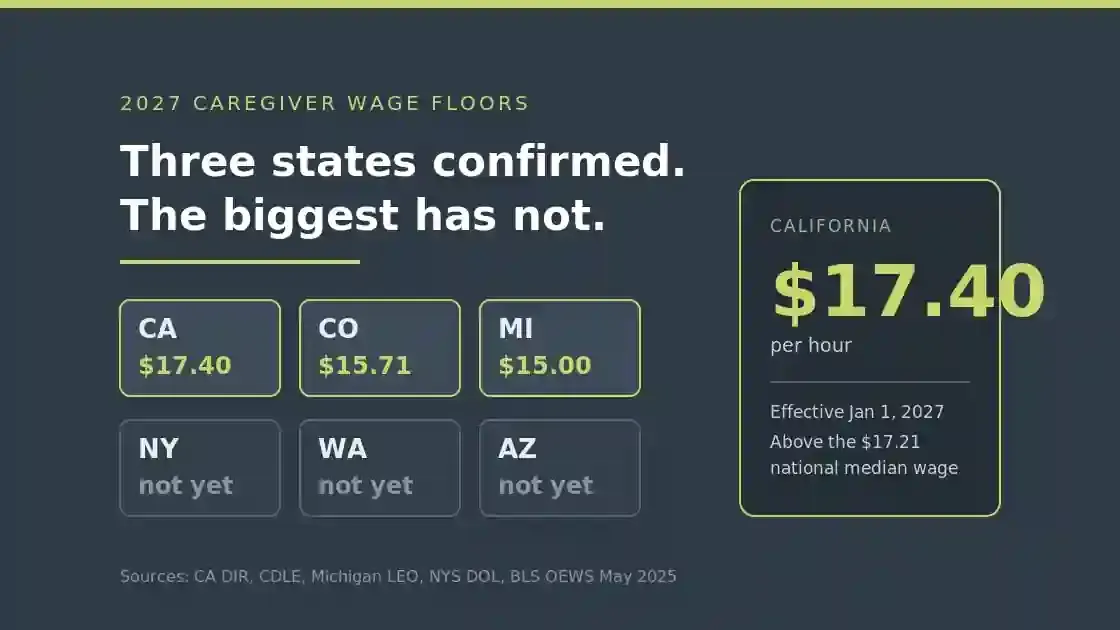
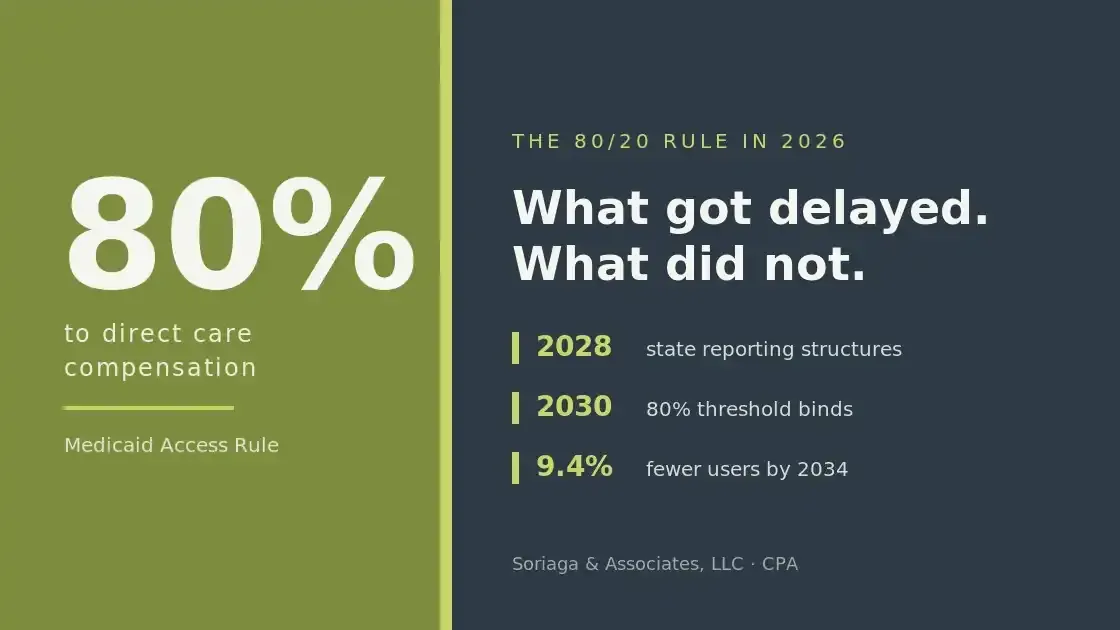
In this example an overtime hour costs $10.21 more than a straight-time hour, and $2.49 per straight-time hour (about 14% of wages) is tax and insurance that never shows on the paycheck. For pricing, model cost by caregiver, not by agency average. For the wage side of that model, see 2027 caregiver wage floors, and for caregiver pay on Medicaid-funded work, see the Medicaid 80/20 rule.
Time records that feed payroll
DOL's recordkeeping fact sheet requires payroll records for at least three years and the records behind wage computations, such as time cards, wage rate tables and schedules, for at least two.
If any of your clients are on Medicaid, the 21st Century Cures Act (section 12006(a)) requires states to implement electronic visit verification for Medicaid personal care services (effective January 1, 2020) and home health care services (January 1, 2023), with federal matching-rate reductions of up to 1% for states that do not comply. That mandate covers Medicaid-funded services, so a private-pay client may not be covered, but one clean time source for every visit is easier than two. Reconcile EVV clock-ins against payroll hours each pay period, and add what EVV does not capture (travel, sleep-time interruptions, training).
Clean time records also make the books easier to close. Our bookkeeping services tie payroll journal entries to the general ledger so labor cost by client or branch is a report, not a rebuild.
Caregiver payroll checklist
- Define the workweek once and use it in scheduling, EVV and payroll.
- Roll up hours by caregiver and week across all clients before testing for overtime.
- Pay and track travel between clients as its own time entry, and count it toward 40 hours.
- Calculate the regular rate as total straight-time pay divided by total hours when client rates differ.
- Pay every hour of shifts under 24 hours, even if the caregiver sleeps.
- For live-in and 24-hour work, keep the sleep-time agreement, scheduled sleep period and an interruption log.
- Review each caregiver's status (W-2 or 1099) and move misclassified caregivers to W-2 on a planned date.
- Deposit and file FICA and FUTA on schedule, and know your state SUTA rate and wage base each January.
- Keep records at least three years (payroll, including live-in agreements) and two years (time records).
- Track the DOL final rule (RIN 1235-AA51, targeted for November 2026) and your state's rules, and change pay policy only after counsel signs off.
Getting this right every week is the point of a payroll retainer. Our payroll services are part of monthly retainers that start at $200 per month, and our home care accounting services cover the rest of the back office for private-duty agencies.
Frequently asked questions
Do home care agencies have to pay caregivers overtime?
The 2013 federal rule still on the books requires third-party agencies to pay 1.5 times the regular rate after 40 hours in a workweek. DOL has paused its own enforcement while it works on a final rule, but the pause does not change the regulation, caregivers can still sue, and stricter state laws still apply. Budget for overtime.
Is travel time between clients paid?
Yes. DOL's regulation says travel from job site to job site during the workday counts as hours worked. Normal home-to-first-client commuting does not. Those travel hours also count toward the 40-hour overtime threshold, so a caregiver with back-to-back visits can reach overtime faster than client hours alone suggest.
How does overtime work if a caregiver covers several clients in one week?
All hours worked for one agency are added together for the week. If the client pay rates differ, DOL's regulation uses the weighted average of the rates as the regular rate. Overtime is half of that rate for each hour past 40. Weeks are never averaged against each other.
Can I treat caregivers as 1099 contractors?
Rarely. Caregivers who work on your schedule, for your clients, at your rates look like employees under both the IRS and DOL tests. DOL's February 2026 contractor rule is only a proposal, and the IRS applies its own control test. Misclassification puts back wages and payroll taxes on you.
Next step
If your caregiver payroll is built on spreadsheets, or you are not sure travel and overtime are being calculated by caregiver and week, book a free 20-minute consultation. We will review a recent pay period with you and tell you what a payroll retainer would take off your plate.
Sources
- eCFR, 29 CFR 552.102, 552.109 and 552.110 (domestic service)
- eCFR, 29 CFR 785.21, 785.22, 785.23 and 785.38 (hours worked)
- eCFR, 29 CFR 778.104 and 778.115 (workweek and regular rate)
- 29 U.S.C. 216 and 29 U.S.C. 218 (govinfo)
- DOL Home Care Rule page and Home Care Rule FAQs
- DOL Fact Sheets #79B, live-in workers, #79D, hours worked and #21, recordkeeping
- DOL Field Assistance Bulletins 2016-1, sleep time, 2025-1, contractor enforcement and 2025-4, home care enforcement
- Federal Register, domestic service proposed rule, July 2, 2025 (90 FR 28976)
- Unified Agenda, RIN 1235-AA51 (reginfo.gov) and 2026 Unified Agenda and Regulatory Plan (Federal Register)
- Federal Register, independent contractor proposed rule, February 27, 2026 (91 FR 9932) and DOL 2026 rulemaking page
- DOL, joint employer proposed rule, RIN 1235-AA48
- IRS Publication 15 (2026) and IRS, independent contractor or employee
- Medicaid.gov, electronic visit verification
Last updated: October 2026.
This article is general information, not legal or tax advice.
Soriaga & Associates, LLC is a CPA firm founded in 1985 in Lisle, Illinois, serving home health, hospice, home care, wound care and dental providers nationwide. (630) 491-1268.