Home Care Business Plan: How to Build 3-Year Financial Projections
Christian Soriaga, CPA13 min read
On this page
Quick answer: The financial section of a home care business plan is built from one chain: billable hours times bill rate gives revenue, caregiver wages plus the taxes and insurance that ride on them give direct cost, and overhead plus the timing of payer payments decide how much cash you need. Model that chain for three years and find your break-even.
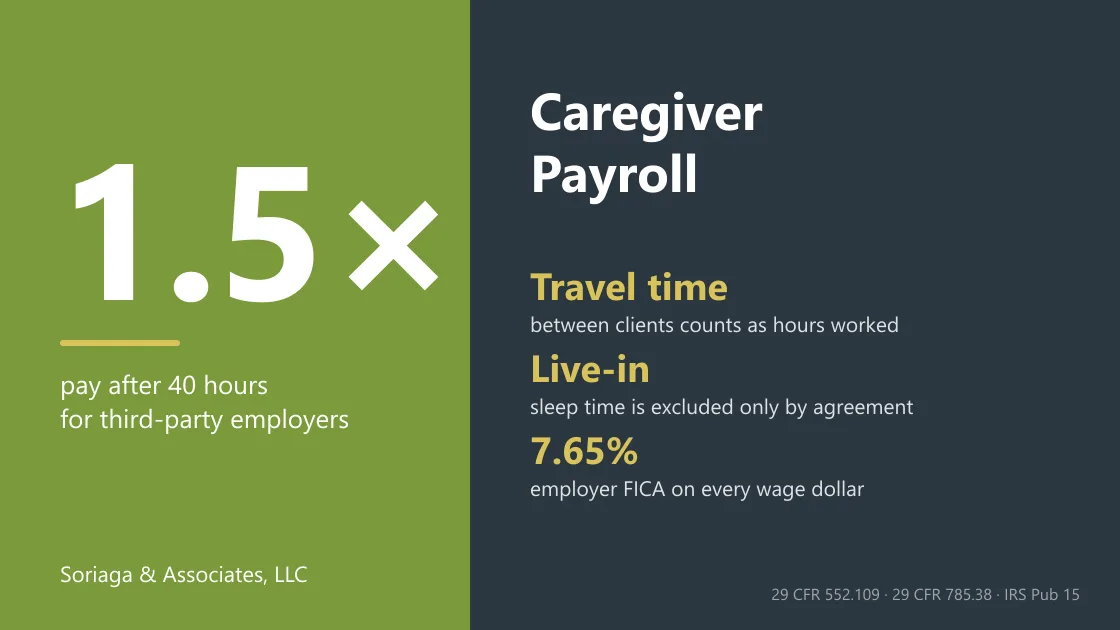
Every caregiver you hire costs you 7.65% employer FICA plus 0.6% net federal unemployment tax on the first $7,000 of wages, before state unemployment, workers' comp and overtime (IRS Publication 15, 2026).
The projections are where most plans for a private-duty agency fall apart. This guide walks through each input for a non-medical agency and ends with a labeled 3-year example you can copy into a spreadsheet and replace with your own numbers.
Key takeaways
- Revenue is hours times rate. Billable hours per week times the net bill rate by payer is the whole top line.
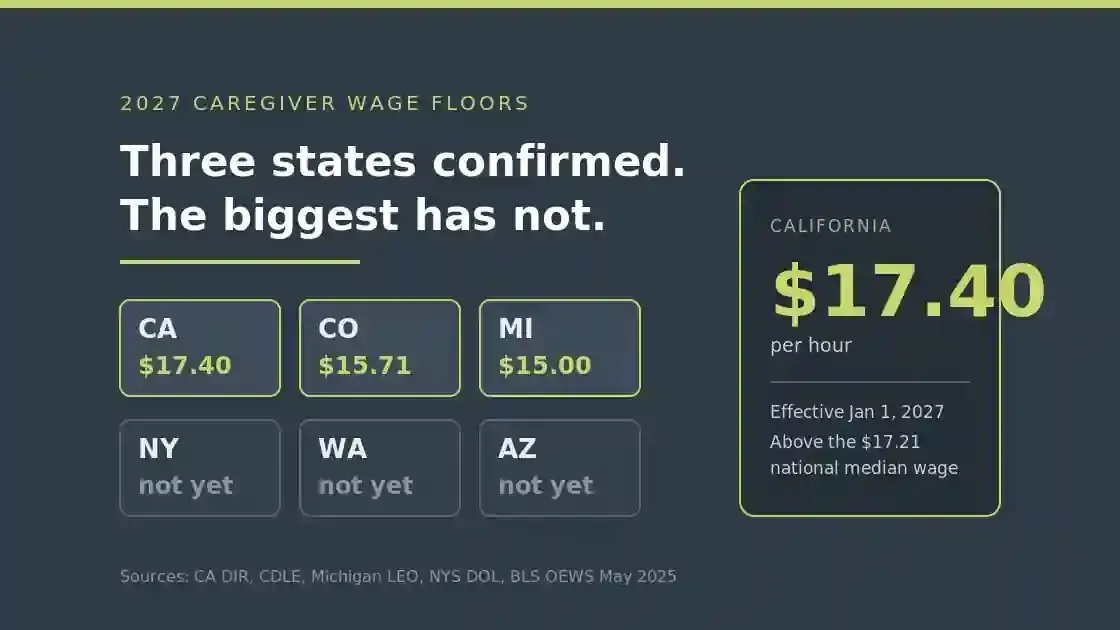
- Wages have a floor. Illinois's minimum wage is $15.00 an hour, and BLS reports a $17.21 median hourly wage for home health and personal care aides (May 2025).
- Overtime belongs in the plan. 29 CFR 552.109 still bars third-party agencies from the companionship and live-in overtime exemptions, even though DOL has paused its own enforcement.
- Payroll taxes are modelable. FICA is 7.65%, and FUTA is 6.0% less up to a 5.4% credit on the first $7,000 per employee (IRS Publication 15, 2026).
- Medicaid waiver hours carry a pass-through rule. States must ensure providers spend 80% of payments on direct care worker pay, beginning 6 years after July 9, 2024 (42 CFR 441.302(k)).
- Cash arrives after payroll. A plan that shows a profit can still run out of money.
Opening your agency in the next 90 days? Book a free 20-minute call and bring your draft projections. We will tell you which assumptions a lender will question and what to set up before your first payroll.
What the financial section has to answer
SBA's guide asks for a prospective financial outlook for the next five years: forecasted income statements, balance sheets, cash flow statements and capital expenditure budgets. It says to be more specific in the first year, with quarterly or even monthly projections (SBA, Write your business plan). We model three years in detail because past that point most inputs are guesses. If a lender wants five, extend the same model.
Home care business plan revenue: billable hours times bill rate
Start with weekly billable hours, not number of clients. Hours are what you pay caregivers for and what you bill.
Revenue = average billable hours per week x 52 x net bill rate.
Forecast the census month by month for year one: hours at the start, hours added, hours lost. Do not assume every client stays. Write down your referral and retention assumptions so a lender can challenge them.
Payer mix changes the rate you actually collect
Your bill rate is a blend. For each payer, ask what you net per hour and how long it takes to get paid.
| Payer | What to model | Source or note |
|---|---|---|
| Private pay | Your own rate card and terms | Your pricing decision |
| Long-term care insurance | Limits come from each client's policy; confirm how and when you are paid before accepting the client | Ask the carrier |
| Medicaid waiver and state-funded programs | The state sets rate and billing rules; the 80% rule applies | 42 CFR 441.302(k) |
| VA Homemaker and Home Health Aide | Aides work for organizations under contract with VA; a VA social worker arranges services | VA program brochure |
On Medicaid hours, the federal rule says a state must ensure each provider spends 80 percent of the payments it receives for homemaker, home health aide or personal care services on direct care worker compensation. Compliance starts 6 years after July 9, 2024, and states can set a lower percentage for small providers or exempt some providers in hardship (42 CFR 441.302(k)(3), (4), (5), (8)). Your plan must show how overhead and profit fit inside the remaining share. Our post on the Medicaid 80/20 rule covers the timeline.
Illustrative, not a published figure: assume half your hours are private pay at $36.00, 30% are long-term care insurance at $34.00 and 20% are state-funded at $24.00. The blended rate is 0.50 x $36.00 + 0.30 x $34.00 + 0.20 x $24.00 = $33.00 per billable hour. We use $33.00 in the model below. These rates are made up for the example. Use your own.
Caregiver wages and overtime
Wage floor. Illinois's minimum wage is $15.00 an hour for workers 18 and older, effective January 1, 2025, and the Illinois Department of Labor's 2026 rights poster still lists $15.00 (Illinois Department of Labor). Check whether a city or county where you operate sets a higher rate.
Reference point. BLS reports a median of $17.21 an hour for home health and personal care aides in May 2025 (BLS Occupational Outlook Handbook). It is a national median, not a quote for your market, so use it only as a check on your own wage assumption.
Overtime. Under 29 CFR 552.109, third-party employers such as home care agencies may not claim the companionship or live-in overtime exemptions. On July 25, 2025, DOL's Wage and Hour Division told investigators to stop enforcing the 2013 rule until the effective date of any final rule (FAB 2025-4), and DOL proposed to rescind the rule on July 2, 2025 (90 FR 28976). As of October 9, 2026, a Federal Register search shows the proposal but no final rule. We would still budget overtime, because a pause in enforcement is not a change to the regulation. Our caregiver payroll guide covers travel time, blended overtime rates and live-in shifts.
Model three wage inputs: the base wage, hours paid but not billed (drive time, orientation, training), and the share of hours above 40 a week.
Employer payroll taxes and insurance
| Cost | How to model it | Source |
|---|---|---|
| Employer Social Security | 6.2% of wages up to the wage base ($184,500 in 2026) | IRS Publication 15 (2026) |
| Employer Medicare | 1.45% of wages, no wage base limit | IRS Publication 15 (2026) |
| Federal unemployment (FUTA) | 6.0%, less up to a 5.4% credit for state unemployment tax paid, so 0.6% net, on the first $7,000 per employee | IRS Publication 15 (2026) |
| State unemployment (SUTA) | Your rate and wage base come from your state notice. | Your state workforce agency |
| Workers' compensation | Required in Illinois from the first employee. Premium depends on your carrier and classification. | Illinois Workers' Compensation Commission |
| General and professional liability | Get quotes. Insurers will ask about services, hours and screening. | Insurance quotes |
The Illinois Workers' Compensation Commission says an employer with one employee, even a part-timer, must have workers' compensation insurance, and only a workers' compensation policy meets the requirement. Get quotes before you submit the plan to a lender.
FUTA applies to only the first $7,000 per person, so it is a per-caregiver cost, not a percentage of revenue. Turnover means paying it again for each new hire.
Startup costs: what to count before the first client
SBA separates one-time costs from monthly costs, says to count at least one year of monthly expenses, and suggests adding about 10% to a break-even analysis for unpredictable costs (SBA, Calculate your startup costs).
For an Illinois non-medical agency, add the state license. Illinois licenses home services agencies under the Home Health, Home Services, and Home Nursing Agency Licensing Act (210 ILCS 55) and the rules at 77 Ill. Adm. Code 245. IDPH's application form calls the home services license a non-medical service license that does not allow skilled services. The same form lists a $1,500 license fee, which is non-refundable (IDPH Form 445104, updated August 2023; confirm the current fee with IDPH). IDPH says it reviews the application within 30 days, that approval or denial of a provisional license should take no more than 90 days, and that the provisional license is valid for 240 days. Put 90 days of pre-opening time in your plan before any revenue arrives.
One-time items to price: entity formation and legal review, the IDPH license, caregiver background checks (IDPH points applicants to 77 Ill. Adm. Code 955), scheduling and billing software setup, insurance deposits and launch marketing. Get a quote for each, or label it an estimate.
A 3-year home care business plan projection (illustrative example)
Below is a worked example. Everything in this section is illustrative, not a published figure. The inputs are our assumptions for a hypothetical Illinois private-duty agency, chosen to show the mechanics. They are not benchmarks, and no real agency's results are implied.
The assumptions
| Input | Assumption |
|---|---|
| Net bill rate | $33.00 per billable hour (blended, from the payer-mix example) |
| Caregiver base wage | $18.00 per paid hour |
| Paid hours vs. billable hours | Paid hours are 5% higher (drive time, training) |
| Overtime | 3% of paid hours, with a half-time premium on the $18.00 wage |
| Employer FICA | 7.65% of wages |
| FUTA | $42 per caregiver (0.6% x $7,000) |
| SUTA | 2.0% of wages (assumed; use your state notice) |
| Workers' compensation | 6.0% of wages (assumed; use your quote) |
| Billable hours per caregiver | 22 per week, so caregiver headcount is hours divided by 22 |
| Other variable costs | 3.0% of revenue (screening, supplies, payment fees) |
| Administrative payroll | Taxes and benefits at 12% on top of salary |
Average billable hours per week: 150 in year 1, 450 in year 2, 800 in year 3. Year 1 is an average across a ramp that starts near zero.
The results
| Year 1 | Year 2 | Year 3 | |
|---|---|---|---|
| Billable hours per year | 7,800 | 23,400 | 41,600 |
| Revenue | $257,400 | $772,200 | $1,372,800 |
| Caregiver wages incl. overtime premium | $149,631 | $448,894 | $798,034 |
| Employer FICA | $11,447 | $34,340 | $61,050 |
| SUTA | $2,993 | $8,978 | $15,961 |
| FUTA | $294 | $882 | $1,554 |
| Workers' compensation | $8,978 | $26,934 | $47,882 |
| Direct caregiver cost | $173,343 | $520,028 | $924,480 |
| Gross profit | $84,057 | $252,172 | $448,320 |
| Administrative salaries ($65,000 / $120,000 / $165,000) plus 12% | $72,800 | $134,400 | $184,800 |
| Rent, software, marketing, professional fees, licensing, liability insurance | $62,400 | $86,900 | $110,800 |
| Other variable costs (3% of revenue) | $7,722 | $23,166 | $41,184 |
| Operating profit (loss) before income tax | ($58,865) | $7,706 | $111,536 |
The administrative line includes the owner's pay, so operating profit is what remains after paying the owner a salary.
What this example shows
- Direct cost works out to $22.22 per billable hour in every year, because the assumptions are proportional to hours. Gross profit per billable hour is $10.78 in every year. The only thing that changes is how many hours there are to spread overhead over.
- Year 1 loses money even with a reasonable rate, because overhead exists before the hours do.
- Small changes swing year 2 hard. With the same assumptions, a $1.00 higher caregiver wage cuts year 2 operating profit by about $28,800, taking it from $7,706 to a loss of about $21,100. Overtime at 8% of paid hours instead of 3% cuts it by about $12,800. A $1.00 higher bill rate adds about $22,700.
Run a base case, a slower-ramp case and a higher-wage case, and show the lender all three.
Break-even for a home care agency
Break-even hours are fixed costs divided by what each billable hour contributes after variable costs.
In the example, each billable hour contributes $9.79: the $33.00 bill rate, less $22.22 of direct caregiver cost, less $0.99 of other variable cost (3% of the bill rate).
| Year 1 | Year 2 | Year 3 | |
|---|---|---|---|
| Fixed costs (administrative payroll plus overhead lines) | $135,200 | $221,300 | $295,600 |
| Break-even billable hours per week | about 266 | about 435 | about 581 |
| Planned average billable hours per week | 150 | 450 | 800 |
Illustrative, not a published figure. Year 1 needs about 266 hours a week and averages 150, so it loses money. In year 2 the cost structure is bigger, and 450 planned hours barely clears the 435 required. Each administrative hire moves break-even up, so state the weekly hours at which each hire pays for itself.
Cash flow: the timing problem a profit forecast hides
A profit and loss statement counts an hour of care when you deliver it. Your bank sees it when the payer pays.
Illustrative, not a published figure: suppose it takes six weeks on average between paying a caregiver for an hour and collecting for it. Year 2 direct caregiver cost of $520,028 is about $10,000 a week, so you would be carrying about $60,000 of payroll cost, taxes and insurance before cash comes back. The same six-week lag is about $20,000 in year 1 and about $106,700 in year 3.
Using the example, a simple funding estimate for year 1 looks like this:
| Item | Amount |
|---|---|
| Year 1 operating loss | $58,865 |
| Working capital (six weeks of year 1 direct cost) | $20,000 |
| One-time startup costs (assumed) | $10,000 |
| Subtotal | $88,865 |
| Cushion of 10% (SBA's suggested buffer for break-even analysis) | $8,887 |
| Illustrative funding need | about $97,800 |
This understates the true peak, because an annual loss nets early months against later ones. Build the monthly cash flow for year 1 and find the lowest balance before you ask for money. Our home care accounting services include cash flow planning for private-duty agencies. Or book a free 20-minute call and we will build the first version with you.
What lenders and the SBA look for in a home care business plan
SBA does not publish a pass/fail formula for projections. Its guidance says:
- Lenders and investors compare expected costs to projected revenue (SBA, Calculate your startup costs).
- Break-even analysis is an important part of a plan presented to a potential investor, and projections should match your funding request (SBA, Write your business plan).
- For 7(a) loans, proceeds can fund working capital, the maximum is $5 million, and the borrower must be creditworthy and show a reasonable ability to repay (SBA, 7(a) loans).
Our view, not an SBA rule: expect a lender to test your census ramp, your wage assumption and how long you can survive a slow start. Ask your lender for its own checklist before you finish.
Mistakes we would fix first: revenue built on client count instead of hours; no overtime, travel or orientation hours in the wage line; one flat payroll tax percentage with no FUTA cap or workers' comp quote; no monthly cash flow; and overhead that does not grow with the census.
Building a plan for a lender or an investor? Book a free 20-minute call. We will review your assumptions and tell you which ones need support.
Frequently asked questions
What should the financial section of a home care business plan include?
SBA's plan guide lists forecasted income statements, balance sheets, cash flow statements and a funding request that matches your projections, with the first year broken out quarterly or monthly. For a home care agency, build those from billable hours, bill rate, caregiver wages, payroll taxes, insurance and the timing of when payers actually pay you.
How much money do I need to start a home care agency?
It depends on your census ramp, wages, license and insurance quotes, and how fast your payers pay. Do not borrow a number from someone else's agency. Build it from your own model: first-year operating loss, one-time startup costs, enough working capital to cover payroll until payers pay, and a cushion for surprises.
How many billable hours do I need to break even?
Divide your fixed monthly or annual costs by the contribution you earn on each billable hour (bill rate minus caregiver cost per billable hour and other variable costs). In our illustrative model that works out to about 266 hours a week on the first-year cost structure, but your wages, rates and overhead will give a different answer.
Do I have to pay caregivers overtime?
Plan for it. The 2013 federal rule at 29 CFR 552.109 still stops third-party agencies from claiming the companionship and live-in overtime exemptions. DOL told its investigators in July 2025 not to enforce it while it considers rescinding it, but the regulation remains on the books and your state rules may differ. Budget overtime into your wage line.
Next step
If you are writing a home care business plan, book a free 20-minute call with Christian Soriaga, CPA and bring your draft assumptions. Once you open, our home care accounting services can take over the monthly books and payroll.
Sources
- SBA, Write your business plan
- SBA, Calculate your startup costs
- SBA, 7(a) loans
- IRS, Publication 15 (Circular E), Employer's Tax Guide (2026)
- eCFR, 29 CFR 552.109, Third party employers
- DOL Wage and Hour Division, Field Assistance Bulletin 2025-4, Home Care Enforcement Guidance (July 25, 2025)
- DOL, Home Care Rule page
- Federal Register, Application of the Fair Labor Standards Act to Domestic Service, proposed rule (July 2, 2025)
- eCFR, 42 CFR 441.302(k), Medicaid home and community-based services compensation standard
- Illinois Department of Labor, Minimum Wage Law and 2026 Your Rights Under Illinois Employment Laws poster
- BLS, Occupational Outlook Handbook: Home Health and Personal Care Aides
- Illinois Workers' Compensation Commission, Insurance
- IDPH, Home Services Agencies and Home Services Agencies FAQ
- IDPH, Home Services Application (Form 445104, non-medical license and $1,500 fee)
- VA, Homemaker and Home Health Aide Care
Last updated: October 2026.
This article is general information, not legal or tax advice.
Soriaga & Associates, LLC is a CPA firm founded in 1985 in Lisle, Illinois, serving home health, hospice, home care, wound care and dental providers nationwide. (630) 491-1268.