Home Health Agency Business Plan: The 2026 Financial Guide for a Medicare-Certified Agency
Christian Soriaga, CPA14 min read
On this page
Quick answer: The financial section of a home health agency business plan has to prove three things. You can fund the Medicare reserve. You can pay staff until Medicare pays you. And your visit and payment math holds up. Build a monthly cash forecast, a startup budget and a revenue model based on Medicare's 30-day payment periods.
To enter Medicare, a new home health agency must show initial reserve operating funds equal to its projected costs for the first three months of billing, and at least half must be non-borrowed money (42 CFR 489.28, eCFR, current as of October 29, 2026).
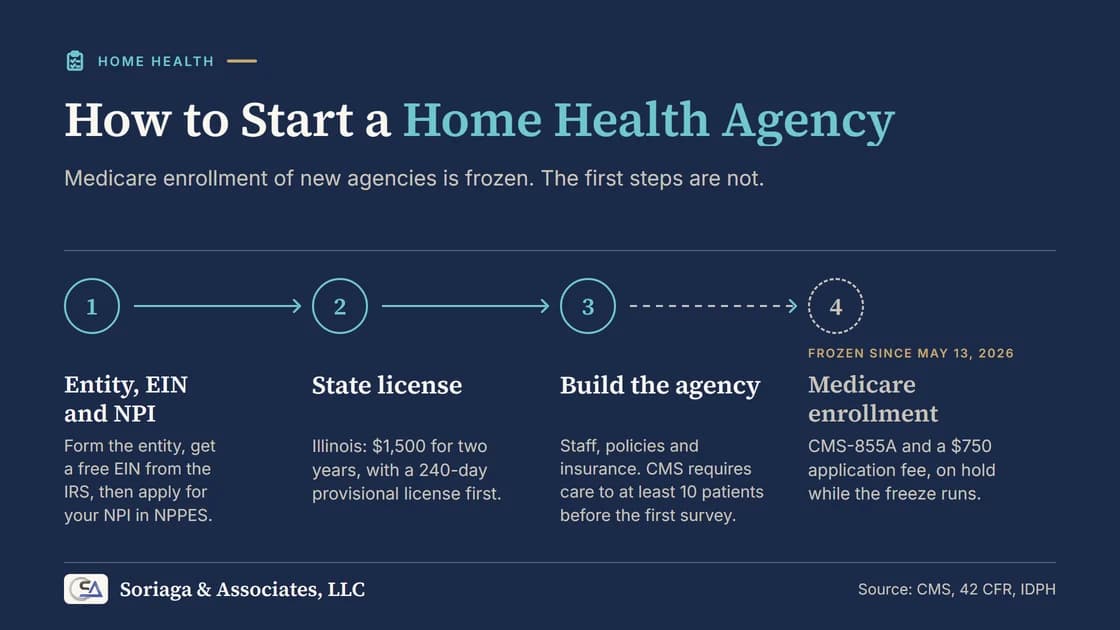
This guide covers the money side of a business plan for a home health agency that plans to bill Medicare. It does not cover your mission statement, market study or clinical program. If you plan to start with non-medical home care, use our home care business plan instead. If you still need the licensing steps, read our guide on how to start a home health agency.
Key takeaways
- Reserve funds come first. CMS can deny billing rights if you cannot prove the money (42 CFR 489.28(g)).
- At least 50 percent of the reserve must be your own money. The rest can be a loan or line of credit from an unrelated lender.
- Medicare enrollment of new agencies is frozen. The freeze began May 13, 2026, and runs six months unless CMS extends it.
- Medicare pays per 30-day period. A period with too few visits is a LUPA and pays far less.
- You treat patients before the survey. CMS expects at least 10 skilled patients first, and at least 7 still in care on survey day.
- Cash is the real risk. Payroll starts months before the first Medicare payment.
- The first cost report is part of the plan. Your costs by discipline set up that report.
Writing your plan now? Bring your draft numbers to a free 20-minute call. We will tell you which assumptions a lender or Medicare contractor will question. Book a free 20-minute call.
What does the financial section of a home health agency business plan need to show?
It needs to show where the money comes from, where it goes, and when. That means a startup budget, a reserve-funds schedule, a monthly cash forecast and a revenue model. Most lenders also want a break-even point and a funding request that matches your projections.
A plan for a Medicare-certified agency has more moving parts than a plan for private-pay home care. You have one big payer, one set of payment rules and a required cash reserve. You also have a long gap with no Medicare revenue.
What to do: List the four parts above and mark which ones you have already built.
What do lenders and CMS look at?
Lenders and CMS look at different things. CMS cares about proof. A lender cares about repayment.
CMS looks at:
- Proof of reserve funds. Bank statements, plus an attestation from a bank officer that the money is in the account and available now (42 CFR 489.28(d)).
- How much is your own money. The officer who will sign your cost report must certify the non-borrowed share. It must be at least 50 percent.
- A line of credit, if you use one. You must give CMS a letter from the lender (42 CFR 489.28(f)).
- Who owns the agency. New home health agencies get "high" screening. Anyone who owns 5 percent or more must give fingerprints (42 CFR 424.518(c)).
A lender looks at your cash forecast, your owner investment and how long you can last before revenue arrives. SBA and bank requirements differ, so ask your lender for its own checklist. Our view, not a rule: expect questions about your admissions ramp, your staffing plan and your worst case.
What to do: Ask your lender what documents it needs, and ask your bank whether it will sign the reserve-funds attestation.
Can you enroll a new home health agency in Medicare right now?
Not as a new agency. CMS put a nationwide enrollment freeze (a "moratorium") on home health agencies and hospices on May 13, 2026. CMS says it lasts six months and may be extended in six-month steps if CMS decides it is needed.
The freeze applies to initial applications. It also covers some changes in majority ownership that require a new enrollment under 42 CFR 424.550(b). Any such application submitted after May 13 is denied. An application the Medicare contractor received before that date is outside the freeze (42 CFR 424.570(a)(1)(iv)).
Status as of November 2, 2026. CMS's moratoria page, last changed August 27, 2026, still showed the first six-month period. We found no notice that extends or lifts it. CMS says it announces either one in the Federal Register. The six-month mark is around November 13, 2026. Our post on the home health enrollment moratorium has the details.
What this means for your plan:
- Build two timelines. One where the freeze ends in November. One where it runs another six months.
- Count the cost of waiting. Rent, licenses, insurance and key hires cost money while you wait.
- Keep the early steps moving. Entity, EIN, NPI and state licensing are separate from Medicare enrollment.
What to do: Put a "freeze extended" column in your cash forecast, and check CMS's moratoria page before you sign a lease.
How much reserve operating funds does Medicare require?
The rule is 42 CFR 489.28. A new home health agency must have "initial reserve operating funds" when it applies. It must keep them through the first three months after Medicare billing starts. Money you expect from Medicare does not count.
CMS sizes the amount in three steps:
- The Medicare contractor picks at least three similar agencies. It looks at location, urban or rural, for-profit or non-profit, visit volume, and freestanding or provider-based.
- It divides their first-year costs by their first-year visits. That gives an average cost per visit.
- It multiplies that by the visits you project for your first three months. A minimum applies, tied to 90 percent of the comparison agencies' average visits.
Other rules for your plan:
- Proof. Bank statements and a bank officer's attestation. Cash equivalents like Treasury bills and money market funds can count if you can turn them into cash when needed.
- At least 50 percent not borrowed. Owner investment counts as non-borrowed.
- Consequences. CMS may deny billing rights if you fall short. It may revoke them if you do not keep the funds for the three months.
Illustrative, not a published figure. Say similar agencies average $100 per visit. You project 600 visits in your first three months. The reserve is $100 x 600 = $60,000. At least $30,000 must be your own money. Both inputs are made up. Your contractor sets the real number, so ask for it early.
What to do: Ask your Medicare contractor how it will size your reserve, then show that amount as its own line in your plan, separate from operating cash.
How does PDGM revenue math work?
Medicare pays a set amount for each 30-day period of care. This is the Patient-Driven Groupings Model, or PDGM. Each period lands in one of 432 payment groups, and each group has its own case-mix weight (a number that raises or lowers the base payment for sicker or more complex patients). CMS recalibrates the weights and the visit thresholds each year.
For your plan, revenue per period is not a single number. It is the base rate times the case-mix weight, adjusted for local wages. Then the 2026 rate changes apply. CMS's CY 2026 final rule gave a 2.4% payment update. It also cut the base rate by a permanent 1.023% and a temporary 3% (MLN Matters MM14304). CMS has proposed more changes for CY 2027, so check the final rule before you lock your numbers.
Here is how the timing works:
- The NOA. You send a Notice of Admission within 5 calendar days after the start of care. A late NOA cuts the period payment by 1/30 for each late day (42 CFR 484.205(j)).
- One payment per period. For periods that start in 2022 or later, you get a single payment after you submit the final claim (42 CFR 484.205(g)(4)).
- LUPA. If a period has fewer visits than its group's threshold, Medicare pays per visit instead of the full amount. The threshold is at least 2 visits and varies by group (42 CFR 484.230(b)).
Illustrative, not a published rate. Say a payment group pays $2,000 per period and its LUPA threshold is 4 visits. Your nurse makes 3 visits, and Medicare pays $150 per visit. You get $450, not $2,000. One more visit would have changed the payment. That is why visit planning is a financial decision, not only a clinical one.
Our deeper post on PDGM and the 30-day period covers the NOA and LUPA clocks.
What to do: Model revenue by period, not by month. Count periods, then apply a case-mix weight, a LUPA rate and a late-NOA allowance.
What does it cost to start a home health agency?
No neutral source sets prices for software, legal work or consulting, so we do not invent them. Use written quotes. Here are the cost groups, with official figures where they exist.
| Cost group | Figure | Source or note |
|---|---|---|
| Entity formation | Varies by state | Your Secretary of State |
| EIN | $0 | IRS |
| State license (Illinois) | $1,500 per two-year license | 210 ILCS 55/4(c) |
| Medicare application fee (2026) | $750 | CMS, Dec. 3, 2025 notice |
| Initial reserve operating funds | Set by your contractor | 42 CFR 489.28 |
| Liability insurance (Illinois) | Required limits: $1M per occurrence, $3M total (not the price) | IDPH application |
| Accreditation (optional) | Set by each accreditor | Get written quotes |
| Clinical and billing software with OASIS | Vendor quotes | OASIS is required for payment |
| Payroll before Medicare revenue | Your plan | At least 10 patients before survey |
| Legal, accounting, background checks | Quotes | Owners get fingerprinted |
Costs vary by state, so check your own state's license fee and rules.
What to do: Replace each "quote" cell with a real quote, and date each one.
What staffing should the plan include?
Medicare's conditions of participation require an administrator who runs day-to-day operations. They also require a clinical manager who oversees patient care and personnel (42 CFR 484.105). Your state may add its own rules.
Beyond those two roles, most plans include:
- Nurses and therapists to make visits and do assessments. BLS reports a median wage of $97,550 a year for registered nurses (May 2025).
- Home health aides. BLS reports a median wage of $35,800 a year for home health and personal care aides (May 2025).
- Intake, billing and OASIS staff, or a billing company.
- Payroll costs on top of wages. Employer Social Security and Medicare tax is 7.65% (IRS Publication 15). Add workers' compensation, unemployment tax and benefits.
Those BLS numbers are national medians. Your local pay may be higher or lower. Use quotes from your own market.
We often see a plan that assumes full staffing from day one. In practice, patients arrive slowly. The fix is a staffing schedule tied to admissions, with a minimum team that you pay no matter what.
What to do: Build a month-by-month headcount table that follows your admissions ramp, and price each role from local offers.
How much cash do you need before the first Medicare payment?
More than most plans show. You pay staff, rent and insurance while you care for your first patients. CMS expects at least 10 skilled patients before your first survey, and at least 7 still in care on survey day. They do not have to be Medicare patients (CMS State Operations Manual, Appendix B). So you have costs and little or no Medicare revenue for months.
After certification, Medicare pays one amount per 30-day period, after the final claim. So the first payment comes after the first period of care, not on day one. CMS publishes no standard time from enrollment to first payment, so ask your Medicare contractor and your accreditor or state survey agency for current timelines.
Illustrative, not a forecast. Say your monthly cost before any Medicare revenue is $45,000. Say five months pass before your first payment. That is $225,000 of operating cash. Add the $60,000 reserve from the example above, and the plan needs $285,000. The reserve cannot also pay bills, so the two amounts do not overlap.
What to do: Build a 13-week cash forecast that starts on your first Medicare visit. Run it twice: once on time and once with revenue starting six months late.
What about your first Medicare cost report?
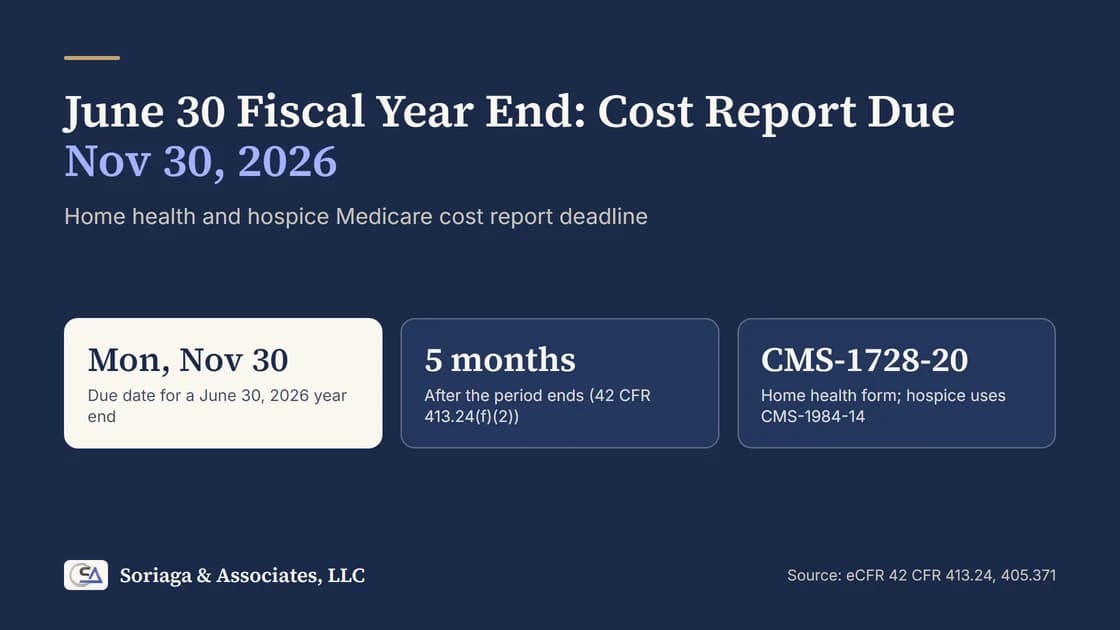
Your plan should show that you will file it, and when. A cost report is due on or before the last day of the fifth month after your cost reporting period ends (42 CFR 413.24(f)(2)). Your Medicare contractor sets your first reporting period, so confirm it.
Cost reports do two jobs. They settle your account with Medicare. And the reports of new agencies help set reserve amounts for the next group of new agencies (42 CFR 489.28(c)). Clean records from day one keep the report simple.
Set up the books before the first patient. Track costs by discipline and by function. Our guide to new home health agency accounting setup shows how. We prepare home health Medicare cost reports for a flat $1,599.99 for a low- or full-utilization report, or $500 for a no-utilization report.
What to do: Add the cost report to your plan as a line item with a due date and an owner.
How do you use our free template for a home health agency plan?
Start with our free 3-year projection template in the home care business plan post. It builds monthly cash for Year 1 and summaries for Years 2 and 3. The numbers inside are examples only.
For a home health agency, change these things:
- Revenue. Replace billable hours and private bill rates with periods of care, case-mix weights, LUPA rates and visit counts.
- Starting cash. Add the initial reserve operating funds as a separate, locked amount.
- Startup costs. Add accreditation or survey costs, OASIS software and Medicare application fees.
- Payroll. Use clinical roles, visit-based pay and the required administrator and clinical manager.
- Payer lag. Delay Medicare cash until after the first period closes and the final claim is paid.
- Cost report. Add the preparation cost and due date.
What to do: Download the template, make those six changes, then test a version where the freeze extends.
What we see in practice
The owners who struggle are rarely weak on the clinical side. They spend reserve money before the survey. Or they assume Medicare pays on day one. Both are cheaper to prevent in the plan than to fix later. Our home health accounting work starts with the cash forecast, then monthly books, then the cost report.
Ready to pressure-test your plan? Bring your reserve estimate, your staffing schedule and your funding plan. We will walk through the numbers with you. Book a free 20-minute call.
Frequently asked questions
What should the financial section of a home health agency business plan include?
Show your startup costs, your initial reserve operating funds, a month-by-month cash forecast, and revenue built from visits and Medicare 30-day period payments. Add staffing costs, a break-even point and your plan to file the first Medicare cost report. Lenders and CMS both want proof that you can pay staff before Medicare pays you.
How much money do I need to start a Medicare-certified home health agency?
There is no single official number. CMS sets your reserve amount from the cost per visit of similar new agencies times your projected visits for your first three months (42 CFR 489.28). On top of that, you need cash for payroll, rent and software until Medicare pays your first claim. Model both amounts in your own plan.
Can I enroll a new home health agency in Medicare right now?
Not as a new agency. CMS started a nationwide enrollment freeze on May 13, 2026, for six months. New initial applications submitted after that date are denied, and CMS may extend the freeze in six-month steps. Check CMS's moratoria page for the current status before you set a launch date.
How does Medicare pay a home health agency?
Medicare pays a set amount for each 30-day period of care. The amount depends on the patient's payment group, and a low-visit period (a LUPA) is paid per visit instead. For periods starting in 2022 or later, you get one payment per period after you submit the final claim (42 CFR 484.205).
When is the first Medicare cost report due?
A cost report is due on or before the last day of the fifth month after your cost reporting period ends (42 CFR 413.24(f)(2)). Confirm your first period and due date with your Medicare Administrative Contractor.
Next step
Planning to open in the next year? Book a free 20-minute call with Christian Soriaga, CPA. Bring your draft plan, your state and your funding sources. Our full-service monthly retainers start at $800 a month, and we can build your cash forecast and reserve schedule before you commit. You can also read our home health accounting page, or call (630) 491-1268.
Sources
- eCFR, 42 CFR 489.28, Special capitalization requirements for HHAs
- CMS, Provider Enrollment Moratoria (checked November 2, 2026)
- CMS, Home Health and Hospice Nationwide Moratorium FAQs
- Federal Register notice 2026-09717, nationwide temporary moratoria on enrollment of home health agencies (May 15, 2026)
- eCFR, 42 CFR 424.570, Moratoria on newly enrolling Medicare providers and suppliers
- eCFR, 42 CFR 424.518, Screening levels for Medicare providers and suppliers
- eCFR, 42 CFR 484.205, Basis of payment
- eCFR, 42 CFR 484.230, Low-utilization payment adjustments
- eCFR, 42 CFR 484.105, Organization and administration of services
- eCFR, 42 CFR 413.24, Adequate cost data and cost finding
- CMS, Calendar Year (CY) 2026 Home Health PPS Final Rule fact sheet (CMS-1828-F)
- CMS, MLN Matters MM14304, Home Health PPS CY 2026 Rate Update
- CMS, State Operations Manual Appendix B, Survey Protocol for Home Health Agencies
- Federal Register, Provider Enrollment Application Fee Amount for Calendar Year 2026 (Dec. 3, 2025)
- Illinois Home Health Agency Licensing Act, 210 ILCS 55/4
- IDPH, Home Health Agency Initial Licensure Application (Form 445103)
- BLS, Occupational Outlook Handbook: Registered Nurses
- BLS, Occupational Outlook Handbook: Home Health and Personal Care Aides
- IRS, Publication 15 (Circular E), Employer's Tax Guide
Last updated: November 2026.
This article is general information, not legal or tax advice. The dollar examples are illustrative, not published rates.
Soriaga & Associates, LLC is a CPA firm with 20+ years in healthcare accounting, serving home health, hospice, home care and dental providers nationwide. (630) 491-1268.