Medicaid Work Requirements Start January 1, 2027: The Medical Frailty Fight and What Home Care Agencies Need to Do Now
Christian Soriaga, CPA6 min read
On this page
Forty-three states and the District of Columbia must impose an 80-hour-per-month work requirement on adult Medicaid enrollees no later than January 1, 2027 — and on September 18, 2026, physician groups and five enrollees sued to block the rule that decides who is too sick to comply. The medical frailty exemption is where home care lives. Many personal care clients qualify for it; many will have to prove it; and CMS's September 8 guidance to states lists personal care services claims as one of the data sources states can use to find them. For a private-duty or Medicaid-funded home care agency, that turns an eligibility story into a billing, census, and cash-flow story, with about three months left.
Key Takeaways
- CMS-2454-IFC was issued June 1, 2026; states must implement no later than January 1, 2027 (CMS fact sheet).
- It applies to non-pregnant adults ages 19–64 in the Medicaid adult group or certain section 1115 demonstrations who are not in Medicare — 43 states and DC cover these populations.
- Enrollees must show 80 hours a month of work, community service, a work program, half-time education, or a combination — or earn 80 × federal minimum wage = $580/month (2026).
- Medically frail individuals, people with disabilities, caregivers of children under 14 or of people with disabilities, and pregnant/postpartum women are among the exempt groups.
- On September 8, 2026, CMS gave states a three-tier framework for verifying medical frailty using ICD-10 codes and claims — including personal care services claims — from a 12-month lookback.
- On September 18, 2026, Taylor v. Kennedy was filed in the U.S. District Court for the District of Maryland asking the court to stay and vacate the IFR's medical frailty provisions.
- The complaint cites independent estimates of 6.4 million people losing coverage per year (2027–2034) under the statute, rising to about 8.2 million with the IFR's added restrictions.
- A non-compliance notice gives enrollees 30 calendar days to respond; disenrolled individuals may reapply at any time — which means churn, not a one-time loss.
What the Rule Requires
The test is monthly and can be met several ways, but every path runs through documentation.
| Path to compliance | Threshold | Source |
|---|---|---|
| Work, community service, or work program | 80 hours per month | CMS-2454-IFC fact sheet |
| Education | At least half-time | CMS-2454-IFC fact sheet |
| Combination | 80 hours total per month | CMS-2454-IFC fact sheet |
| Income alternative | $580 per month (2026) | CMS-2454-IFC fact sheet |
| Response window after non-compliance notice | 30 calendar days | CMS-2454-IFC fact sheet |
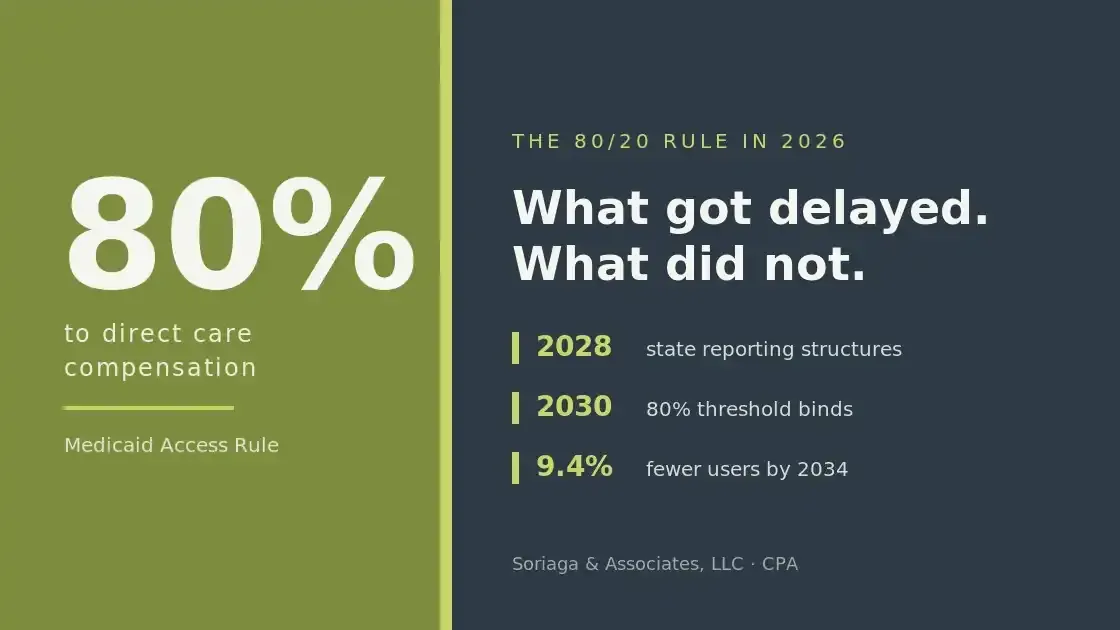
States verify at application and at renewal, and may verify more often. Two different "80s" now apply to home care: the Medicaid 80/20 rule governs what share of an HCBS payment reaches the caregiver; this rule is an 80-hour activity test on the beneficiary. Same number, opposite side of the transaction.
Who is exempt — on paper
The statute exempts the medically frail, people with disabilities, parents and caretakers of children under 14 or of people with disabilities, pregnant and postpartum women, and American Indians and Alaska Natives, among others. States may also grant short-term hardship exceptions, including for counties with unemployment at or above 8% or 1.5 times the national rate.
The Medical Frailty Fight: What Changed in September
The exemption list reads generously. The question is how an enrollee proves it — and that is what moved this month.
CMS's three-tier framework (September 8)
CMS posted a slide deck to states describing an optional framework:
| Tier | What it means | Evidence |
|---|---|---|
| Tier 1 | Condition confirmed to significantly impair ability to comply | ICD-10 codes in available data |
| Tier 2 | Condition may indicate frailty; more information needed | Severity, functional status, high acute use, polypharmacy |
| Tier 3 | Insufficient data | Manual individualized review; documentation may be required |
The deck allows states to use claims adjudicated in the prior 12 months — paid, pended, or denied — and names personal care services alongside inpatient, pharmacy, and DME claims as data that can support a determination. It also defines frailty to include a disability that "significantly impairs" one or more activities of daily living. LeadingAge's read, published September 22, is that the slides "provide little new information" and leave the grey areas unresolved.
The lawsuit (September 18)
The American College of Physicians, the American Academy of Pediatrics, and four other provider groups, plus five enrollees, filed suit challenging the IFR's frailty provisions. They argue the rule makes medically frail people prove their condition prevents work, which the statute does not require, and that a 12-month claims lookback excludes people a 24-month window would catch. Trade coverage notes that a similar challenge by 25 states and DC was dismissed this summer. Plan for January 1 as written.
Why This Hits Home Care Twice
Direction one: your clients
Working-age Medicaid clients who are not exempt — or who are exempt but cannot prove it in 30 days — lose coverage, and their authorized hours leave your schedule. The notice goes to the enrollee, not to you.
Direction two: your caregivers
Home care aides are disproportionately low-wage workers, and many are Medicaid enrollees. A part-time caregiver under 80 hours is exposed. That is a retention problem in the same quarter as a census problem, and pushing part-timers to 80 hours shows up in overtime and payroll tax.
Your claims are now exemption evidence
This is the angle nobody is modeling. If a state runs a Tier 1 or Tier 2 check against the last 12 months of claims, a personal care client whose claims were billed late, billed under the wrong codes, or never billed at all may look less frail in the data than in real life. Clean, timely, correctly coded claims are no longer just a revenue issue — they may help keep your client eligible.
| Exposure | Financial effect | Timing |
|---|---|---|
| Client disenrollment | Authorized hours lost | Rolling from Jan 2027 |
| Reapplication churn | Authorization gaps, unbillable shifts | Continuous |
| Caregiver coverage loss | Turnover, replacement cost | Rolling from Jan 2027 |
| Stale or miscoded claims | Weaker frailty evidence for clients | Now — 12-month lookback |
What to Change in the Books Before January
- Tag at-risk clients. Age 19–64, adult group, not dual-eligible. Count them and the authorized hours attached.
- Clear the unbilled queue. Anything delivered in the last 12 months that is not yet on a claim should be billed now; it may be part of the state's frailty evidence.
- Add an eligibility-status field and reconcile it to the payer's eligibility file monthly, not at re-authorization.
- Open an unbillable-hours account. Shifts delivered after disenrollment but before you learn of it are the predictable loss; do not let them hide in bad debt.
- Budget a census haircut for Q1 2027 at 5%, 10%, and 15% of at-risk hours, and find the point where overhead stops being covered.
- Watch state notices. New York State of Health, for example, says it will notify affected enrollees by September 30, 2026; other states are on their own schedules.
Agencies whose general ledger does not split Medicaid revenue by program and authorization status will not see any of this until the bank balance does. That is the first thing our bookkeeping services for home care agencies set up. Agencies that also run a Medicare-certified line should keep that split consistent with what feeds their Medicare cost report filing.
The Compliance Calendar
| Date | Event | Source |
|---|---|---|
| June 1, 2026 | CMS issues CMS-2454-IFC | CMS fact sheet |
| Sept 8, 2026 | CMS medical frailty slide deck posted to states | Medicaid.gov |
| Sept 18, 2026 | Taylor v. Kennedy filed, D. Md. | Complaint |
| Sept 30, 2026 | NY State of Health enrollee notices due out | NY State of Health |
| Jan 1, 2027 | Latest state implementation date | CMS fact sheet |
| 30 days from notice | Enrollee window to show compliance or exemption | CMS fact sheet |
The Bottom Line
The rule, the exemptions, and the January 1 date have not changed. What changed in September is how frailty gets proven — and home care claims are part of the proof. Bill clean, bill current, tag the at-risk census, and budget the hours you expect to lose. If you want that modeled against your authorization data, schedule a free consultation.
Sources
- CMS, Medicaid Community Engagement Requirement for Certain Individuals IFC (CMS-2454-IFC) fact sheet, June 1, 2026
- Federal Register, Medicaid Program; Community Engagement Requirement for Certain Individuals, June 3, 2026
- Medicaid.gov, Implementing Medical Frailty Under Community Engagement slide deck (posted Sept 8, 2026)
- Taylor et al. v. Kennedy et al., Complaint, D. Md., Sept 18, 2026
- NY State of Health, Changes to Medicaid Coverage
- Healthcare Dive, "New lawsuit targets Medicaid work requirements' medical frailty rules," Sept 22, 2026
- LeadingAge, "CMS Releases Medicaid Work Requirements and Medical Frailty Guidance to States," Sept 22, 2026
Last updated: September 2026.
Soriaga & Associates, LLC is a CPA firm specializing in home health, hospice, and private-duty home care accounting.