Dental Practice Owner Salary: What Owners Really Take Home
Christian Soriaga, CPA9 min read
On this page
Quick answer: A dental practice owner salary is not one number. Owners are paid from the practice's profit, and profit depends on collections and overhead. The ADA Health Policy Institute reports that general dentists averaged $215,320 in net income in 2025. A trade report on the ADA's 2025 survey says owner general dentists averaged $217,781 and nonowners $160,891 for 2024.
The ADA's 2026 update says expenses per general dentist rose 4.9% between 2016-20 and 2021-25, while revenue rose only 1.4% (ADA Health Policy Institute, inflation-adjusted).
If you own a general dental practice, your pay is what the practice keeps after every bill. That is why two owners with the same collections can take home very different amounts. This post covers owner pay versus profit, how the S corp salary and distribution split works, and how overhead moves your income. It is general information, not advice for your situation.
Key takeaways
- Average pay is a starting point. General dentists averaged $215,320 in net income in 2025 (ADA Health Policy Institute).
- Owners are paid last. Staff, lab, rent and loans come out of collections first.
- Overhead is the biggest lever you control. At $800,000 in collections, each overhead point is $8,000 a year (illustrative).
- Salary and profit are different. An S corporation owner takes a wage plus distributions. The IRS requires reasonable pay first (irs.gov).
- Owners work more hours. The ADA says owners work about 2.5 more hours a week than employee and associate dentists.
- Our calculator shows both paths. Try the associate vs owner calculator with your own numbers.
Want your own numbers checked? Bring last year's profit and loss report. Book a free 20-minute call.
How much do dental practice owners make?
Start with the public numbers, and know what each one measures.
The ADA Health Policy Institute (HPI) surveys private practice dentists. Its 2026 update says the average net income of general practitioner dentists was $215,320 in 2025. It also says incomes were unchanged in 2025 and have fallen after inflation in recent years because costs grew faster than revenue.
For owners versus nonowners, a Dental Economics report on the ADA's 2025 Survey of Dental Practice (published November 24, 2025) says owners netted $217,781 and nonowners netted $160,891 in 2024. The ADA's own update says the gap between owner and nonowner income has narrowed over 15 years.
The U.S. Bureau of Labor Statistics (BLS) is a different kind of source. It reports a median annual wage of $176,110 for dentists in May 2025, and $170,950 for general dentists. BLS says its pay data does not include self-employed workers. So it describes employed dentists, not owners.
These figures are averages. Half of owners are below any average. Your pay depends on your collections, your overhead and the hours you work.
Action: Use these figures as background only. Your real baseline is last year's profit and loss report.
Is an owner's salary the same as practice profit?
No. This is where most confusion starts.
Profit is collections minus the practice's costs. Salary is a wage the practice pays you through payroll. A solo dentist who runs a sole proprietorship or an LLC taxed as one has no salary. The owner takes draws, and the whole profit is taxed on the owner's return whether or not it was withdrawn.
An S corporation is different. The owner is an employee of the practice. The practice pays a salary through payroll and can pay the rest of the profit as a distribution.
Profit is also not the same as cash in your pocket. Loan principal and some equipment purchases are not expenses, but they still use cash. Income tax and your own health insurance and retirement savings come out as well. A practice can show a healthy profit and still leave little cash after a year of loan payments.
Action: Ask your bookkeeper for two numbers each month: profit, and cash left after loan payments.
How does the S corp salary and distribution split work?
In an S corporation, the owner's income has two parts. The first is a salary, which carries payroll tax. The second is a distribution, which does not.
The IRS says an S corporation must pay a shareholder-employee reasonable compensation for services before it makes non-wage distributions. The IRS can reclassify distributions as wages if the pay is too low. Its factors include training and experience, duties, time and effort, and what comparable businesses pay (irs.gov, S corporation compensation and medical insurance issues).
For a solo dentist, this matters a lot. The IRS looks at where receipts come from. Receipts from your own clinical work point to wages. Profit tied to staff, equipment or other dentists can point to distributions.
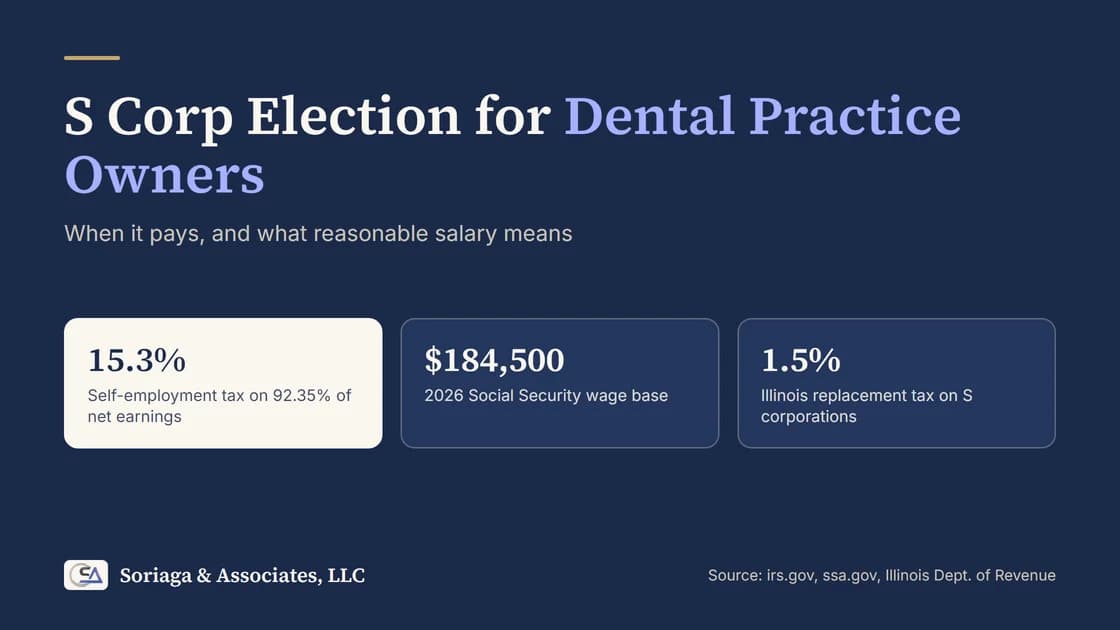
Self-employment tax is the comparison point. The IRS says it is 12.4% for Social Security plus 2.9% for Medicare, generally on 92.35% of net earnings (irs.gov, Topic no. 554). For 2026, the Social Security part stops at the $184,500 wage base (ssa.gov).
Illustrative example (made-up numbers, not a salary recommendation): The practice earns $280,000 in profit. The owner is paid a $150,000 salary. The other $130,000 is a distribution.
| Item | Sole proprietor or single-member LLC | S corporation |
|---|---|---|
| Income subject to payroll or self-employment tax | $258,580 (92.35% of $280,000) | $150,000 salary |
| Social Security part | $22,878 (12.4% of the $184,500 wage base) | $9,300 owner + $9,300 practice |
| Medicare part | $7,499 (2.9% of $258,580) | $2,175 owner + $2,175 practice |
| Total | $30,377 | $22,950 |
The gap is $7,427 in this example, before income tax. The figures also leave out the 0.9% Additional Medicare Tax, which applies to wages or self-employment income over $200,000 for a single filer (irs.gov, Topic no. 560). The sole proprietor column is above that line. The gap is also before federal and state unemployment tax, payroll fees, a separate tax return and any state tax on S corporations. For instance, Illinois charges S corporations a 1.5% replacement tax. Those costs can cancel the saving at lower profits. Our S corp election for dentists post covers when it pays and when it does not.
To try your own numbers, use our S corp tax calculator.
Action: If you are an S corporation owner, write down how you set your salary each year. Update it when your duties or profit change.
How does overhead change what an owner takes home?
Overhead is your costs as a percent of collections: staff, lab, supplies, rent and other operating costs, but not your own pay. Owner income is what remains: collections times (100% minus overhead).
The ADA gives a public benchmark. For general dentists, the 2021-25 inflation-adjusted averages were $804,144 in revenue per dentist and $552,909 in expenses per dentist. Dividing the two gives expenses of about 69% of revenue. That division is ours. The ADA does not state it as an overhead rate, and your practice will differ.
Illustrative example (made-up numbers): A practice collects $800,000 in a year.
| Overhead | Costs | Owner income before tax |
|---|---|---|
| 60% | $480,000 | $320,000 |
| 65% | $520,000 | $280,000 |
| 70% | $560,000 | $240,000 |
| 75% | $600,000 | $200,000 |
Each 5 points of overhead moves owner income by $40,000. That is why a small drift in staff cost or lab bills can matter more than a fee increase. An associate paid 30% of collections gets $240,000 at the same collections, and that pay does not move with overhead. The break-even is 70% overhead. Below it, owning pays more at these numbers. Above it, the associate path pays more.
Action: Pull your last twelve months of expenses, divide by collections, and write down your overhead percent. Then check which line grew fastest.
How can I compare owner income with associate pay?
Use our free dental associate vs owner income calculator. Enter your collections, overhead, hours and what an associate would be paid. It shows both incomes before tax, pay per hour and the break-even overhead.
The starting numbers in the form are an example, not a typical practice. Nothing you enter is stored or sent. If you want to see how associates are paid, read our companion post, how associates are paid in 2026.
Action: Run the calculator twice: once with your overhead today, and once with it five points lower.
What we see in practice
The most common problem we fix is owners who do not know their overhead percent. Their books are months behind, or costs sit in the wrong accounts. They cannot tell whether pay is falling because collections dropped or because costs grew.
The second problem is an S corporation salary that was picked once and never revisited. Clean monthly books fix both. Our dental accounting services cover monthly bookkeeping, payroll and tax planning for general dental practices. Monthly retainers start at $800 per month. We confirm the price in writing after a free call.
Want to know what you really take home? Book a free 20-minute call with Soriaga & Associates, LLC. We will look at your overhead and your pay setup.
Frequently asked questions
How much do dental practice owners make?
The ADA Health Policy Institute reports that general dentists averaged $215,320 in net income in 2025. A trade report on the ADA's 2025 survey put owner general dentists at $217,781 and nonowners at $160,891 for 2024. Your own number depends on collections, overhead and hours.
Is a dental practice owner salary the same as practice profit?
No. Profit is what is left after the practice pays its costs. A salary is the wage the practice pays you through payroll, which only happens if you run payroll for yourself, as an S corporation owner does. Many owners take profit as owner draws and have no salary at all.
How much salary should a dentist pay themselves from an S corporation?
There is no set percent. The IRS says an S corporation must pay a shareholder-employee reasonable pay for services before it makes non-wage distributions. It looks at training, duties, time worked and what similar businesses pay. A CPA should help you set and document the number. Book a free call if you want a second look.
How does overhead change what a dentist owner takes home?
Owner income is collections minus overhead. On the same collections, every extra point of overhead lowers your income by one percent of collections. At $800,000 in collections, each point is $8,000 a year. This is an illustrative example.
Do dental practice owners make more than associate dentists?
On average, yes, but the gap has narrowed and owners work more hours. The ADA reports owners work about 2.5 more hours a week than employee and associate dentists. Use the free calculator to compare both paths with your own numbers.
Next step
Gather your last twelve months of profit and loss and your most recent payroll report. Book a free 20-minute call with Soriaga & Associates, LLC, a CPA firm with 20+ years in healthcare accounting. We will work out your overhead percent and tell you what we would look at first. See our dental accounting services for what monthly support includes.
Sources
- ADA Health Policy Institute, Trends in dentists' income, revenue and hours worked (2026 update: $215,320 average GP net income in 2025; 2021-25 revenue and expenses per dentist; owner hours)
- Dental Economics, ADA study reveals dentists' revenue, net income and hours worked in 2025 (November 24, 2025: owner and nonowner net income for 2024)
- U.S. Bureau of Labor Statistics, Occupational Outlook Handbook: Dentists (May 2025 median pay; self-employed not included)
- IRS, S corporation compensation and medical insurance issues
- IRS, Topic no. 554, Self-employment tax
- IRS, Topic no. 560, Additional Medicare Tax
- SSA, Contribution and Benefit Base ($184,500 for 2026)
Last updated: November 2026. Figures checked in October and November 2026.
This article is general information, not legal or tax advice. The worked examples use made-up numbers and are illustrative.
Soriaga & Associates, LLC is a CPA firm founded in 1985 in Lisle, Illinois, serving home health, hospice, home care, wound care and dental providers nationwide. (630) 491-1268.