Hospice Consulting: What a Financial Consultant Does and When to Hire One
Christian Soriaga, CPA9 min read
On this page
Quick answer: Hospice consulting means paid outside help for your hospice, and there are three main kinds. A clinical consultant helps with care and survey readiness. A billing consultant helps with claims. A financial consultant, usually a CPA, handles your books, cost report, cap tracking and cash forecast. Hire the type that matches your biggest risk.
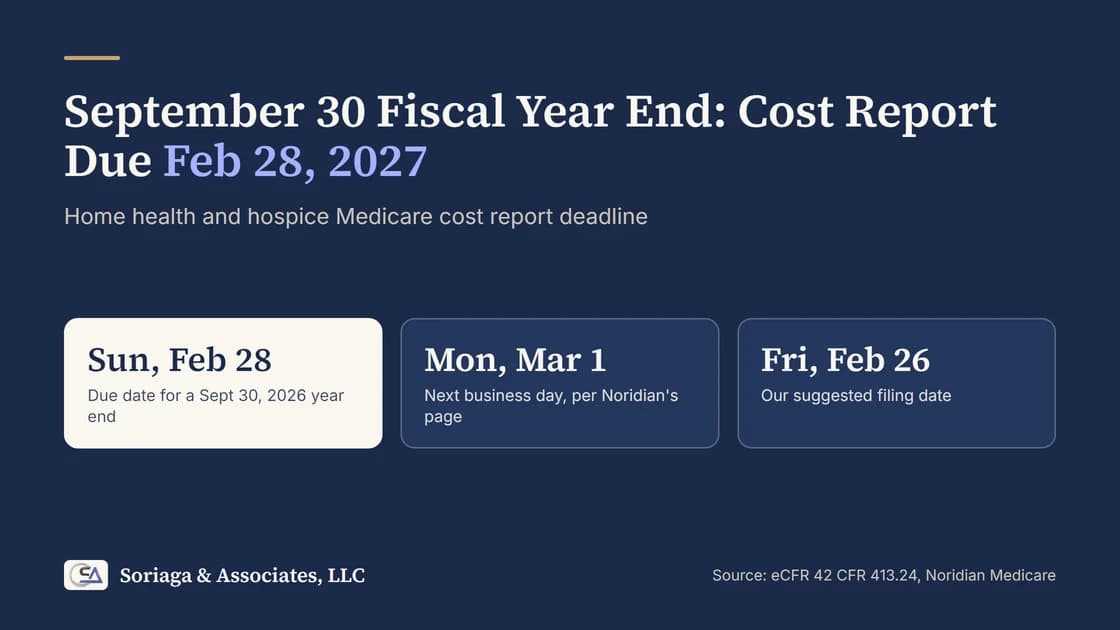
Medicare says you must file your hospice cost report on or before the last day of the fifth month after your fiscal year ends (42 CFR 413.24(f)). Your cap filing is due 5 months after the cap year ends (42 CFR 418.308(c)). Both are money tasks, and both need records kept all year.
This guide is for hospice owners who plan to hire help. It covers who does what, what the financial side includes, red flags, and questions to ask. We are a CPA firm, so we do the financial side. We do not do clinical or survey consulting, and we say so below.
Key takeaways
- Three kinds of help: clinical and survey, billing, and financial. Few people do all three well.
- Financial consulting covers: monthly books, cap tracking, budgets, the cost report and a cash forecast.
- Two Medicare deadlines are money deadlines: the cost report (fifth month after year end) and the cap filing (5 months after the cap year).
- One-time or monthly: a one-time project fits a defined task. A monthly partner fits an ongoing need for clean numbers.
- Opening soon? Book a call before your first claim. Book a free 20-minute call.
- Ask for a written scope, a named person who does the work, and a clear price before you sign.
Opening a hospice or hiring help this quarter? Book a free 20-minute call and bring your budget or last month's bank statement.
What does a hospice consultant do?
The word "consultant" covers very different jobs. Match the person to the problem.
| Type | Typical work | Who it fits |
|---|---|---|
| Clinical and survey | Care policies, staff training, mock surveys, quality reporting | Owners with survey or care-quality worries |
| Billing | Claim submission, denials, payer follow-up | Owners with slow or rejected claims |
| Financial (CPA) | Books, cap tracking, cost report, budget, cash forecast | Owners who cannot see their numbers |
Clinical and survey consultants work on care itself. CMS says a hospice must meet the conditions of participation (the care and safety rules for hospices) and hold a valid Medicare provider agreement. Surveyors check the hospice against those rules (CMS, Hospices page). A clinical consultant helps you get ready for that review.
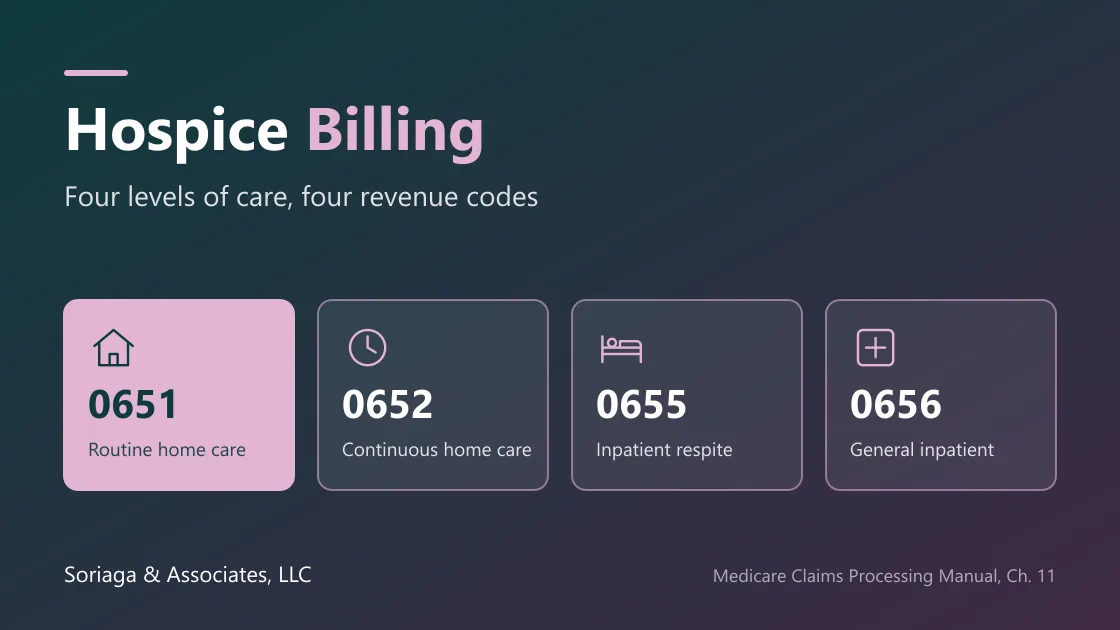
Billing consultants work on claims. They fix errors, chase denials and watch payer rules. For more on the billing side, see our post on hospice billing.
Financial consultants turn the claims and bank activity into numbers you can use. That is the part we do, and the rest of this guide explains it.
What to do: List your top three worries. Put each one under clinical, billing or financial. That tells you whom to call first.
What does a financial consultant do for a hospice?
A financial consultant keeps your numbers accurate and watches the rules that put your Medicare money at risk. Five jobs matter most.
- Monthly books. Your bank and credit card activity is sorted and reconciled every month, so you can trust your profit and loss statement.
- Cap tracking. Medicare limits what it pays your hospice each year. The FY 2026 cap is $35,361.44 per beneficiary, and the FY 2027 cap is $36,174.75 (CMS final rule fact sheet). A monthly tracker shows how close you are. You can test the idea in our hospice cap calculator.
- Budgets and cash forecasts. Medicare pays after you bill. A forecast shows when cash gets tight, before payroll day.
- The cost report. This is the yearly report Medicare uses to review your costs. It is due on or before the last day of the fifth month after your year ends. It has its own filing format, and Medicare requires an electronic file (42 CFR 413.24(f)). See our hospice cost report page.
- CFO-level advice. Pricing, hiring, growth plans and lender reports. For smaller hospices, a part-time CFO is often enough.
Why the cap gets its own line. MedPAC (the group that advises Congress on Medicare) reported that about 28% of hospices exceeded the aggregate cap in 2023, up from about 23% in 2022. Those hospices were over by about $410,000 on average (MedPAC, March 2026). You see that risk coming only if you track it monthly.
Illustrative example (not a real hospice): Your cap year is half over. You have counted 200 beneficiaries so far at the FY 2026 cap of $35,361.44. Your cap room is $7,072,288. Medicare has paid you $6,500,000. You are at about 92% of cap room, and you still have six months of admissions ahead. That is the moment to ask why, not the day you file.
What to do: Ask any financial consultant to show you a sample monthly cap tracker. If they cannot, keep looking.
When do you need a one-time project, and when do you need a monthly partner?
Both models are fair. The question is whether your need has an end date.
A one-time project fits when:
- You need a single report, such as the hospice cost report or the cap calculation.
- You want a cleanup of past books before a lender or loan review.
- You are a startup that is not ready for a monthly fee yet.
For those cases, we offer one-time work. A hospice cost report is $1,599.99 flat, or $500 if there was no utilization. The hospice cap calculation is quoted separately. Our post on your first year as a new hospice shows what to set up before the first claim.
A monthly partner fits when:
- Your books fall behind every month.
- You cannot say, today, how close you are to the cap.
- You make decisions on hiring or growth without a forecast.
- Your clinical director or administrator does the books on the side.
A one-time consultant leaves when the project ends. The numbers then drift until the next crisis. A monthly partner keeps them current, so the cost report and cap filing become a routine task. That is the main difference. Our hospice accounting services are built around that monthly view.
What to do: Write down whether your need has an end date. If it does, ask for a one-time quote. If it does not, ask for a monthly scope.
What are the red flags when hiring a hospice consultant?
Watch for these before you sign.
- A guaranteed result. No one can promise you will pass a survey, avoid an audit or never go over the cap.
- No written scope. You should see what is included, what is not, and what it costs.
- No named person. Ask who does the work, and who reviews it.
- A pitch outside their lane. A billing consultant who also sells clinical sign-offs is a warning. So is a financial firm that claims to run your survey.
- A request for your logins with no agreement. Access to Medicare portals and bank accounts should come with a written agreement.
- Pressure to sign today. A good fit survives a few days of thought.
- No sample work. Ask for a sample monthly report or cap tracker with the names removed.
What to do: Put the scope, price and named staff in writing before you share any logins.
What questions should you ask before you hire?
Take this list to every call.
- What exactly will you deliver, and by when?
- Who does the work day to day?
- How do you track the aggregate cap, and how often do I see it?
- Who prepares the cost report, and what do you need from me?
- What do you not do? (A fair answer names the gaps.)
- How do you work with my clinical team and my billing company?
- What does it cost, and what makes the price change?
- What happens if a deadline is missed?
Good consultants answer these plainly. For the cap and cost report, ask which month of the year the work happens. The cost report is due once a year, but the cap needs a view all year.
What to do: Bring your own questions to a free call. We will answer them, and we will tell you if you need a different kind of consultant.
Will you need more than one consultant?
Usually, yes. A hospice that is opening or growing often has a clinical lead, a billing partner and a financial partner. They share data, and they should talk to each other.
Here is how that can look. The clinical consultant tells the team how to document. The billing partner turns that into clean claims. We take the payments and bank activity and build the books, the cap view and the cost report. When the three agree, the numbers hold up.
What to do: Share the same month-end reports with all three. Mismatches show up fast.
How do I get started?
If you are opening soon, start with three items before your first claim: a chart of accounts built for hospice, a bank and payroll setup, and a cap tracker. If you are established, start with a look at your last cap filing and cost report.
We are a CPA firm with 20+ years in healthcare accounting, including home health and hospice. We do the financial side and refer you elsewhere for clinical work. Look at our hospice accounting services for the monthly option. Or ask about one-time work if you are not ready for a monthly retainer yet.
Opening soon or comparing consultants? Book a free 20-minute call with a CPA who works with hospices.
Frequently asked questions
What does a hospice consultant do?
It depends on the type. A clinical consultant helps with care policies, staff training and survey readiness. A billing consultant helps with claims and denials. A financial consultant, usually a CPA, handles the books, the cost report, cap tracking, budgets and cash forecasts.
Do I need a hospice consultant if I am opening a new hospice?
Most new owners need help in more than one area. Clinical and licensing help comes first. Financial help matters from the first claim, because the cap year, the cost report and Medicare payment timing all start early.
What is the difference between a hospice consultant and a hospice CPA?
A consultant usually works on one project, such as a mock survey or a billing cleanup. A CPA firm with a monthly engagement keeps your books, cap numbers and cash forecast current all year, and files the cost report.
When is the hospice cost report due?
On or before the last day of the fifth month after your fiscal year ends (42 CFR 413.24(f)). For a December 31 year end, that is May 31.
When is the hospice cap report due?
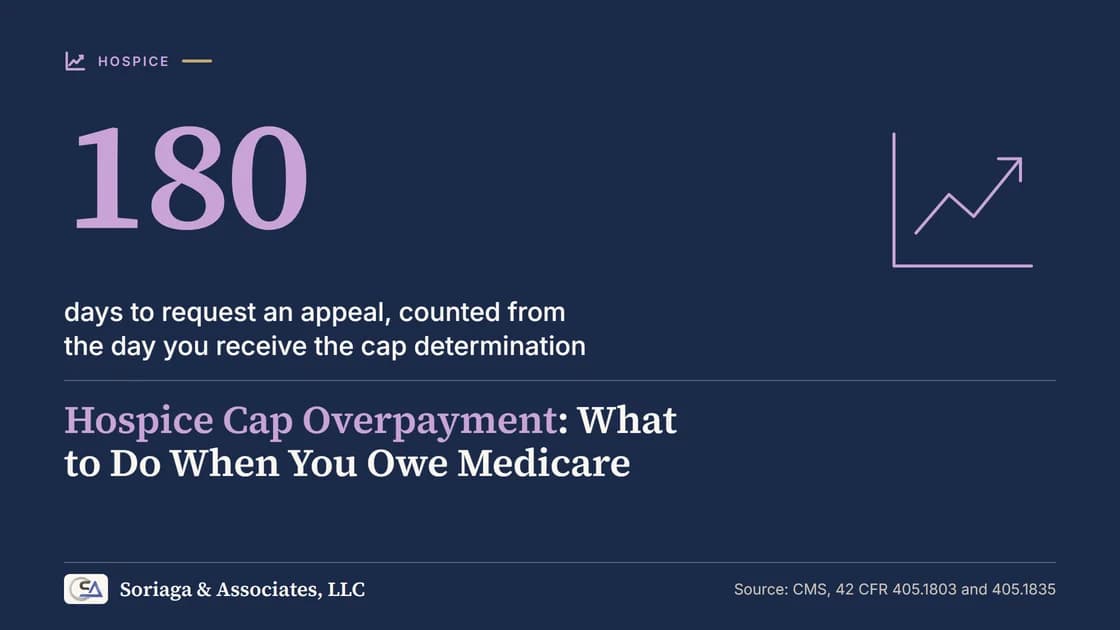
No later than 5 months after the end of the cap year (42 CFR 418.308(c)). Medicare can suspend payments in whole or in part until you file it.
Can a financial consultant help with a survey or an ADR?
We help with the money side: cash flow, tracking held or denied claims, and the effect on your cap and cost report. Your clinical team and a clinical consultant handle the medical records and survey work.
How much does a hospice cost report cost?
At Soriaga & Associates, LLC, a hospice cost report is $1,599.99 flat, or $500 if there was no utilization. The hospice cap calculation is quoted separately.
Next step
Book a free 20-minute call with Christian Soriaga, CPA. Tell us what you are worried about. We will say whether you need a monthly partner, a one-time project or a different kind of consultant.
Sources
- eCFR, 42 CFR 413.24, Adequate cost data and cost finding (cost report due date and electronic format)
- eCFR, 42 CFR 418.308, Limitation on the amount of hospice payments (cap filing deadline and payment suspension)
- CMS, FY 2027 hospice wage index and payment rate update final rule fact sheet (cap amounts)
- CMS, Hospices (certification and compliance) (conditions of participation and surveys)
- MedPAC, March 2026 Report to the Congress, Chapter 10 (share of hospices over the cap, average overage)
Last updated: October 2026.
This article is general information, not legal or tax advice.
Soriaga & Associates, LLC is a CPA firm founded in 1985 in Lisle, Illinois, serving home health, hospice, home care, wound care and dental providers nationwide. (630) 491-1268.