Bookkeeper vs. Accountant vs. CPA: Who Does Your Small Business Need?
Christian Soriaga, CPA8 min read
On this page
Quick answer: A bookkeeper records and organizes your day-to-day transactions. An accountant interprets those records and prepares reports and returns. A CPA is an accountant who holds a state license. Most small businesses need monthly bookkeeping first, and CPA oversight as soon as taxes, payroll, loans or growth come into play.
If you are searching "bookkeeper vs accountant," you are probably trying to decide who to hire, or whether the person you already pay is enough. This guide explains the difference in plain English, with a side-by-side table, the warning signs that you have outgrown your current setup, and a simple way to choose.
Key takeaways
- Bookkeepers keep the records. They categorize transactions, reconcile bank and card accounts, and produce monthly financial statements.
- Accountants analyze and report. They review the books, prepare returns and financial reports, and advise on what the numbers mean.
- A CPA is a licensed accountant. The license comes from a state board, and the IRS gives CPAs unlimited rights to represent clients.
- You often need both functions. Clean monthly books plus CPA review is the combination that keeps taxes, loans and audits from becoming emergencies.
- One firm can do both, which removes hand-offs and finger-pointing between two separate providers.
What does a bookkeeper do?
A bookkeeper keeps the financial record of your business accurate and current. Typical work includes:
- Categorizing every deposit, expense and transfer
- Reconciling bank and credit card accounts to the statements each month
- Tracking what customers owe you and what you owe vendors
- Recording payroll entries
- Producing a monthly profit and loss statement and balance sheet
Think of bookkeeping as the foundation. If it is wrong, everything built on it is wrong too: your tax return, your cash-flow picture, and the numbers a lender or buyer sees. Our bookkeeping services cover exactly this monthly work, for small businesses and healthcare agencies.
A bookkeeper generally does not decide how you should be taxed, whether you should change your business structure, or what your results mean. That is accountant territory.
What does an accountant do?
An accountant takes the bookkeeper's records and works with them. That can include:
- Reviewing the books for errors and unusual items
- Preparing financial statements and reports for lenders or investors
- Preparing business and personal tax returns
- Planning for taxes during the year, not only in April
- Advising on entity type, owner pay, retirement plans and big purchases
"Accountant" is a job description, not a license. Some accountants hold degrees and credentials. Others do not. That is why the next section matters.
What is a CPA, and how is it different from an accountant?
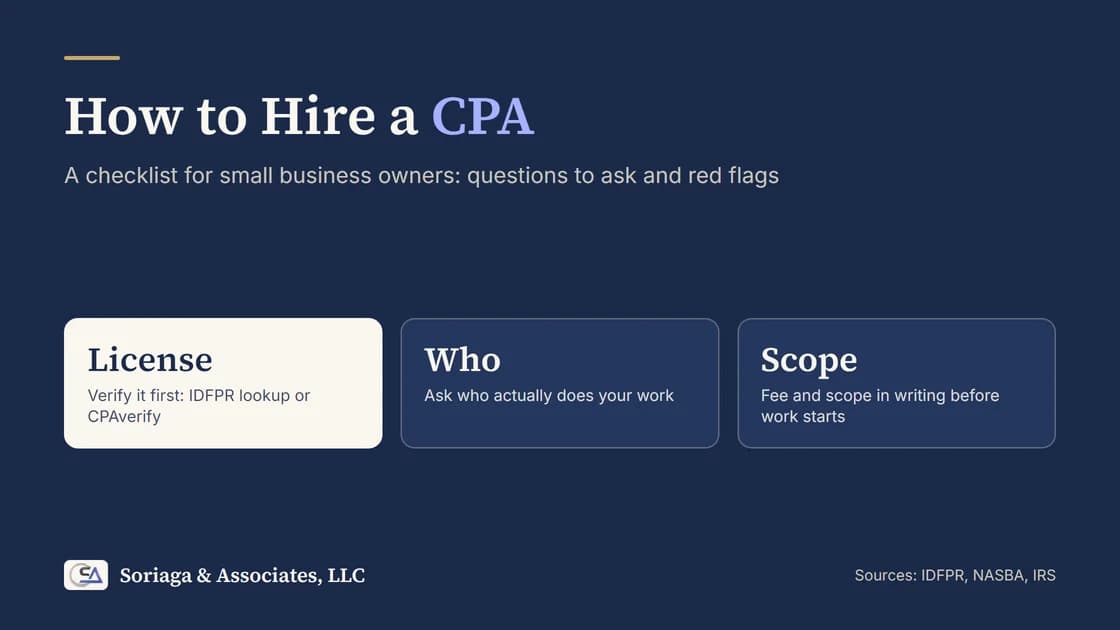
A Certified Public Accountant is an accountant who has been licensed by a state board of accountancy. You can check a license on your state regulator's website (in Illinois, the Department of Financial and Professional Regulation) or through NASBA's national CPAverify tool. We walk through the steps in how to hire a CPA.
For tax work, one difference is especially practical. The IRS says CPAs, enrolled agents and attorneys have unlimited representation rights, meaning they can represent a client on any matter, including audits, payment and collection issues, and appeals. A paid preparer with only a PTIN (the IRS preparer tax ID) has no representation authority for returns filed after 2015, and participants in the IRS Annual Filing Season Program have limited rights. If you want someone beside you when a notice arrives, that matters. We cover the details in our post on CPA vs. accountant vs. tax preparer in Illinois.
Bookkeeper vs. accountant vs. CPA: side-by-side
| Bookkeeper | Accountant | CPA | |
|---|---|---|---|
| Main job | Records and reconciles transactions | Reviews records, prepares reports and returns | Everything an accountant does, with a state license |
| Typical tasks | Categorizing, bank reconciliations, payables and receivables, monthly statements | Financial statements, tax returns, analysis, planning | Tax returns, planning, review of books, IRS representation, advisory |
| Credential | Not required in most places; training and software skills vary | Not required; may hold a degree or other credential | State license from a board of accountancy |
| IRS representation | No | Only if also an enrolled agent, CPA or attorney | Yes, unlimited rights |
| Best when | You need clean, current books every month | You need returns or reports prepared | You need tax planning, a licensed signer, or help with an audit or notice |
The categories overlap. Some bookkeepers are highly skilled, and some accountants never go near a ledger. What matters is who does which job for your business, and who checks the work.
What does each one cost?
Prices vary widely by location, volume of transactions and scope, so we will not quote numbers here. The factors that move the fee are:
- How many transactions and accounts you have each month
- Whether your books are current, or months behind and in need of cleanup
- Payroll, sales tax, multiple entities or inventory
- How much advice and planning you want, beyond the monthly records
- The software you use
Ask any provider for a written quote that lists what is included, or book a free 20-minute call with us for ours. Our own services are quoted after a free 20-minute call, because the scope depends on your situation.
Signs you have outgrown your bookkeeper
You do not have to fire a good bookkeeper. But if you see these signs, add CPA-level oversight:
- Your tax bill surprises you every year. Nobody is planning during the year.
- Your preparer keeps asking for records. The books are not tax-ready.
- You are taking on a loan, a partner or a buyer. Outsiders want reviewed financials.
- You are hiring employees. Payroll taxes, filings and classification rules add risk.
- You are considering a new entity or S-corp election. That is a tax-strategy decision, not a data-entry task.
- You got an IRS or state notice. You need someone with representation rights.
- The financial statements do not match reality. If the profit and loss does not match your bank account, someone needs to look closely.
- You avoid your numbers. If you dread opening the software, you are not using the books to run the business.
If the books are behind rather than just unreviewed, start with a cleanup. Our catch-up bookkeeping service reconciles the missing months, fixes errors and gets you ready for taxes.
How do a bookkeeper and a CPA work together?
In a good setup, the flow looks like this:
- Monthly: the bookkeeper categorizes transactions, reconciles accounts and issues statements.
- Quarterly: the CPA reviews the numbers, checks estimated tax payments and flags planning opportunities.
- Year-end: the books are closed cleanly, and the CPA prepares the returns from them.
- Any time: when a question or notice arrives, the CPA already knows the file.
The weak point is the hand-off. When bookkeeping and tax sit with separate providers, year-end becomes a back-and-forth about missing receipts and miscoded accounts. When one firm does both, the person preparing your return has seen your books all year.
That is the model we use at Soriaga & Associates, LLC. We are a CPA firm founded in 1985 in Lisle, Illinois, near Naperville, and we serve small businesses, healthcare agencies and dental and medical practices in English and Spanish, in person or remotely across the country. Our small business accounting team handles bookkeeping, payroll, tax and CPA review under one roof.
How to choose: a simple decision guide
- You only need clean monthly records and your taxes are simple: a skilled bookkeeper plus a CPA for the annual return can work. Confirm who talks to whom.
- You want fewer moving parts: choose a CPA firm that does the monthly bookkeeping too.
- Your books are behind: start with cleanup, then move to monthly service.
- You run a healthcare agency or practice: choose someone who understands Medicare, Medicaid and practice revenue, since generic bookkeeping often miscodes them.
- You are growing or borrowing: add CPA oversight now, before a lender or buyer asks for statements you cannot produce.
Before you hire anyone, ask what software they use, who actually does the work, how often you will hear from them, and whether the quote is in writing. If you want a second opinion on your current setup, you can book a free 20-minute call with Christian Soriaga, CPA. We will tell you plainly whether you need monthly bookkeeping, a one-time cleanup, CPA review, or nothing more than what you have.
Frequently asked questions
Is a bookkeeper cheaper than an accountant?
Usually the hourly rate for routine bookkeeping is lower than for CPA-level work, because the tasks are more repetitive and need less credentialing. But the cheaper option on paper is not always the cheaper option in practice. Errors in the books show up later as tax-return corrections, missed deductions or a stalled loan application. Ask for a written quote and compare what is included, not just the rate.
Can a bookkeeper file my business taxes?
Some can, if they also hold a preparer tax ID (PTIN) and the training to do it, but many bookkeepers record transactions only and hand the books to a tax preparer. Whoever is paid to prepare the return must have a PTIN. If you want someone who can also represent you before the IRS in an audit, hire a CPA, an enrolled agent or an attorney.
Do I need a bookkeeper if I have a CPA?
Your CPA needs accurate books to do good work. Either you or a bookkeeper keeps them current during the year, or the CPA firm does it. Many small business owners find it simplest to have one firm do both, so the person preparing the return already knows the books.
What is the difference between an accountant and a CPA?
A CPA holds a state license from a board of accountancy. Accountant is a general term that can describe anyone who works with financial records, with or without a credential. For tax matters, the IRS gives CPAs unlimited representation rights.
When should a small business move from a bookkeeper to a CPA?
When the questions get bigger than recording transactions: choosing an entity type, planning taxes during the year, taking a loan, hiring employees, buying equipment, or facing an IRS or state notice. You do not have to drop your bookkeeper. You add CPA oversight.
Can one firm do both bookkeeping and CPA work?
Yes. Many CPA firms, including ours, keep the books monthly and prepare the taxes. That avoids hand-offs between separate people and means the person planning your taxes has seen your numbers all year.
Next step
If you are weighing a bookkeeper, an accountant or a CPA, book a free 20-minute call. Bring your last bank statement and your most recent tax return if you have them, and we will outline what a sensible setup looks like for your business. You can also read about our bookkeeping services, or call (630) 491-1268.
Sources
- IRS, Understanding tax return preparer credentials and qualifications (representation rights of CPAs, enrolled agents and attorneys; PTIN-only preparers; Annual Filing Season Program)
- IRS, Choosing a tax professional (PTIN requirement for paid preparers; Directory of Federal Tax Return Preparers)
- Illinois Department of Financial and Professional Regulation, Check a License
- NASBA, CPAverify and All About CPAverify
Last updated: October 2026.
This article is general information, not legal or tax advice.
Soriaga & Associates, LLC is a CPA firm founded in 1985 in Lisle, Illinois, serving small businesses, healthcare agencies and dental and medical practices nationwide, in English and Spanish. (630) 491-1268.