New Hospice LLC: Cap Tracking, Cost Report and Bookkeeping in Year One
Christian Soriaga, CPA10 min read
On this page
Quick answer: A new hospice has three Medicare money obligations that start in year one: stay under the aggregate cap, stay under the 20 percent inpatient day limit, and file a cost report on time. The cap and the cost report are separate filings with separate due dates, and both depend on bookkeeping that tracks revenue and days by level of care from the first patient.
The FY 2027 hospice aggregate cap amount is $36,174.75 per beneficiary for the cap year October 1, 2026 to September 30, 2027, and a hospice must file its own cap determination within 5 months after the cap year ends (CMS fact sheet CMS-1851-F; 42 CFR 418.308(c)).
Most new hospice owners come from clinical or management roles and know how to deliver care. The accounting rules for hospice are unlike most other healthcare, because a payment cap and a day limit can create overpayments even when every claim was billed correctly. This guide explains what those rules mean in plain English, and how to build books that make them manageable.
Key takeaways
- The aggregate cap is a limit on total Medicare payments. It is the cap amount times the number of beneficiaries counted. Payments above it are overpayments and must be refunded (42 CFR 418.308(d)).
- FY 2027 cap amount: $36,174.75. The cap year runs October 1 to September 30.
- The cap is not part of the cost report. It is a separate filing due within 5 months after the cap year ends.
- Inpatient days are limited to 20 percent of total hospice days for Medicare patients (42 CFR 418.302(f)).
- The cost report (Form CMS-1984-14) is due five months after your fiscal year ends, and a late report can suspend payments.
- Track revenue and days by level of care from day one.
- Plan for slow first cash. Care is delivered long before the first reimbursement arrives.
Opening a hospice? Book a free 20-minute call and we will map your cap, cost report and cash flow calendar.
What is the hospice aggregate cap, and does it apply to a new hospice?
Yes, it applies from the first Medicare patient. The aggregate cap is a ceiling on the total Medicare hospice payments a hospice can keep for a cap year. It equals the cap amount multiplied by the number of Medicare beneficiaries counted for that year (42 CFR 418.309).
The cap amount for FY 2027 is $36,174.75, which is the FY 2026 amount of $35,361.44 increased by the 2.3 percent FY 2027 hospice payment update. The source is the CMS fact sheet on the FY 2027 hospice wage index and payment rate update final rule (CMS-1851-F), effective October 1, 2026.
Two details trip up new owners:
- The cap year is October 1 to September 30, the twelve-month period ending September 30 (42 CFR 418.3). The older November 1 to October 31 year no longer applies.
- Beneficiaries can be counted two ways. The streamlined method counts beneficiaries who elected hospice during the cap period and were not counted in an earlier cap. The proportional (patient-by-patient) method counts only the share of each patient's hospice days that fall in your cap year. Your cap workpapers show which method applies.
Why does this matter in year one? Hospices that admit patients with long stays can exceed the cap because payments per patient accumulate day after day. You do not find that out when you bill a claim. You find out when you compare cumulative payments to the cap. That is why we suggest tracking the position monthly instead of once a year. You can play with the numbers using our free hospice cap calculator, which also checks the inpatient limit.
When is the cap filed, and what happens if I am over it?
The hospice, not the MAC, makes the first calculation. Under 42 CFR 418.308(c), a hospice must file its self-determined aggregate cap determination with its Medicare contractor no later than 5 months after the end of the cap year, and remit any overpayment due at that time. Payments made above the cap are overpayments and must be refunded (42 CFR 418.308(d)). The contractor then notifies the hospice of its final determination.
If a hospice does not file within 5 months after the cap year, Medicare payments can be suspended in whole or in part until the filing is made (42 CFR 418.308(c); 42 CFR 405.371).
Example timeline: for a cap year ending September 30, 2026, the self-determined filing is due about the end of February 2027. For the FY 2027 cap year, it is about the end of February 2028. Always confirm the exact date with your MAC.
Because the cap year does not match a calendar-year or fiscal-year cost reporting period in most cases, a new hospice ends up with two calendars running side by side: the cap calendar and the cost report calendar. Put both on one schedule from the beginning.
What is the 20 percent inpatient limit?
Separate from the aggregate cap, inpatient care days (general inpatient and inpatient respite) for Medicare patients may not exceed 20 percent of the total days those patients elected hospice (42 CFR 418.302(f)). At the end of the cap period, the MAC calculates the limit. Only days provided and billed as general inpatient or respite count as inpatient days; routine home care and continuous home care days count in the total but not in the inpatient number.
If a hospice exceeds the limit, payment for the excess days is figured at the routine home care rate and the hospice must refund the excess reimbursement. For a hospice with 40,000 total Medicare days, the inpatient allowance is 8,000 days.
For a new hospice with a small census, the percentage can swing sharply. A few inpatient stays in a month with few total days move the ratio a lot. Track inpatient days and total days monthly.
What does the first hospice cost report involve?
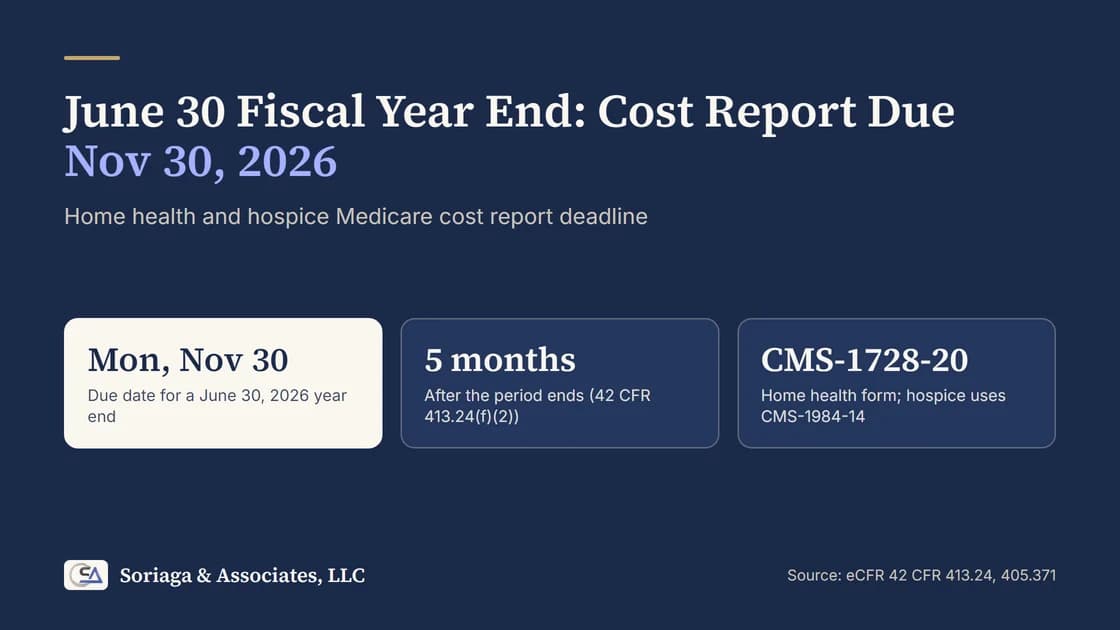
Freestanding hospices file Form CMS-1984-14. The cost report is due on or before the last day of the fifth month following the close of the cost reporting period (42 CFR 413.24(f)(2)). Extensions are available only in narrow cases: the MAC may grant one only for extraordinary circumstances outside your control, such as a flood or fire. If a timely, acceptable report is not filed, Medicare payments are suspended in whole or in part until it is filed (42 CFR 405.371).
The cost report is built from your books. Preparation typically needs:
- Your PS&R (Provider Statistical and Reimbursement) report
- Your trial balance or year-end financial statements
- Payroll records and statistics that support your cost data
- Your depreciation schedule or fixed asset listing
- Your prior-year cost report and any MAC correspondence, when there is one
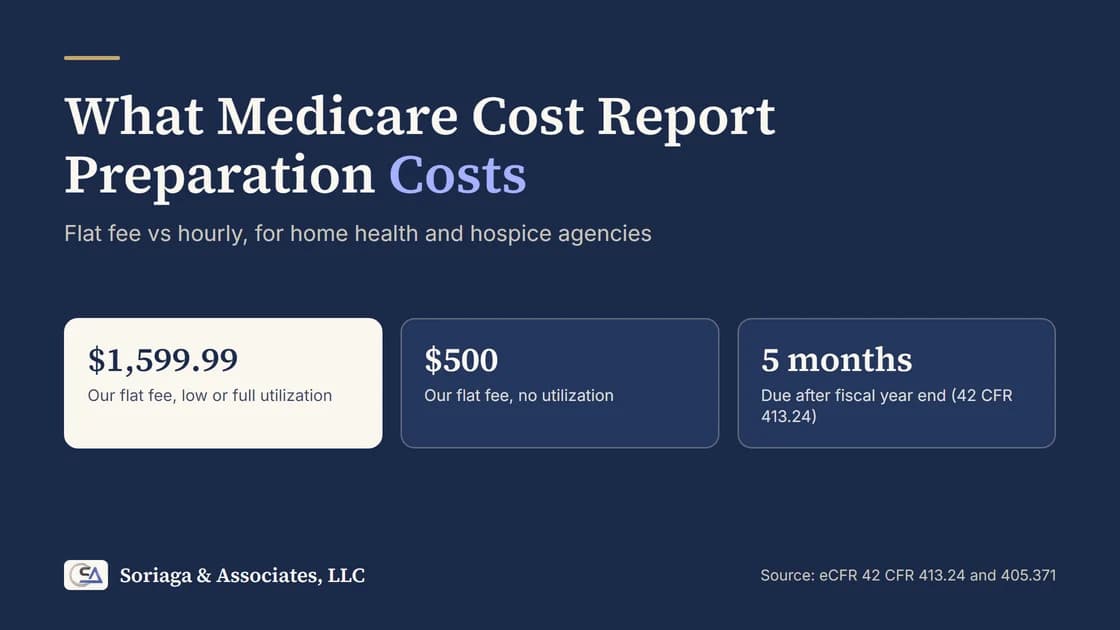
We prepare the report, our CPAs review it, and we file it electronically through MCReF to your MAC. Our flat fee is $1,599.99 for low or full utilization and $500 for no utilization. Cap review is a separate service, so raise it on the call if you want it. Read more on our hospice cost report page.
Remember that the cap and the cost report are different filings. Filing one does not satisfy the other.
How should a new hospice set up its books?
Hospice bookkeeping has more moving parts than ordinary small-business bookkeeping, mainly because Medicare pays a daily rate that depends on the level of care. Set up these basics:
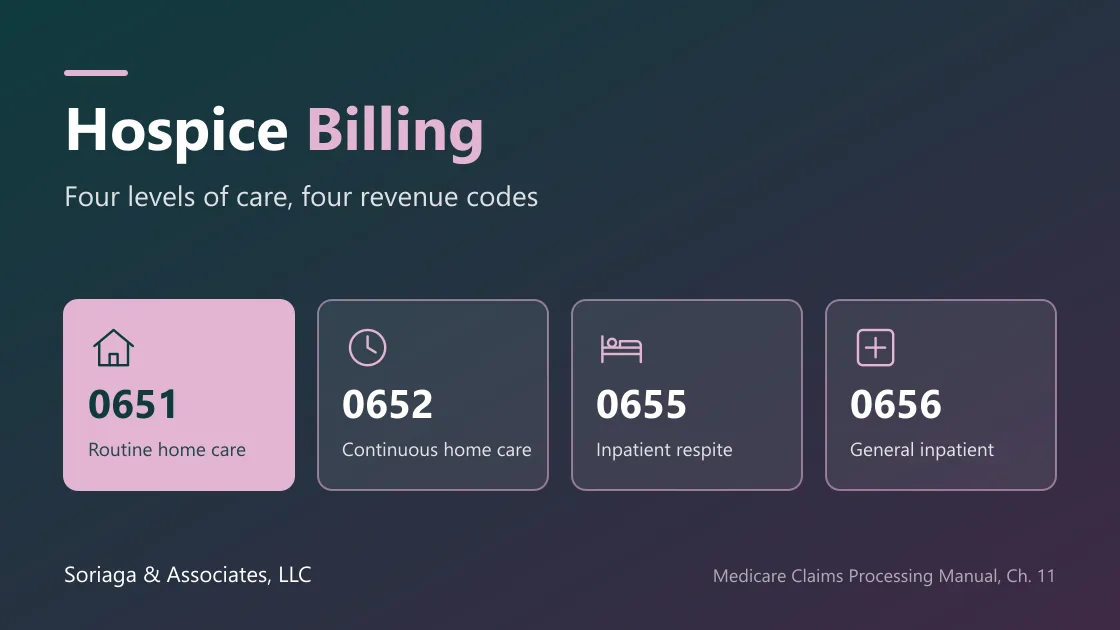
Revenue by level of care. Hospice Medicare pays under four levels of care: routine home care, continuous home care, inpatient respite care and general inpatient care. Track revenue and patient days for each. This feeds both the cap review and the inpatient limit.
Revenue by payer. Medicare, Medicaid and private insurance behave differently. Keep them separate so you can see the margin on each and so Medicare numbers tie to your PS&R.
Cost centers. Separate patient-care costs (nursing, social work, aide, chaplain and bereavement, physician, medications and equipment) from administrative costs. The cost report groups costs this way, so your accounts should support it.
Patient days and census. Keep a monthly count of days by level of care and the number of beneficiaries counted. Agree on who produces it and who checks it.
A monthly cap schedule. A simple worksheet comparing cumulative Medicare payments to an estimated cap, updated each month, shows trouble while you can still act. Our hospice accounting services page describes how we monitor the cap position monthly and aim to flag potential overage risk early.
Payroll by role. Clinical and administrative payroll should be coded separately. See payroll services.
Monthly reconciliation. Tie the bank to the books, and tie Medicare payments to your remittances and the PS&R.
Why is cash flow tight for a new hospice?
Costs begin before revenue. You hire a medical director, nurses, aides and social workers; you pay for software, insurance and rent; and you admit patients. Medicare pays after claims are submitted and processed. For a new hospice, that gap between cost and first reimbursement is common, and it has to be financed from your own reserves or financing.
Billing discipline is part of cash flow. A Notice of Election (NOE) must be submitted to and accepted by the MAC within 5 calendar days after the admission date. If it is late, Medicare does not cover or pay for the days from the admission date until the NOE is accepted, and those days are provider liability that the hospice cannot bill the beneficiary for (Medicare Claims Processing Manual, Chapter 11). The manual allows an exception for some circumstances, including a newly certified hospice still awaiting notice or its user ID. Our hospice billing guide covers the NOE rules, levels of care and rates.
Ways to reduce risk in year one:
- Build a 12-month cash projection with slow census growth.
- Keep a calendar for NOEs and claims, and check them weekly.
- Watch accounts receivable by payer.
- Review the cap position monthly so a refund does not surprise you.
- Read about the aggregate cap in more depth.
When should a new hospice hire a CPA?
Before you admit your first patient. The chart of accounts, level-of-care tracking and cap schedule are cheap to design at the start and costly to rebuild later. A CPA who handles cost reports regularly will also tell you what the MAC and auditors look for.
Soriaga & Associates, LLC is a CPA firm that has served clients since 1985 from Lisle, Illinois. We have 20+ years in healthcare, we have prepared Medicare cost reports since 2004, and we prepare 50 to 100 a year. Most of our cost report clients are in California, Illinois, Nevada and North Carolina, and we file for agencies served by any Medicare Administrative Contractor through MCReF. Christian Soriaga, CPA, speaks fluent Spanish.
Frequently asked questions
What is the hospice aggregate cap for FY 2027?
The FY 2027 hospice cap amount is $36,174.75 per beneficiary, according to the CMS fact sheet on the FY 2027 hospice final rule (CMS-1851-F). It applies to the cap year October 1, 2026 through September 30, 2027. The FY 2026 amount was $35,361.44.
Is the hospice cap part of the Medicare cost report?
No. It is a separate filing with its own due date. A hospice files its own self-determined cap determination with its MAC within 5 months after the cap year ends, and the cost report is a different filing.
What is the 20 percent inpatient limit?
Under 42 CFR 418.302(f), inpatient days (general inpatient and respite) for Medicare patients may not exceed 20 percent of the total days those patients elected hospice. If you go over, payment for the excess days is figured at the routine home care rate and you must refund the difference.
When is a hospice's cost report due?
On or before the last day of the fifth month after the cost reporting period ends, under 42 CFR 413.24(f)(2). Hospices file Form CMS-1984-14. A late report can lead to suspended Medicare payments under 42 CFR 405.371.
What does Soriaga & Associates charge for a hospice cost report?
A flat $1,599.99 for low or full utilization and $500 for no utilization. Cap calculation is quoted separately.
Why is cash flow tight for a new hospice?
Hospices pay clinicians and staff as soon as they admit patients, but Medicare pays only after claims are processed, and a Notice of Election filed late means unpaid days. New hospices should plan for a gap between cost and first reimbursement.
Next step
If you are opening a hospice, the time to set up the cap schedule and cost report calendar is before the first admission. Book a free 20-minute call and we will go through your plan. You can also run the hospice cap calculator, read about hospice accounting services, or call (630) 491-1268. To start now, book online.
Sources
- CMS, FY 2027 Hospice Wage Index and Payment Rate Update Final Rule (CMS-1851-F) fact sheet (FY 2027 cap amount $36,174.75)
- eCFR, 42 CFR 418.308, Limitation on the amount of hospice payments (self-determined cap filing; overpayments; text read via Cornell LII)
- eCFR, 42 CFR 418.309, Hospice aggregate cap and 42 CFR 418.3, definitions (cap period)
- eCFR, 42 CFR 418.302, Payment procedures (inpatient limit in paragraph (f)) (text read via Cornell LII)
- eCFR, 42 CFR 413.24, cost report due date and 42 CFR 405.371, suspension of payment
- CMS, Form CMS-1984-14 Hospice Facility Cost Report and MCReF
- CMS, Medicare Claims Processing Manual, Chapter 11: Processing Hospice Claims (Notice of Election timeliness)
Last updated: October 2026.
This article is general information, not legal or tax advice.
Soriaga & Associates, LLC is a CPA firm founded in 1985 in Lisle, Illinois, serving home health, hospice, home care, wound care and dental providers nationwide. (630) 491-1268.