2027 Caregiver Wage Floors: What Is Confirmed, What Is Not, and What It Does to Home Care Margins
Christian Soriaga, CPA7 min read
On this page
Key Takeaways
- California confirmed $17.40/hour effective January 1, 2027 (up from the 2026 rate), certified by the Department of Finance on July 31, 2026.
- Colorado confirmed $15.71/hour for 2027, a 3.6% CPI-U increase over the 2026 rate of $15.16; Denver's 2027 local rate is $19.84.
- Michigan confirmed $15.00/hour effective January 1, 2027, up from $13.73 in 2026.
- New York has not published a 2027 rate. Beginning in 2027, New York indexes to the three-year moving average of CPI-W for the Northeast Region, with an economic off-ramp. The announcement is statutorily due around October 1, 2026.
- New York's home care aide minimum is $19.65/hour downstate and $18.65/hour upstate for 2026 — $2.65 above the general minimum in each region, plus a $4.09/hour NYC wage-parity benefit obligation on Medicaid-reimbursed work.
- Washington, New Jersey, Missouri, and Arizona have announced no 2027 rate as of September 18, 2026. Illinois and Massachusetts have no further increase scheduled at $15.00.
- The federal minimum wage remains $7.25/hour, and DOL's proposal to rescind the 2013 home care rule sits in final rule stage with a projected November 2026 publication.
- BLS put the May 2025 median wage for home health and personal care aides at $17.21/hour, with 4.3 million aides employed and 18% projected growth through 2035.
What Each State Has Actually Published
Wage floors are not a single national number, and they are not announced on a single national calendar. CPI-indexed states typically publish in August through October for a January 1 effective date; legislated-schedule states publish years in advance. That timing difference is why a multi-state agency always has partial information in September.
Confirmed 2027 rates
| State | 2027 rate | Effective | Source |
|---|---|---|---|
| California | $17.40/hour | Jan 1, 2027 | CA DIR release 2026-66, Aug 13, 2026 |
| Colorado | $15.71/hour ($12.69 tipped) | Jan 1, 2027 | CDLE press release, Aug 13, 2026 |
| Denver (local) | $19.84/hour | Jan 1, 2027 | CDLE press release, Aug 13, 2026 |
| Michigan | $15.00/hour | Jan 1, 2027 | Michigan LEO Wage and Hour |
California's release carries a second number that matters to agency overhead: the exempt salary threshold rises to $72,384 per year on January 1, 2027, because it is fixed at twice the state minimum for full-time work. Any California home care agency with salaried schedulers, care coordinators, or branch managers near that line has a reclassification decision, not just a wage increase.
Not yet announced as of September 18, 2026
| State | Most recent published rate | 2027 status |
|---|---|---|
| New York | $17.00 downstate / $16.00 upstate (2026) | CPI-indexed, not published |
| Washington | $17.13 (2026) | Not announced; L and I posts around Sept 30 |
| New Jersey | $15.92 most employees (2026) | Not announced |
| Missouri | $15.00 (2026) | No scheduled increase after HB 567 removed indexing |
| Arizona | $15.15 (2026) | Not published by the Industrial Commission |
New Jersey's release also sets a separate $18.92/hour floor for long-term care facility direct care staff — a reminder that several states carve out care occupations from the general minimum, and that the carve-out rate is the one your scheduler needs.
No increase scheduled
| State | Rate | Note |
|---|---|---|
| Illinois | $15.00 | No further increase scheduled |
| Massachusetts | $15.00 | Unchanged since Jan 1, 2023 |
New York Is the Exposure Nobody Has Sized
New York runs the most expensive home care wage structure in the country, and it is the one state on this list with no 2027 number.
The three stacked obligations
| Obligation | 2026 amount | Applies to |
|---|---|---|
| General minimum wage | $17.00 / $16.00 | All covered employees |
| Home care aide minimum (PHL 3614-f) | $19.65 / $18.65 | Home care aides |
| Wage parity supplemental benefit (PHL 3614-c) | $4.09 NYC / $3.22 Nassau, Suffolk, Westchester | Medicaid-reimbursed work |
A downstate New York agency serving Medicaid clients is therefore obligated to roughly $23.74 per hour in 2026 in base wage plus supplemental benefit before payroll taxes, workers' compensation, supervision, or travel. The home care aide premium over the general minimum has widened each year — $2.55 in 2024, $2.60 in 2025, $2.65 in 2026 — so an agency modeling 2027 should assume the premium holds or grows, not that it compresses.
The published home care aide schedule in NYSDOL Fact Sheet P105 ends at January 1, 2026. There is no 2027 row. Any 2027 New York number in circulation right now is an estimate, and it should be labeled as one inside your own budget file.
How a Wage Floor Moves Through the P&L
Direct labor in private-duty home care typically runs 65-75% of revenue. A floor increase is not a line item; it is a multiplier on the largest expense in the business.
Illustrative cost of a $1.00 increase
| Input | Assumption | Effect |
|---|---|---|
| Annual billable service hours | 100,000 | — |
| Wage increase | +$1.00/hour | +$100,000 direct wages |
| Employer payroll taxes at ~9% | FICA, FUTA, SUTA | +$9,000 |
| Workers' compensation at ~$4.50 per $100 of payroll | Class-code dependent | +$4,500 |
| Total incremental cost | — | about $113,500 |
Illustrative calculation on assumed volumes and burden rates, not a published figure. Your payroll tax and workers' compensation rates will differ.
Michigan agencies face the largest confirmed jump on this list: $13.73 to $15.00 is $1.27 an hour, or roughly 9.2%, on January 1. On 100,000 service hours that is about $144,000 of incremental loaded cost before a single rate negotiation. Colorado's 3.6% and California's smaller step are absorbable; Michigan's is a budget event.
The multipliers people forget
A floor increase also raises the overtime rate, the holiday and on-call premium, and any differential expressed as a percentage of base pay. If 6% of your hours are overtime, the effective increase on a $1.00 move is closer to $1.03. Small on its own, meaningful against a five-point margin.
Two Federal Items That Could Change the Math
Neither is final. Both belong in a 2027 planning memo rather than a 2027 budget.
The 80/20 rule is under review
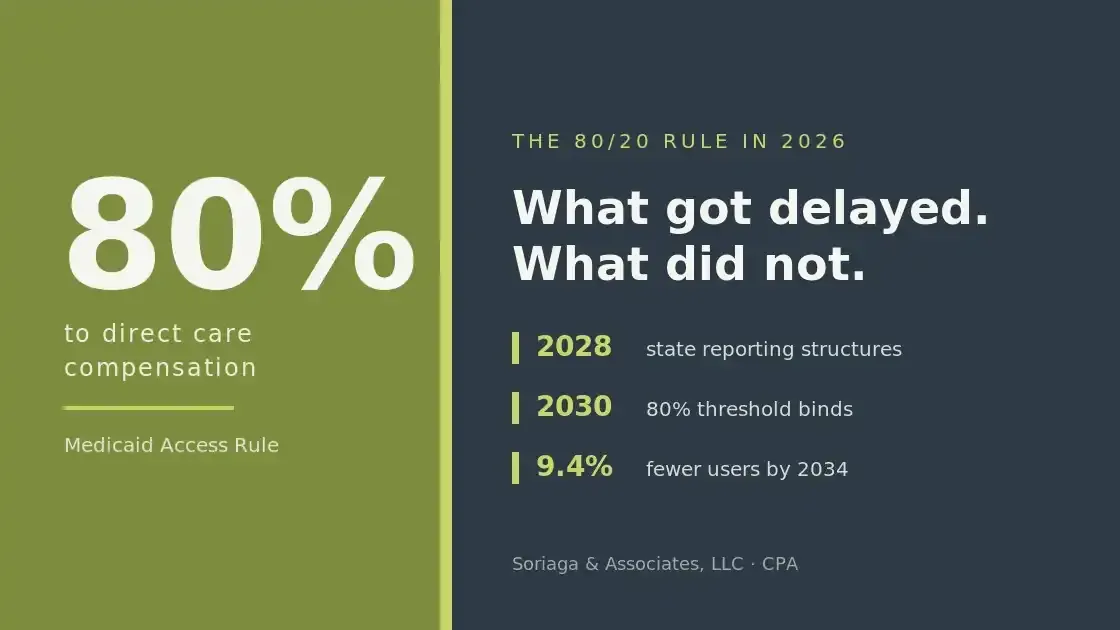
The 80% compensation pass-through from the 2024 Ensuring Access to Medicaid Services final rule (CMS-2442-F) has not been rescinded. What exists is a proposed rule under review at OIRA — RIN 0938-AV70, "Strengthening the Integrity of Medicaid and CHIP Managed Care, Financing, and Access to Care" (CMS-2450), received May 12, 2026 and still pending as of September 18, 2026. CMS's own Unified Agenda entry says the rule will address "rescinding or revising provisions finalized in the 2024 final rules," naming CMS-2442-F among them. It does not name the 80/20 provision specifically. Until a proposed rule publishes, the compensation pass-through stands, and the 2030 payment threshold stands with it.
The FLSA home care rule may revert
DOL's proposal to rescind the 2013 domestic service rule — which would restore third-party home care employers' ability to claim the companionship services and live-in overtime exemptions — is listed at final rule stage with a projected November 2026 publication (RIN 1235-AA51). If it publishes as proposed, the overtime economics of live-in and companionship staffing change materially in states that follow the federal standard. States with their own broader wage-and-hour rules, New York and California among them, would not be affected the same way.
Both of these are the kind of pending item that belongs in a documented assumption log rather than a forecast, which is exactly the discipline that separates agencies that survive a rate cycle from agencies that are surprised by one. Clean bookkeeping for home care agencies is what makes the direct-care compensation split reportable when a rule finally lands, rather than something you reconstruct under deadline.
What the National Wage Data Says About Your Recruiting Position
The floor is the legal minimum. The market rate is what actually fills shifts.
| Metric | Value | Data year |
|---|---|---|
| Median hourly wage, home health and personal care aides | $17.21 | May 2025 |
| Mean hourly wage | $17.36 | May 2025 |
| Employment (OEWS) | 4,305,810 | May 2025 |
| 10th percentile annual wage | under $27,040 | May 2025 |
| 90th percentile annual wage | over $45,040 | May 2025 |
| Projected employment change, 2025-2035 | +18% (+847,300 jobs) | 2025-35 projection |
| Average annual openings | about 760,500 | 2025-35 projection |
Read the confirmed 2027 floors against that $17.21 median. California's $17.40 floor now sits above the national median wage for the occupation. Colorado's $15.71 and Michigan's $15.00 sit below it. In California the floor has effectively become the market, which removes wage as a recruiting differentiator and pushes competition onto scheduling reliability, hours guarantees, and benefits. In Michigan the floor still leaves headroom — but a 9.2% statutory jump compresses that headroom fast.
What to Do Before January 1
- Lock the confirmed states now. California, Colorado, and Michigan have published rates. Those three belong in the 2027 budget as hard numbers this month.
- Flag the unannounced states as a range, not a point estimate, and set a calendar reminder for early October when New York and Washington typically publish.
- Build a per-hour cost stack by state and branch — base wage, payroll taxes, workers' comp, PTO accrual, supervision, mileage, and in New York the wage-parity benefit.
- Measure your wage delta against the applicable floor. If it is near zero, you have no recruiting headroom and no absorption capacity for the next increase.
- Quantify declined referrals for lack of staff. Access data moves payers in a rate conversation more reliably than cost data.
- Separate direct-care compensation in the chart of accounts regardless of what happens to the 80/20 rule. Every plausible outcome still requires that split.
The Bottom Line
Three confirmed increases, one large unknown, and two federal rules in motion. The agencies that come through 2027 intact will not be the ones in the cheapest states — they will be the ones that know cost per hour to the penny, by payer and by branch, and walk into rate negotiations before January 1 rather than after. If you want a second set of eyes on the cost model you are about to take into a rate conversation, schedule a free consultation.
Sources
- California Department of Industrial Relations, news release 2026-66, August 13, 2026
- Colorado Department of Labor and Employment, 2027 minimum wage press release, August 13, 2026
- Michigan Department of Labor and Economic Opportunity, Minimum Wage
- New York State Department of Labor, Minimum Wage
- New York State Department of Labor, Home Care Aide Minimum Wage Fact Sheet P105
- New York State Department of Labor, Home Health Care Aides and Wage Parity
- Washington State Department of Labor and Industries, 2026 minimum wage announcement
- New Jersey Department of Labor and Workforce Development, minimum wage release, October 1, 2025
- Missouri Department of Labor and Industrial Relations, Minimum Wage
- Industrial Commission of Arizona, Minimum Wage
- Illinois Department of Labor, Minimum Wage Law
- Commonwealth of Massachusetts, Minimum Wage and Overtime Information
- U.S. Department of Labor, Minimum Wage
- U.S. Department of Labor, Wage and Hour Division, Direct Care Workers
- Office of Information and Regulatory Affairs, Unified Agenda RIN 1235-AA51
- Office of Information and Regulatory Affairs, Unified Agenda RIN 0938-AV70 (CMS-2450)
- U.S. Bureau of Labor Statistics, Occupational Employment and Wage Statistics, May 2025
- U.S. Bureau of Labor Statistics, Occupational Outlook Handbook: Home Health and Personal Care Aides
Last updated: September 2026.
Soriaga & Associates, LLC is a CPA firm specializing in home care, home health, and hospice accounting, including Medicare cost report filing for certified agencies.