Hospice Billing Guide: Levels of Care, Revenue Codes, NOEs and the Aggregate Cap
Christian Soriaga, CPA13 min read
On this page
Quick answer: Hospice billing is a daily-rate system: every day of care is billed at one of four levels (revenue codes 0651, 0652, 0655 and 0656), the Notice of Election must be accepted within 5 calendar days of admission, and claims go out monthly. Underneath it all, the aggregate cap limits what Medicare will let you keep.
For FY 2027 (October 1, 2026 to September 30, 2027), the aggregate cap is $36,174.75 per beneficiary, and routine home care pays a national rate of $236.33 a day for days 1 to 60 (CMS Transmittal 13976, September 30, 2026).
Most hospice cash-flow pain traces to a late NOE, a missing face-to-face attestation, a claim that spans two months, or a cap liability nobody saw coming.
Key takeaways
- Medicare pays four daily rates: routine home care (0651), continuous home care (0652), inpatient respite (0655) and general inpatient (0656).
- FY 2027 routine home care is $236.33 per day for days 1 to 60 and $186.33 for day 61 and later, before wage-index adjustment.
- The NOE must be submitted and accepted within 5 calendar days of the admission date. Days before acceptance are not paid and are provider liability.
- Hospices bill monthly by calendar month on type of bill 081x or 082x. A claim spanning two months is returned.
- The service intensity add-on (SIA) pays extra for RN and social worker visits during routine home care in the last 7 days of life.
- The FY 2027 aggregate cap is $36,174.75, up 2.3% from $35,361.44. Inpatient days cannot exceed 20% of total Medicare days.
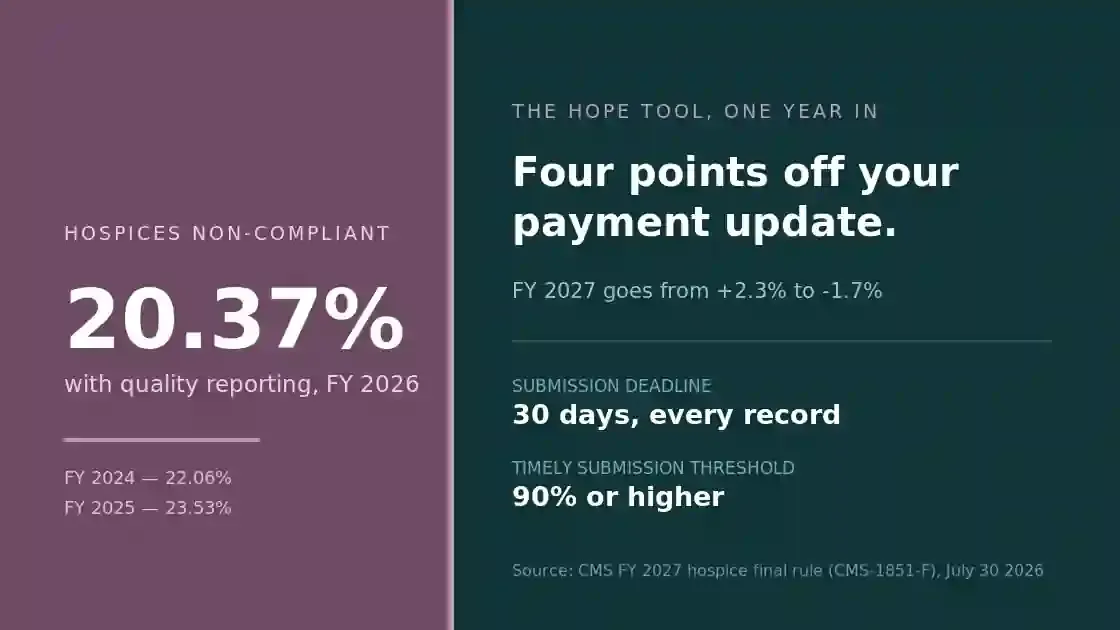
- Hospices that miss quality reporting get a -1.7% update instead of +2.3%.
- For elections on or after October 1, 2026, the election statement addendum is mandatory for every patient.
- The cost report (CMS-1984-14) and the self-determined cap filing are each due 5 months after the period ends.
Not sure where your billing process leaks cash? Book a free 20-minute consultation and we will review your NOE timing, claim edits and cap exposure.
Hospice billing basics: monthly claims and type of bill
Medicare pays a hospice a predetermined daily rate for each day a beneficiary is under its care, with no retroactive adjustments other than the statutory caps (Medicare Claims Processing Manual, Ch. 11, section 30.1).
Monthly billing by calendar month
Hospices must bill each beneficiary monthly, and the claim must stay inside one calendar month rather than a 30-day period. A patient admitted August 8 who revokes on September 1 generates two claims: August 8 to 31, and September 1 to 1. A claim that spans multiple months is returned for correction. The one exception is a patient who is discharged or revokes and then re-elects in the same month (Ch. 11, section 90).
Type of bill and filing limit
| Item | Rule | Source |
|---|---|---|
| Type of bill, non-hospital-based hospice | 081x | Claims Processing Manual Ch. 11, 30.3 |
| Type of bill, hospital-based hospice | 082x | Claims Processing Manual Ch. 11, 30.3 |
| Timely filing of claims | 1 calendar year after the date of service | 42 CFR 424.44 |
Each level-of-care line must carry a HCPCS code showing where care happened: Q5001 for the patient's home, Q5003 for a long-term care or non-skilled nursing facility, Q5004 for a skilled nursing facility, Q5006 for an inpatient hospice facility. If care moved during the month, bill one line per location.
The four hospice levels of care and FY 2027 rates
FY 2027 national rates for hospices that submit quality data:
| Level of care | Revenue code | FY 2027 national rate | Source |
|---|---|---|---|
| Routine home care, days 1 to 60 | 0651 | $236.33 per day | CMS Transmittal 13976, Table 1 |
| Routine home care, day 61 and later | 0651 | $186.33 per day | CMS Transmittal 13976, Table 1 |
| Continuous home care | 0652 | $1,726.16 per 24 hours ($71.92 per hour) | CMS Transmittal 13976, Table 1 |
| Inpatient respite care | 0655 | $545.93 per day | CMS Transmittal 13976, Table 1 |
| General inpatient care | 0656 | $1,231.51 per day | CMS Transmittal 13976, Table 1 |
These are national rates before wage-index adjustment, for care on or after October 1, 2026. One caution: CMS rescinded Transmittal 13924 (August 18) and replaced it with Transmittal 13976 (September 30) after a technical error in the wage index forced the rates to be recalculated. If your billing system was loaded in August, confirm it matches the September 30 tables.
Routine home care: the 60-day split
Routine home care (RHC) is paid for every day the patient is not at another level. Days 1 to 60 of an election pay the higher rate; day 61 and later pay the lower one. That is a $50.00 daily difference in FY 2027 ($236.33 minus $186.33).
The count follows the patient. Medicare counts 60 days from the admission date whether or not some days were non-covered. If a patient is discharged and readmitted within 60 days, the day count continues; after a break of more than 60 days, a new election resets it to the high rate (Ch. 11, section 30.2).
Continuous home care
Continuous home care (CHC) is for a period of crisis, at home only, and is not paid during a hospital, SNF or inpatient hospice stay:
- At least 8 hours of care in the midnight-to-midnight day, not necessarily consecutive.
- More than half the care must be nursing by an RN or LPN. Aide care cannot be discounted or given "at no charge" to qualify.
- Time is reported in 15-minute increments. Shift changes, meal breaks and staff education do not count.
Inpatient respite and general inpatient care
Inpatient respite is paid for a maximum of 5 continuous days at a time, counting the admission date but not the discharge date. The sixth and later days pay at the routine home care rate. General inpatient care (GIP) is paid in a Medicare-certified hospice facility, hospital or SNF. On the day of discharge from an inpatient unit, the home care rate applies unless the patient dies as an inpatient, in which case the inpatient rate is paid for that date (Ch. 11, section 30.1).
Illustrative calculation, not a published figure: a patient who stays on routine home care for 150 days is paid 60 days at $236.33 plus 90 days at $186.33, or $14,179.80 plus $16,769.70, which is $30,949.50 at national rates before wage adjustment. That single patient uses most of the $36,174.75 cap amount, which is why length of stay drives cap risk.
The Notice of Election and the Notice of Termination
The 5-day NOE rule
When a patient elects hospice, the hospice files a Notice of Election (NOE). A timely NOE is one submitted to and accepted by the Medicare Administrative Contractor within 5 calendar days after the admission date. The date the NOE posts to the Common Working File does not decide timeliness (Ch. 11, section 20.1.1).
If the NOE is late, Medicare does not cover or pay for the days from the admission date until the NOE is submitted and accepted. Those days are provider liability, the hospice cannot bill the beneficiary for them, and they are reported on the claim with occurrence span code 77 with the charges shown as non-covered.
Illustrative calculation, not a published figure: if an NOE is accepted about 8 days after admission, those 8 days at the national RHC rate of $236.33 are roughly $1,890 of unpaid care for one patient, before wage adjustment.
Exceptions to a late NOE
A hospice can request an exception. The manual lists four qualifying circumstances: a disaster that damages the hospice's ability to operate, a CMS or MAC systems problem, a newly certified hospice still awaiting notice or its user ID, and other circumstances beyond the hospice's control.
A common trap is the corrected NOE: an error such as a changed beneficiary identifier may not be returned for correction until Medicare finishes processing it. To get an exception you generally must document when the original NOE was submitted, when it became available to correct, and that you resubmitted within two business days. MACs will not grant exceptions for identifier changes visible more than two weeks before admission, so run an eligibility check right before admitting.
The Notice of Termination or Revocation
If a patient is discharged alive or revokes the election, the hospice files a Notice of Termination/Revocation (NOTR, type of bill 8xB) within 5 calendar days after the effective date of discharge or revocation, unless a final claim has already been filed. It is not used for a transfer, and it is rejected if the NOE was not posted first (Ch. 11, section 20.1.2).
Billing leaking cash at the front door? If NOE timing, claim returns or cap exposure are on your mind, we can review your process with you. Book a free 20-minute call and bring your last three months of remittances.
The service intensity add-on (SIA)
The SIA is an extra payment on top of routine home care for RN visits and social worker visits in the last 7 days of life. Key rules from the manual (Ch. 11, section 30.2.2):
| Element | Rule |
|---|---|
| Eligible visits | Visits by an RN or a social worker during routine home care |
| Window | The last 7 days of life (the patient is discharged deceased) |
| Minimum and maximum | 15 minutes minimum; 1 to 16 units per day (4 hours) combined |
| Not eligible | Social worker phone calls |
| Payment | CHC rate per 15 minutes multiplied by units (up to 16), wage-adjusted |
Illustrative calculation, not a published figure: the FY 2027 national CHC hourly rate of $71.92 is about $17.98 per 15-minute unit. At the 16-unit daily maximum, that is roughly $288 for the day at national rates, before wage adjustment.
The aggregate cap and the inpatient cap
How the aggregate cap works
Total Medicare payments to a hospice for a cap year are compared with an aggregate cap: the number of beneficiaries counted multiplied by the cap amount. Anything paid above that must be refunded (Benefit Policy Manual, Ch. 9, section 90.2). The cap year runs October 1 to September 30.
| Metric | Value | Source |
|---|---|---|
| FY 2027 aggregate cap amount | $36,174.75 | CMS Transmittal 13976 |
| FY 2026 aggregate cap amount | $35,361.44 | CMS Transmittal 13976 |
| Update applied | 2.3% (FY 2027 payment update) | CMS Transmittal 13976 |
Beneficiaries are counted under the proportional method (a fraction of each patient's total hospice days spent with you in the cap year) or, for eligible hospices that elected it, the streamlined method (each patient counted once in the first year of service). Hospices cannot switch back and forth.
Your claims create the "total payments" side of that comparison, so track payments and beneficiary counts against the cap all year. Our post on FY 2027 hospice payment changes covers the rule behind the new cap amount.
Self-determined cap filing and repayment
The hospice must file its own aggregate cap determination within 5 months after the end of the cap year and send any overpayment at that time. If it does not file, Medicare can suspend payments in whole or in part until it does (42 CFR 418.308). The MAC later issues a cap determination letter, and cap determinations can be reopened for up to 3 years (Benefit Policy Manual Ch. 9, section 90.2.2 and 90.3).
For scale, one MAC (CGS Administrators) identified $9.1 million in cap overpayments across 805 hospices for cap year 2020 (OIG A-06-23-09003, November 2024).
The inpatient cap
Separate from the aggregate cap, inpatient days (general inpatient plus respite) may not exceed 20% of a hospice's total Medicare days for the cap year. Payment for days over the limit is cut back to the routine home care rate, and the excess must be refunded (Benefit Policy Manual Ch. 9, section 90.1). A hospice with 40,000 total Medicare days has an 8,000-day inpatient allowance.
Billing compliance: documents auditors ask for first
Certification and the physician narrative
A written certification of terminal illness must be on file before a claim is submitted. It must include the six-month prognosis statement, supporting clinical findings, signatures and dates, and a physician narrative that reflects the patient's individual circumstances. The narrative cannot use check boxes or standard language used for every patient (Benefit Policy Manual Ch. 9, section 20.1).
The face-to-face encounter
For the third benefit period and each one after, a hospice physician or hospice nurse practitioner must have a face-to-face encounter no more than 30 calendar days before the recertification. The attestation must be completed before the claim is submitted. If the encounter is untimely, the patient cannot be recertified and the hospice must discharge the patient from the Medicare benefit. CMS expects the hospice to keep caring for the patient at its own expense until a timely encounter re-establishes eligibility (Claims Processing Manual Ch. 11, section 30.3; Benefit Policy Manual Ch. 9, section 20.1).
The election statement and addendum
The election statement must show the effective date, designated attending physician and patient signature. In the FY 2027 final rule, CMS made the election statement addendum mandatory for all beneficiaries who elect hospice; before, it had to be provided on request. For elections beginning on or after October 1, 2026, the hospice must give the addendum in writing within the first 5 days of the election's effective date and file it with the election statement. The addendum lists conditions, items, services and drugs the hospice considers unrelated to the terminal illness (CMS FY 2027 final rule fact sheet; 42 CFR 418.24 as amended, 91 FR 49118). The Benefit Policy Manual (section 20.2.1.2) still describes the older request-based version, under which a requested addendum is a condition for payment.
What billing means for the cost report and your finances
Billing and cost reporting use the same facts. The days, levels of care and revenue you bill are the starting point for the hospice cost report on Form CMS-1984-14, which is due on or before the last day of the fifth month after your fiscal year ends (42 CFR 413.24(f)(2)).
The quality-reporting penalty also flows through billing. For FY 2027, hospices that comply with quality reporting get a 2.3% update (3.2% market basket less a 0.9-point productivity adjustment), while those that do not get -1.7%, which is the 2.3% update minus 4 percentage points (CMS FY 2027 final rule fact sheet). On the national RHC high rate, that is the difference between $236.33 and $227.09 per day (Transmittal 13976, Tables 1 and 2). For benchmarks across the industry, see our hospice cost report statistics.
How Soriaga & Associates helps
Our hospice accounting services cover monthly bookkeeping and billing oversight so claims, deposits and cap tracking reconcile. Our Fractional CFO services give owners a monthly view of cash, cap exposure and margins. Medicare cost report filing is a flat $1,599.99 for low- or full-utilization hospices, or $500 with no utilization.
Frequently asked questions
What are the four hospice levels of care and their revenue codes?
Medicare pays hospices one of four daily rates. Routine home care is revenue code 0651, continuous home care is 0652, inpatient respite care is 0655, and general inpatient care is 0656. Each level-of-care line also carries a Q5001 to Q5010 HCPCS code showing where the care was delivered, such as the patient's home or a nursing facility.
How long does a hospice have to file the Notice of Election?
Five calendar days after the admission date. The NOE must be submitted to and accepted by the Medicare Administrative Contractor within that window. If it is late, Medicare does not pay for the days from admission until the NOE is accepted. Those days become provider liability, and the hospice cannot bill the patient for them.
How is the hospice aggregate cap calculated?
Medicare multiplies the number of beneficiaries a hospice served in the cap year by the cap amount, which is $36,174.75 for the 2027 cap year (October 1, 2026 to September 30, 2027). Payments above that total must be refunded. The hospice files its own cap determination within five months after the cap year ends.
How often do hospices bill Medicare, and which type of bill is used?
Monthly, by calendar month rather than 30-day period. Claims use type of bill 081x for non-hospital-based hospices and 082x for hospital-based ones. A claim that spans two calendar months is returned for correction. Claims must be filed within one calendar year after the date of service to be timely.
When is the hospice cost report due, and what does Soriaga & Associates charge?
The hospice cost report (Form CMS-1984-14) is due on or before the last day of the fifth month after the fiscal year ends. Soriaga & Associates, LLC prepares hospice cost reports for a flat $1,599.99 for low- or full-utilization providers, or $500 if the hospice had no Medicare utilization.
Next step
If you have had denials or never tracked cap exposure monthly, book a free 20-minute consultation and we will walk through your billing workflow and cost report timeline.
Sources
- CMS, FY 2027 Hospice Wage Index and Payment Rate Update Final Rule (CMS-1851-F) fact sheet
- CMS Transmittal 13976, FY 2027 hospice payment rates, cap and wage index (September 30, 2026)
- CMS, Medicare Claims Processing Manual, Chapter 11: Processing Hospice Claims
- CMS, Medicare Benefit Policy Manual, Chapter 9: Coverage of Hospice Services
- Federal Register, FY 2027 Hospice Wage Index and Payment Rate Update final rule (2026-15686, August 3, 2026)
- 42 CFR 424.44, Time limits for filing claims (govinfo)
- 42 CFR 418.308, Limitation on the amount of hospice payments (govinfo)
- 42 CFR 413.24, Adequate cost data and cost finding, cost report due date (govinfo)
- CMS, Form CMS-1984-14 Hospice Facility Cost Report
- HHS OIG, A-06-23-09003: CGS Administrators did not reopen and recalculate most selected hospices' caps for years prior to 2020 (November 2024)
Last updated: October 2026.
This article is general information, not legal or tax advice.
Soriaga & Associates, LLC is a CPA firm founded in 1985 in Lisle, Illinois, serving home health, hospice, home care, wound care and dental providers nationwide. (630) 491-1268.