OASIS-E2 and PDGM Case-Mix Accuracy: Protecting Home Health Revenue in 2026
Christian Soriaga, CPA6 min read
On this page
Key Takeaways
- OASIS-E2 took effect April 1, 2026 and is required for all assessments with a target date on or after that day (OMB control number 0938-1279, expiring 12/31/2028).
- The legacy iQIES data-entry front end was discontinued April 1, 2026. Assessments dated 1/1/2025-3/31/2026 are accepted only through December 31, 2026.
- 432 case-mix groups come from 2 admission sources x 2 timing categories x 12 clinical groups x 3 functional impairment levels x 3 comorbidity levels.
- CY 2026 recalibrated all 432 weights, functional levels, comorbidity subgroups, and LUPA thresholds using CY 2024 claims as of July 11, 2025; 18 groups saw their LUPA threshold drop by one visit.
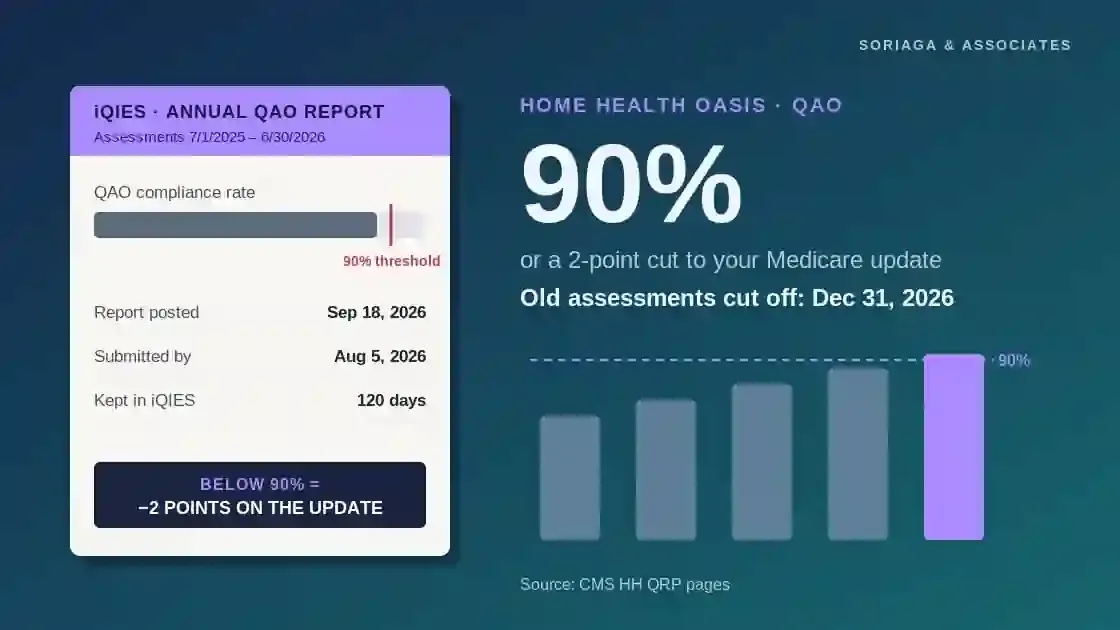
- The CY 2026 national standardized 30-day payment amount is $2,038.22, or $1,998.41 for agencies that fail quality reporting — a 2-percentage-point APU penalty.
- CY 2026's aggregate impact was -1.3%, or -$220 million: a +2.4% update against a -1.023% permanent and -3.0% temporary behavior adjustment.
- The CY 2027 proposed rule (CMS-1844-P) proposes no new permanent adjustment, keeps the -3.0% temporary adjustment, and estimates a +2.4% net aggregate impact (+$420 million). It drew 657 comments and is not final.
- OASIS data must reach CMS within 30 days of the assessment date to count as timely for the HH QRP.
What OASIS-E2 Changed, and What It Broke
OASIS-E2 is a targeted revision rather than a rewrite. The items it touches sit close to scoring and submission edits, which is why a modest instrument change carries financial weight.
The instrument
| Item | Detail | Source |
|---|---|---|
| Effective date | Assessments with a target date on or after 4/1/2026 | CMS OASIS Data Sets |
| Prior version | OASIS-E1, effective 1/1/2025 | CMS OASIS Data Sets |
| OMB control number | 0938-1279, expires 12/31/2028 | CMS OASIS Data Sets |
| Submission system | iQIES, file upload only | CMS / QTSO |
The submission change most agencies underestimated
CMS discontinued the legacy iQIES front-end interface — the screen QA staff used to key assessments in by hand — effective April 1, 2026. Assessments with target dates on or after that day cannot be hand-entered at all; data must be uploaded in the correct file format. Assessments dated 1/1/2025 through 3/31/2026 will be accepted until 12/31/2026, and then that door closes too.
If your agency used manual entry as a backstop when the EMR export failed, the backstop is gone. A file-format error is now a submission failure, and a submission failure is an APU risk worth two percentage points on every 30-day period for a full year.
How 432 Groups Actually Get Built
PDGM assigns each 30-day period to one of 432 home health resource groups. CMS states the arithmetic plainly: 2 x 2 x 12 x 3 x 3 = 432.
The five variables
| Variable | Levels | Set by | OASIS-dependent? |
|---|---|---|---|
| Admission source | 2 — community or institutional | Claims history | No |
| Timing | 2 — early or late | Claims history | No |
| Clinical grouping | 12 | Primary diagnosis coding | Indirectly |
| Functional impairment level | 3 — low, medium, high | OASIS GG and M items | Yes |
| Comorbidity adjustment | 3 — none, low, high | Secondary diagnosis coding | Indirectly |
The 12 clinical groups are musculoskeletal rehabilitation; neuro/stroke rehabilitation; wounds; behavioral health; complex nursing interventions; and seven MMTA subgroups covering surgical aftercare, cardiac and circulatory, endocrine, gastrointestinal and genitourinary, infectious disease/neoplasms/blood-forming diseases, respiratory, and other.
Functional impairment level is the one variable clinicians control at the bedside, and it is the one CMS keeps re-deriving. CMS sets the functional thresholds so that roughly one-third of periods in each clinical group falls into each of the three levels. That is a relative standard, not an absolute one. When CMS recalibrates against newer claims, an identical clinical picture can score into a different level than it did the year before — and revenue per period changes without anyone at your agency doing anything differently.
The comorbidity structure
For CY 2026, CMS finalized 20 low-comorbidity subgroups and 98 high-comorbidity interaction subgroups. A period receives the low adjustment or the high adjustment, never both. A diagnosis qualifies for inclusion only if it appears in more than 0.1% of 30-day periods with at least median resource use — which is why a comorbidity your clinicians consider obvious may carry no payment weight at all, and why coding to the list beats coding to intuition.
The LUPA Trap
Every one of the 432 groups carries its own LUPA threshold, set at the 10th percentile of visits in that group or two visits, whichever is higher. CMS updates those thresholds annually.
| Rule year | LUPA threshold movement | Status | Source |
|---|---|---|---|
| CY 2026 | 18 case-mix groups declined by one visit | Final | CY 2026 HH PPS final rule |
| CY 2027 | 18 groups decline by one visit; 2 groups increase by one visit | Proposed | CMS-1844-P |
A period that cleared threshold by a single visit in CY 2025 can fall under it in CY 2026 for the identical patient. LUPA converts a full 30-day period payment into a per-visit payment — the largest single per-episode revenue event in home health, and the most preventable one, because it is a scheduling problem rather than a clinical one.
CY 2025-forward LUPA add-on factors
| Discipline | Add-on factor |
|---|---|
| Skilled nursing | 1.7200 |
| Physical therapy | 1.6225 |
| Speech-language pathology | 1.6696 |
| Occupational therapy | 1.7238 |
Unchanged in CY 2026 and in the CY 2027 proposal.
Where accuracy turns into dollars
| Risk | Financial consequence |
|---|---|
| Functional score understated | Lower case-mix weight, lower payment for identical care |
| Functional score overstated | Audit and overpayment exposure |
| Visit count below the group's LUPA threshold | Full period payment replaced by per-visit payment |
| Qualifying comorbidity not coded | Missed low or high comorbidity adjustment |
| Assessment submitted late or in a bad format | HH QRP non-compliance, 2-point APU reduction |
The Rate Environment Around the Assessment
Case-mix accuracy matters more when the base rate is under pressure, and it is.
CY 2026, final
| Metric | Value | Source |
|---|---|---|
| National standardized 30-day payment amount | $2,038.22 | CMS Transmittal 13488 (CR 14304) |
| Same, agencies not submitting quality data | $1,998.41 | CMS Transmittal 13488 |
| Payment update | +2.4% (3.2% market basket less 0.8 pt productivity) | CY 2026 final rule |
| Permanent behavior adjustment | -1.023% | CY 2026 final rule |
| Temporary behavior adjustment | -3.0% | CY 2026 final rule |
| Aggregate impact vs. CY 2025 | -1.3% (-$220 million) | CY 2026 final rule |
| Fixed-dollar loss ratio | 0.37 | CY 2026 final rule |
CY 2027, proposed — not final
| Metric | Value | Status |
|---|---|---|
| Payment update | +2.1% (+$370 million) | Proposed |
| Net aggregate impact vs. CY 2026 | +2.4% (+$420 million) | Proposed |
| Additional permanent adjustment | None proposed | Proposed |
| Temporary behavior adjustment | -3.0%, collecting about $500 million | Proposed |
| Remaining temporary adjustment balance | about $4.9 billion | Proposed rule estimate |
| Recalibration data year | CY 2025 claims as of March 15, 2026 | Proposed |
| Fixed-dollar loss ratio | 0.29 | Proposed |
| Estimated 30-day periods, CY 2027 | 7,680,775 | Proposed rule estimate |
| Comments received | 657 | Regulations.gov, docket CMS-2026-2311 |
The comment window closed August 31, 2026, and no final rule had issued as of September 18, 2026.
The margin context CMS itself publishes
| Comparison | Base rate | Estimated 30-day cost | Spread |
|---|---|---|---|
| CY 2024 | $2,038.13 | $1,548.39 | about 32% |
| CY 2025 | $2,057.35 | $1,532.84 | about 34% |
CMS uses this spread to argue the rates are adequate. It is a national average against a national average cost, and it is the number every proposed cut rests on. An agency whose actual cost per period runs materially above $1,532.84 is not the agency in that table — and the only way to prove that in a comment letter, a rate appeal, or a bank conversation is a cost structure that ties cleanly to the Medicare cost report rather than to a management spreadsheet.
Building an Internal Accuracy Program
Case-mix accuracy is a documentation-control problem, not a coding problem. The fix is process, and it is auditable.
- Reconcile the assessed functional level against the final claim on a monthly sample. Divergence means the OASIS and the claim are telling different stories.
- Run a LUPA watch list against the actual CY 2026 thresholds for your top 20 payment groups by volume, not a single blended threshold.
- Second-review every SOC and ROC for 60 days after any instrument change — April 2026 for E2, and again whenever the next version lands.
- Track inter-clinician variance on GG items. Wide variance on the same patient type is the clearest signal of a training gap, and the cheapest one to close.
- Validate file format before the deadline, not after a rejection notice. Manual entry is no longer available as a recovery path.
- Clear the 12/31/2026 backlog. Any assessment dated 1/1/2025-3/31/2026 that is still unsubmitted has a hard expiration.
The Bottom Line
The instrument changed in April, the weights changed in January, and both change again if CY 2027 finalizes as proposed. Agencies that audit their own functional scoring and LUPA exposure quarterly keep the revenue their care actually earns. Agencies that do not find out from a MAC, two years late, in a letter. If you want a second set of eyes on where your case mix and your claims diverge, schedule a free consultation.
Sources
- CMS, OASIS Data Sets — OASIS-E2 instruments effective April 1, 2026
- QTSO/CMS, OASIS iQIES Software Discontinuation, February 24, 2026
- CMS, Overview of the Patient-Driven Groupings Model
- CMS, CY 2026 Home Health PPS Final Rule Fact Sheet (CMS-1828-F), November 28, 2025
- CMS Transmittal 13488 (CR 14304), November 20, 2025 — CY 2026 payment rates
- CMS, CY 2027 Home Health PPS Proposed Rule Fact Sheet (CMS-1844-P), July 1, 2026
- CMS, HH QRP Quick Reference Guide — 30-day submission requirement and 2-point APU reduction
Last updated: September 2026.
Soriaga & Associates, LLC is a CPA firm with 25+ years of home health and hospice accounting experience. Ask about our bookkeeping services built for PDGM agencies.