Home Health Consulting: What a Consultant vs. a CPA Should Fix First
Christian Soriaga, CPA13 min read
On this page
Quick answer: Home health consulting usually means clinical, survey and OASIS help, which fixes how you deliver and document care. A healthcare CPA fixes how the money is tracked, billed, reported and taxed. Fix first whichever problem can hurt you soonest, and expect to need both.
CMS's FY 2025 Medicare fee-for-service data put home health's improper payment rate at 6.9%, about $1.07 billion, and 49.4% of that was insufficient documentation (CMS, 2025 Medicare FFS Supplemental Improper Payment Data).
If you run a Medicare-certified agency, you have probably been pitched on home health consulting more than once. Some pitches are about surveys, some about OASIS, some about "profitability." This guide sorts out which problems a consultant fixes, which a CPA fixes, and which need both, so you spend your first dollar where it matters.
Key takeaways
- Consultants and CPAs fix different things. Consultants cover survey readiness, clinical documentation, OASIS and policies. A CPA covers books, the cost report, cash flow, PDGM revenue analysis and tax.
- Documentation is the biggest audit exposure. In CMS's 2025 data, 49.4% of home health improper payments were insufficient documentation and 30.4% were medical necessity errors.
- The CY 2026 base rate is $2,038.22 per 30-day period after the -3.0% temporary adjustment. The rate is not the lever you control; your costs and billing accuracy are.
- CY 2027 is still proposed. CMS proposes a net +2.4% update and continues the -3.0% temporary adjustment. The final rule is not out yet.
- MedPAC reported a 21.2% FFS Medicare margin for freestanding agencies in 2024 but only 5.0% all-payer. Your own margin may look nothing like either, which is why cost per visit matters.
- Your cost report is due by the last day of the fifth month after your fiscal year ends (42 CFR 413.24). A messy ledger makes it expensive and risky.
- New-agency enrollment is frozen. A nationwide moratorium on new Medicare home health agencies began May 13, 2026, and is scheduled to run through about November 13, 2026 unless CMS extends it.
- Before you hire anyone, ask for a written scope, named deliverables and who is accountable when a number or a survey result is wrong.
Not sure whether you need a consultant, a CPA, or both? A 20-minute call is enough to sort your top three problems into "clinical" and "financial." Book a free 20-minute call and we will tell you honestly which one comes first.
Home health consulting: what consultants actually cover
"Home health consulting" is a broad label. In practice it splits into a few lanes, and the lane matters more than the title.
Clinical, survey and compliance consultants
A home health agency consultant with a clinical background typically helps with the items below. This is the right hire when a survey, a complaint, or a documentation problem is the threat.
- Conditions of Participation. The federal rules in 42 CFR Part 484 set the standards your agency is surveyed against, including quality assessment and performance improvement (QAPI) under 484.65, which requires an ongoing, agency-wide, data-driven program.
- Survey readiness. Mock surveys, plans of correction, and policy and procedure manuals.
- OASIS and clinical documentation. Coding accuracy, plan-of-care consistency and visit-note quality. This work protects both patient care and payment, because documentation is what supports your claims.
- Startup help. Licensing, accreditation and Medicare enrollment steps for new agencies.
A good home health compliance consultant will also tell you what they do not do. If someone offers to "optimize your cost report" without reading your general ledger, ask how.
What a CPA covers that consultants usually do not
A home health CPA, or a Fractional CFO, works from the financial records outward.
- A clean monthly close with revenue recorded by payer and by 30-day period.
- PDGM revenue analysis, including how many periods ended as low-utilization payment adjustments (LUPAs).
- Cost per visit by discipline, so you know where you make or lose money.
- Cash-flow forecasting that accounts for 30-day billing and payer timing.
- The Medicare cost report (Form CMS-1728-20), tax returns and owner-level planning.
You can see how we set this up on our home health accounting page.
Who fixes what: a decision table
Use this table to route each problem. "Both" means each professional covers a different half of the problem.
| Problem | Fix it with | Why |
|---|---|---|
| Survey is coming or a deficiency was cited | Consultant | Conditions of Participation (42 CFR Part 484) are clinical and operational standards |
| OASIS errors, thin visit notes, face-to-face gaps | Consultant | Documentation drives payment support and medical necessity |
| Policies and procedures are out of date | Consultant | Surveyors review them against the Conditions of Participation |
| Books are months behind or mix payers and periods | CPA | You cannot manage what you cannot see |
| You do not know cost per visit or margin by discipline | CPA | Needs ledger data and visit counts side by side |
| Cash is tight even though census is steady | CPA | Usually a billing-timing, denial or payroll-timing problem |
| Cost report (CMS-1728-20) is due | CPA | Must tie to the general ledger and the filing deadline |
| Medicare is reviewing or recouping claims | Both | Consultant addresses documentation; CPA models the cash impact and records the liability |
| Documentation errors are driving payment errors | Both | Consultant fixes the notes; CPA tracks the dollars and denials |
| Adding a location, selling, or bringing in an investor | Both | Compliance diligence plus financial diligence |
| Tax planning and owner compensation | CPA | Entity and tax strategy |
The first five financial fixes
If your clinical house is reasonably in order, these five items give you the clearest picture of the business. They are the core of any home health financial consulting engagement.
1. Close the books every month
Most agencies we see start here. A clean close means bank accounts are reconciled, payroll is posted, and revenue is booked to the correct period and payer. Without it, every other number is a guess. A monthly close also makes your cost report much cheaper to prepare later, since the report starts from your ledger.
2. Track PDGM revenue by period and watch LUPAs
Medicare pays home health in 30-day periods. For CY 2026 the national standardized rate is $2,038.22 per period after the -3.0% temporary adjustment, before case-mix and wage adjustments, for agencies that submit quality data (CMS Transmittal 13488). The final payment for a period depends on the patient group, and CMS recalibrates the case-mix weights and LUPA thresholds for all 432 payment groups each year (CMS CY 2026 final rule fact sheet). A period with too few visits for its group is paid per visit instead of at the full case-mix amount. Tracking the share of LUPA periods by month tells you whether scheduling, referrals or documentation is costing you revenue. Our post on home health cost report statistics has more benchmark data.
3. Know your cost per visit
Cost per visit is total allocated cost divided by visits, by discipline. MedPAC found that FFS Medicare payments exceeded costs for freestanding agencies for more than 20 years, with a 21.2% margin in 2024 (MedPAC, March 2026). That is an industry average. Your own cost per visit tells you whether you are above it or below it.
Illustrative calculation, not a published figure: if a nursing visit costs you $110 fully loaded and a period averages 8 visits, that period costs about $880 in visit labor before overhead. Compare that to your actual average paid amount per period, not to the national rate.
4. Forecast cash around 30-day billing
Revenue is booked when care is delivered, but cash arrives after billing and payer processing. Payroll does not wait. A 13-week cash forecast built from your open periods, Notice of Admission timing and denials shows a shortfall weeks before it hits your bank balance.
5. Get cost report ready before the deadline
A full cost report is due on or before the last day of the fifth month after your fiscal year ends, or 150 days after year-end when your year ends on a day other than the last day of a month (42 CFR 413.24(f)(2)(i)). The report is only as good as the ledger behind it. We file the Medicare cost report for a flat fee: $1,599.99 for low- or full-utilization agencies and $500 for no-utilization agencies. See our Medicare cost report filing page for what is included.
What a consultant fixes first (and why it sometimes comes first)
Financial fixes do not outrank everything. Three situations put the consultant first.
A survey or complaint is imminent
If a state surveyor or accrediting body is about to walk in, clinical readiness comes first. No spreadsheet fixes a documentation or process gap in the time you have.
Documentation is the weak link
The CMS 2025 data are blunt. Of home health's roughly $1.07 billion in improper payments, 49.4% were insufficient documentation, 30.4% medical necessity, 11.8% no documentation, 4.8% other and 3.6% incorrect coding. The review covered claims submitted July 1, 2023 through June 30, 2024.
| Error type (home health) | Share of improper payments | Source |
|---|---|---|
| Insufficient documentation | 49.4% | CMS 2025 Medicare FFS Supplemental Improper Payment Data |
| Medical necessity | 30.4% | Same |
| No documentation | 11.8% | Same |
| Other | 4.8% | Same |
| Incorrect coding | 3.6% | Same |
Those numbers describe documentation, which is a clinical-process problem first and a payment problem second. See our post on home health improper payments and OIG audits for how that exposure turns into audits.
Facing a review, a recoupment, or a cost report you are not sure about? Bring the notice or the draft to a free call and we will tell you which part needs a clinical consultant and which part needs a CPA. Book a free 20-minute call.
You are in a program with extra review
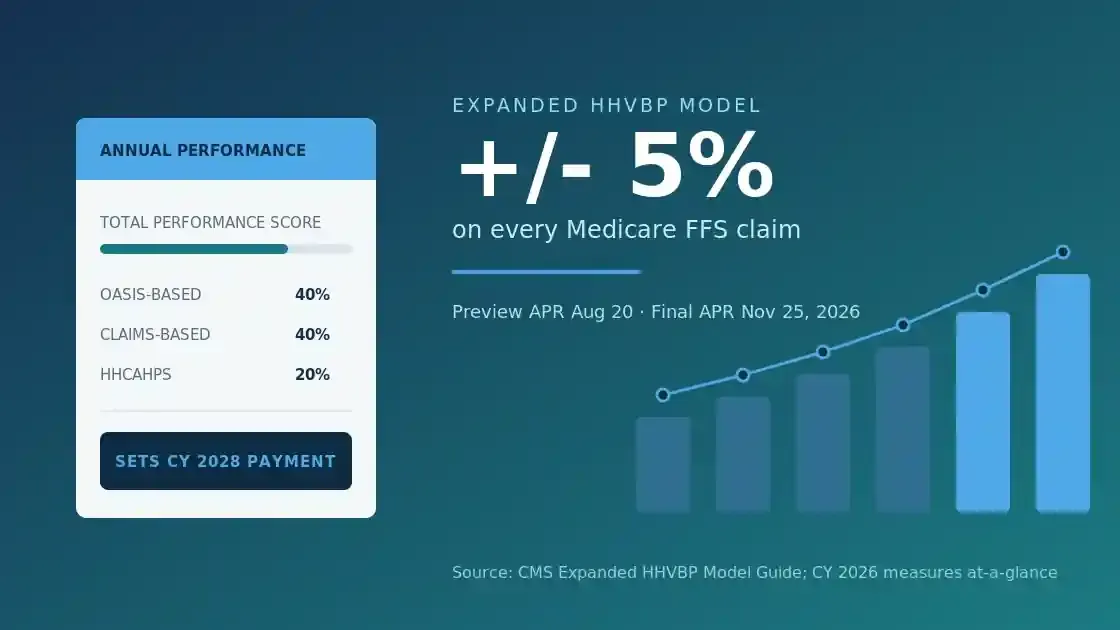
Some agencies face extra oversight. The Review Choice Demonstration for home health runs in Illinois, Ohio, Texas, North Carolina, Florida and Oklahoma, and agencies choose between pre-claim review and postpayment review (CMS). In the expanded Home Health Value-Based Purchasing model, CY 2026 is the fourth performance year, and performance in 2026 sets payment adjustments applied to CY 2028 claims (CMS). Both programs reward clean, consistent clinical documentation, so a clinical consultant earns their fee here. A CPA then tracks the cash effect.
What to ask before you hire a home health consultant
You do not need a market price to evaluate a proposal. You need clarity on what you will get. Ask every candidate, consultant or CPA:
- What exactly will you deliver, and by when? Ask for a written scope and named deliverables.
- Who does the work? The person who sells the engagement is often not the person who does it.
- What is your background? For a clinical consultant, ask about direct home health experience and survey experience. For a financial professional, ask about home health cost reports and PDGM.
- How are you paid? Flat fee, hourly or retainer. Be wary of fees tied to a percentage of "savings" or recovered revenue on a Medicare account, and ask your health care attorney to review any such arrangement.
- What happens if you are wrong? Ask about professional liability coverage and who stands behind the work in an audit.
- Can you work with my other advisors? Consultants, your CPA and your attorney should share information, not work in silos.
- How will we know it worked? Ask for a measurable result, such as a lower LUPA rate, a faster close, or a mock-survey score.
Red flags
- A guarantee of survey results, audit outcomes or higher payment.
- Anyone who will "fix" your cost report without reviewing your ledger.
- A scope that is vague, or a price with no scope attached.
- Pressure to sign quickly because of a regulatory deadline.
- No references you can call, or no one who will put their name on the work.
- Advice to bill in ways your clinicians cannot document.
What is changing in 2026 and 2027
Two things shape your priorities this fall.
Rates. CY 2026 is final: a net -1.3% aggregate change, which includes a -1.023% permanent adjustment and the -3.0% temporary adjustment (CMS CY 2026 final rule fact sheet). CY 2027 is a proposed rule only. CMS proposes a net +2.4% increase ($420 million), continues the -3.0% temporary adjustment, and proposes no new permanent adjustment (CMS CY 2027 proposed rule fact sheet, CMS-1844-P). MedPAC's March 2026 report recommends that, for 2027, Congress cut the 2026 base payment rate by 7% (MedPAC). That is a recommendation to Congress, not a rule. Plan with a range, and update when the final rule publishes. CMS has not announced a date; based on its usual timing, we expect it around early November.
New-agency enrollment. CMS announced a nationwide moratorium on Medicare enrollment of new home health agencies and hospices effective May 13, 2026, for six months, extendable in six-month increments. It also covers new branches and practice locations and non-exempt changes in majority ownership, which matters if you plan to sell or expand. It is scheduled to end around November 13, 2026. As of October 2, 2026, CMS's moratoria page (last modified August 27, 2026) still shows only the original six-month period, and no extension notice has appeared in the Federal Register, where CMS says any extension will be published. Check cms.gov and the Federal Register before you rely on a date.
| Item | Status | Source |
|---|---|---|
| CY 2026 national standardized 30-day amount | $2,038.22 (final, with -3.0% temporary adjustment; agencies submitting quality data) | CMS Transmittal 13488 |
| CY 2026 aggregate impact | -1.3% (final) | CMS CY 2026 final rule fact sheet |
| CY 2027 aggregate impact | +2.4% (proposed) | CMS CY 2027 proposed rule fact sheet |
| Freestanding HHA FFS Medicare margin, 2024 | 21.2% | MedPAC, March 2026 |
| Freestanding HHA all-payer margin, 2024 | 5.0% | MedPAC, March 2026 |
| Moratorium, new HHAs | May 13, 2026, scheduled through about Nov. 13, 2026 | CMS moratoria page |
When you need a Fractional CFO instead of a one-time project
Many consulting engagements are projects: a mock survey, a policy rewrite, a one-time cleanup. Financial oversight does not end. A monthly accounting retainer, with a Fractional CFO layer when you need forecasts and decisions, gives you a steady cadence: books closed, KPIs reviewed, cash forecast updated. Our Fractional CFO services are built for agencies that want that rhythm without a full-time hire. Retainers start at $200 per month.
Ready to put the numbers in order? Bring your last cost report, your latest P&L, and your top three worries. Book a free 20-minute call.
Frequently asked questions
What does a home health consultant do?
A home health consultant usually works on the clinical and operational side: survey readiness, OASIS accuracy, clinical documentation, policies, and Conditions of Participation. They help you pass surveys and document correctly. They generally do not keep your books, file your Medicare cost report, or prepare your tax returns.
Do I need a consultant or a CPA first?
Match the first hire to the problem. If a survey, OASIS errors or documentation gaps are the threat, start with a clinical or compliance consultant. If you cannot trust your monthly numbers, cash is tight, or a cost report is coming due, start with a healthcare CPA. Most agencies need both over time.
Can a CPA help with home health compliance?
A CPA helps with the financial side of compliance: accurate books, a cost report that ties to your ledger, and revenue records that match your claims. A CPA does not replace a clinical consultant for survey readiness or OASIS coding. The two roles cover different risks, and each checks the other's numbers.
How much does a home health consultant cost?
Fees vary widely by scope, and no neutral government source publishes a market rate, so we will not guess. Ask each firm for a written scope, deliverables and fee basis. For comparison, our Medicare home health cost report is a flat $1,599.99 for low or full utilization, or $500 for no utilization.
Sources
- CMS, 2025 Medicare Fee-for-Service Supplemental Improper Payment Data (home health Table D3)
- CMS, CY 2026 Home Health PPS Final Rule fact sheet (CMS-1828-F)
- CMS Transmittal 13488, CY 2026 home health payment rates
- CMS, CY 2027 Home Health PPS Proposed Rule fact sheet (CMS-1844-P)
- MedPAC, March 2026 Report to the Congress, Chapter 8: Home health care services
- eCFR, 42 CFR 413.24, Adequate cost data and cost finding
- eCFR, 42 CFR 484.65, Quality assessment and performance improvement (Conditions of Participation)
- CMS, Expanded HHVBP Model: CY 2026 resource
- CMS, Review Choice Demonstration for Home Health Services
- CMS, Provider Enrollment Moratoria
- Federal Register notice 2026-09717, nationwide temporary moratorium on enrollment of HHAs (May 15, 2026)
Last updated: October 2026.
This article is general information, not legal or tax advice.
Soriaga & Associates, LLC is a CPA firm founded in 1985 in Lisle, Illinois, serving home health, hospice, home care, wound care and dental providers nationwide. (630) 491-1268.