Navigating the Medicare Cost Report: A Comprehensive Guide for Providers
Christian Soriaga, CPAUpdated 17 min read
On this page
Quick answer: A Medicare cost report is the annual report a Medicare-certified provider files with its Medicare Administrative Contractor (MAC). It lists your costs by cost center, your visit or patient-day statistics, and the numbers used to settle what Medicare owes you or you owe Medicare for the year. Home health agencies file Form CMS-1728-20 and hospices file Form CMS-1984-14. It is due on or before the last day of the fifth month after your cost reporting period ends (42 CFR 413.24(f)(2)), and a late or unacceptable report can lead to suspended Medicare payments (42 CFR 405.371(d)(1)).
If you own a home health agency or hospice, this is the guide to read first. It explains what the report is, who files it, which form applies, when it is due, how it is filed and what happens if it is late. For help getting yours done, see our Medicare cost report preparation service.
Key takeaways
- It is an annual filing, not optional paperwork. CMS states that Medicare-certified institutional providers must submit a cost report to their MAC each year.
- The form depends on your provider type. Home health uses CMS-1728-20, hospice uses CMS-1984-14, hospitals use CMS-2552-10 and skilled nursing facilities use CMS-2540-10.
- The due date is a fixed rule. The last day of the fifth month after your cost reporting period ends, or 150 days after period end if the period does not end on a month end.
- Filing is electronic. MCReF accepts the full package, including supporting documentation, for fiscal years ending on or after 12/31/2017.
- Lateness has a real cost. Payment can be suspended until an acceptable report is filed.
- The data becomes public. CMS keeps cost report data in HCRIS and publishes it for research and benchmarking.
- Preparation is a records exercise. The report is only as good as your trial balance, payroll, statistics and Medicare payment records.
Not sure which form or due date applies to you? Book a free 20-minute call and we will confirm your cost reporting period, form and deadline.
What is a Medicare cost report?
A Medicare cost report is a standardized annual filing that a Medicare-certified provider submits to its MAC. According to CMS, a cost report includes provider information, utilization data, costs and charges by cost center, Medicare settlement data, and financial statement data.
In plain terms, you report what it cost you to run the agency and how much care you delivered, then the report works out how those costs relate to what Medicare paid you during the year. The result is a settlement: if Medicare paid you less than the settled amount, you may be owed money, and if it paid more, you may owe money back.
Three ideas make the report easier to understand.
- Cost centers. Your expenses are grouped into cost centers, such as administrative and general costs and the patient-care disciplines. The report then allocates general costs across those centers using statistics, for example visits.
- Statistics. For a home health agency, the key statistic is visits by discipline. For a hospice, it is patient days by level of care and related counts. The cost report links dollars to these units of service.
- Reconciliation to Medicare's own records. Your reported Medicare activity has to match what Medicare says it paid you. That is the job of the Provider Statistical and Reimbursement (PS&R) report, which providers pull from the CMS system themselves.
The report is not a tax return, and it is not a profit and loss statement, although it starts from your financial statements. Medicare has its own rules about which costs are allowable and how they are allocated, so numbers that are correct for the IRS or your lender can still need adjusting before they go on the cost report.
Why does CMS require a cost report?
CMS requires the report because it is the annual accounting for the provider's Medicare payments. Interim payments during the year are estimates. The cost report, once reviewed by the MAC, supports the final settlement for the cost reporting period.
There is a second purpose. CMS maintains the data in its Healthcare Provider Cost Reporting Information System (HCRIS), and it posts public data files from that system. CMS organizes home health, hospital and skilled nursing facility data as one zipped file per fiscal year, and hospice data as one file covering all fiscal years. Researchers, analysts and other agencies use these files to benchmark costs and margins. That matters to you because a competitor, a buyer or a bank can look at what your agency reported, and a sloppy report stays visible for years.
CMS also notes that the data are accurate only as of the point in time they were validated, and that conclusions drawn from them are not attributable to CMS. In practice, that means a filed report can be reviewed, audited and revised, and the public file reflects what was submitted.
Who must file a Medicare cost report?
CMS says Medicare-certified institutional providers are required to submit an annual cost report to a MAC. For the audience of this guide, that means:
- Medicare-certified home health agencies. If you bill Medicare as a home health agency, you file a home health cost report each cost reporting period. See home health cost report preparation for how we handle it.
- Medicare-certified hospices. Hospices file a hospice cost report each period, and our hospice cost report page covers that form.
- Hospitals and skilled nursing facilities. They file their own forms, covered in the table below.
Two situations cause confusion for owners.
New agencies. A newly certified agency has a first cost reporting period that begins when its Medicare agreement takes effect. Confirm that period and the due date with your MAC as soon as you are certified, and see our guide to new home health agency accounting setup for what to put in place before the first Medicare payment.
Little or no Medicare activity. Under 42 CFR 413.24(h), if a provider has low Medicare utilization, as determined by the contractor, and correspondingly low interim payments, the contractor may waive a full or simplified cost report. The provider must still submit the CMS-prescribed forms and any other data the contractor requires within the same time period. CGS, a MAC for home health and hospice, states on its FAQ page that after filing a low-utilization report a provider may not subsequently file a full cost report, so the choice matters. Whether you qualify as low utilization, or have no Medicare activity at all, is a determination to confirm with your MAC before you file.
Which Medicare cost report form applies to you?
Each provider type has its own form and its own chapter of the Provider Reimbursement Manual, Part II, which holds the instructions. This is the answer to the common search for the "Medicare cost report form."
| Provider type | CMS form | What CMS says about it |
|---|---|---|
| Home health agency | CMS-1728-20 | For cost reporting periods beginning on or after January 1, 2020. Instructions are in Provider Reimbursement Manual Part II, Chapter 47. |
| Hospice | CMS-1984-14 | The form behind CMS's hospice data from fiscal year 2015 forward. Instructions are in Provider Reimbursement Manual Part II, Chapter 43. |
| Hospital | CMS-2552-10 | Listed by CMS for fiscal years 2010 to 2026. |
| Skilled nursing facility | CMS-2540-10 | Listed by CMS for fiscal years 2011 to 2025. |
Notes on the table:
- The CMS cost reports page is the source for these form numbers. CMS also revises the instructions from time to time, so check the current Provider Reimbursement Manual chapter for your form before you rely on a line-level instruction.
- The CMS page lists the skilled nursing facility form as CMS-2540-10 for fiscal years 2011 to 2025. We could not confirm a newer SNF form number, so if you operate a skilled nursing facility, ask your MAC which version applies to your period.
- The general information section of that CMS page also contains an older home health form reference, which does not match its form table. For home health, the current form is CMS-1728-20.
When is a Medicare cost report due?
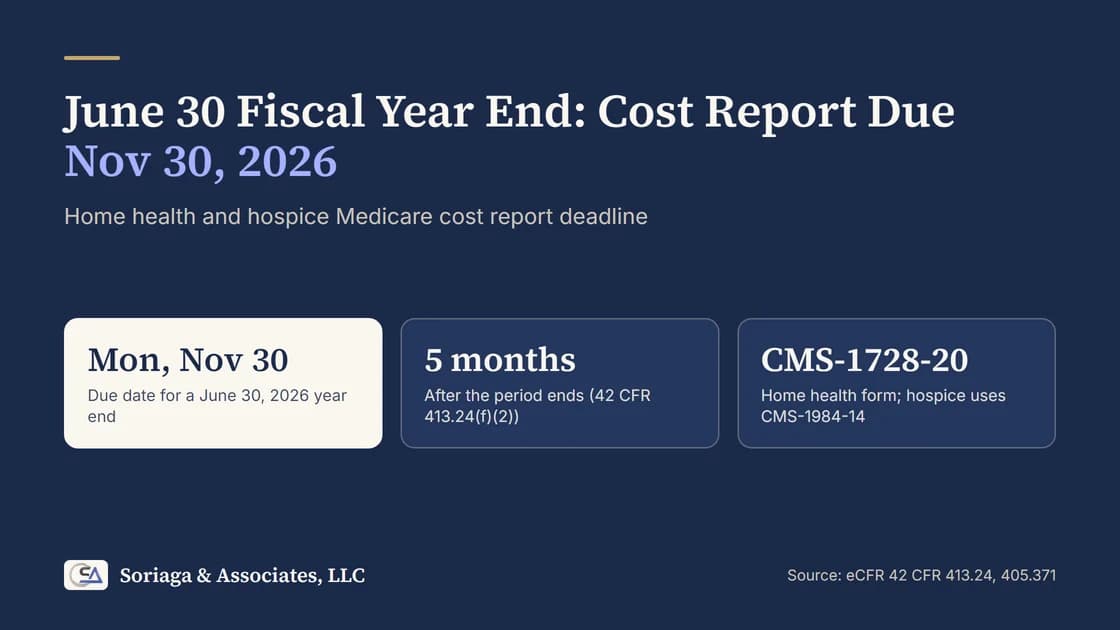
The rule is in 42 CFR 413.24(f)(2)(i). Cost reports are due on or before the last day of the fifth month following the close of the period covered by the report. If the cost reporting period ends on a day other than the last day of a month, the report is due 150 days after the last day of the period.
Examples:
| Cost reporting period ends | Due on or before |
|---|---|
| December 31 | May 31 |
| June 30 | November 30 |
| September 30 | February 28 (February 29 in a leap year) |
| March 15 (not a month end) | 150 days after March 15, which is August 12 |
An extension is available only in narrow cases. Under 42 CFR 413.24(f)(2)(ii), the contractor may grant one only when the provider's operations are significantly adversely affected by extraordinary circumstances beyond its control, such as a flood or fire. A busy season, staff turnover or a late audit of your books is not an extraordinary circumstance.
One practical point: the MAC may also send a notice with your due date, and CGS tells its providers to wait for its letter before sending a report. Do not treat the letter as the deadline. The regulation sets it, and the safest approach is to calendar your date from the rule on the day your fiscal year ends.
To calculate your date, use our free cost report deadline calculator. For the rule in more depth, including how it applies to different fiscal year ends, read our guide to when the Medicare cost report is due.
How is a Medicare cost report filed?
Providers file electronically through MCReF, the Medicare Cost Report E-filing system run by CMS. Here is what CMS says about it:
- It gives Medicare Part A providers the ability to electronically file 100% of their cost report package, including all supporting documentation.
- It is available for fiscal year ends on or after 12/31/2017.
- Successful submissions are received immediately by the provider's MAC, which begins its 30-day cost report acceptance process.
Access runs through the same CMS sign-in used for the PS&R system, and a user needs the proper MCReF role approved for the provider. If you do not already have a person at the agency with that role, setting it up can take longer than owners expect, so do it well before the due date.
What the MAC checks on receipt matters too. CGS notes in its FAQ that a full cost report with level-one edit errors may be rejected. A rejected report is not an accepted report, and for deadline purposes the regulation speaks of an acceptable cost report. For that reason, filing on the last day with an unreviewed report is a poor strategy.
We file Medicare cost reports through MCReF for any MAC. For a deeper walk through the filing steps, see our guide to Medicare cost report filing through MCReF.
What is inside a home health cost report?
At owner level, a home health cost report (Form CMS-1728-20) has these building blocks. The instructions for each worksheet are in Provider Reimbursement Manual Part II, Chapter 47.
- Provider information and status. Who you are, your cost reporting period and the certification of the report, which is signed electronically.
- Statistics. Visits by discipline, such as skilled nursing, physical therapy, occupational therapy, speech-language pathology, home health aide and medical social services. These drive how general costs are allocated.
- A trial balance of expenses. Your costs by account, grouped into cost centers. This is where payroll, contract labor, rent, insurance, vehicles, software and depreciation land.
- Adjustments. Costs that are not allowable under Medicare rules, or that must be reclassified, are adjusted before allocation.
- Cost allocation. General and administrative costs are spread across the patient-care cost centers using statistics.
- Medicare settlement. The report compares what Medicare paid during the year to what the report supports and produces the settlement summary.
The statistical side is where home health owners most often get into trouble, because visit counts come from the clinical system, not the accounting system. If the two do not agree, the allocation is wrong. For benchmark data on the home health industry, see our home health cost report statistics. For how we prepare the report, see home health cost report preparation, which also covers our flat fee.
What is inside a hospice cost report?
A hospice cost report (Form CMS-1984-14) has a similar structure. The instructions are in Provider Reimbursement Manual Part II, Chapter 43.
- Provider information and certification.
- Statistics. Patient days and related counts, by level of care, and the other service statistics the form asks for. Hospice settlement relies on days, so day counts need to match your billing records.
- Trial balance and adjustments. Costs by account, with non-allowable items removed and reclassifications made.
- Allocation of general costs. Spread across the hospice cost centers.
- Medicare settlement data. Matched to what the PS&R shows Medicare paid.
CMS has updated the hospice instructions over time, including a transmittal effective for cost reporting periods ending on or after December 1, 2024, so confirm you are using current instructions and software for your period. For hospice benchmark data, see our hospice cost report statistics. For our hospice service, see hospice cost report preparation.
What is the PS&R report, and why does everyone talk about it?
The Provider Statistical and Reimbursement (PS&R) report summarizes the claims Medicare processed for your agency and what it paid. Your cost report has to reconcile to it. CGS states in its FAQ that its redesigned system allows providers to obtain their own PS&R reports, and that the MAC no longer sends them unless a provider cannot access the system.
Treat the PS&R as the control total for Medicare activity. If your books show different Medicare revenue, find out why before you file. The usual causes are timing differences, adjustments and denied or re-billed claims, and each one needs an explanation in your workpapers. Our Medicare cost report filing process starts with this reconciliation.
What happens if the cost report is late?
Under 42 CFR 405.371(d)(1), if a provider has failed to timely file an acceptable cost report, payment to the provider is immediately suspended in whole or in part until a cost report is filed and the Medicare contractor determines it to be acceptable. The regulation also says the notice and rebuttal procedures in 42 CFR 405.372 do not apply to an unfiled cost report.
For an agency living on Medicare cash flow, that is the main risk. Some details from CGS's FAQ are useful:
- The MAC's provider audit unit has 30 days from receipt to determine whether a late report is acceptable.
- After acceptance, CGS says the penalty withhold is lifted within 24 hours, and funds may take a couple of days more to be disbursed.
- If other payment holds exist, funds will not be released.
The 30-day review comes after you file, and a report with errors can add time. The cost of a late report is therefore not only the missed date; it is the weeks of payments held while the MAC reviews it.
If you are already late, do not wait. Read our guide to a late Medicare cost report, gather your records and file an accurate report as soon as you can.
Do low-utilization and no-utilization reports exist?
Yes, in the sense that the rules allow simplified filing in some cases, but the decision is the MAC's, not the provider's.
- Low utilization. 42 CFR 413.24(h)(1) lets the contractor waive a full or simplified cost report when it determines the provider has low Medicare utilization and correspondingly low interim payments. Under (h)(2), the provider still submits the CMS-prescribed forms and any other data the contractor requires within the same time period. CGS notes that a low-utilization filer may not later file a full cost report, and that electronic cost report submission is optional for these filings. It also states a vaccine-charge limit that can require a full report.
- No utilization. If you billed no Medicare services in the period, ask your MAC which no-utilization filing it requires.
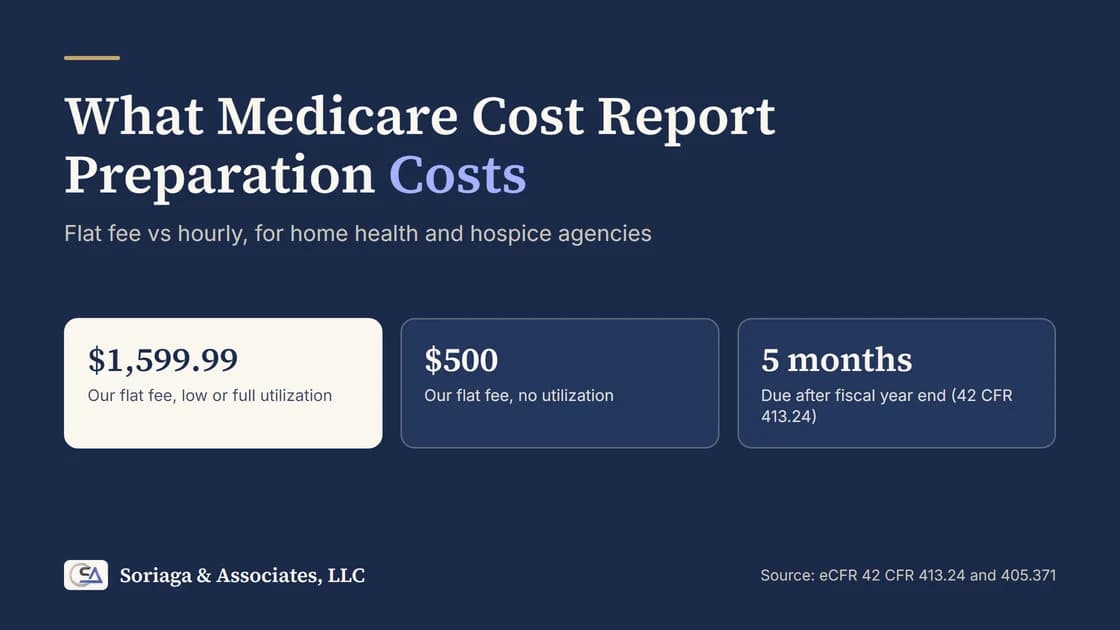
Our published flat fee is $1,599.99 for a full or low-utilization report and $500 for a no-utilization report. If you are unsure which category you are in, book a free 20-minute call before you file, because a low-utilization filing cannot be followed by a full report later (per CGS).
How do I prepare for the cost report?
Preparing well is mostly about collecting the right records and getting them to agree. Use this checklist, and download our cost report document checklist (PDF) to send to your bookkeeper.
- The PS&R report for the cost reporting period, pulled from the CMS system.
- A trial balance or year-end financial statements, with accounts that map to cost centers.
- Payroll records by role and discipline, including contract labor, with hours or time studies if staff work in more than one function.
- Statistics from your clinical system: visits by discipline for home health, or patient days by level of care for hospice, matched to billing.
- A fixed-asset and depreciation schedule, with invoices and in-service dates for items bought in the year.
- Rent, lease, insurance and vehicle documents that explain the larger expense lines.
- The prior-year cost report and MAC correspondence, including any notice of program reimbursement, adjustments or open audit items.
- A list of related-party transactions, because Medicare has specific rules for costs paid to owners and affiliates.
- Ownership and certification details that appear on the report cover pages, and the person who will sign the electronic certification.
Put your due date on the calendar first; the cost report deadline calculator gives it in seconds. Two habits then make the biggest difference. First, close your books monthly and reconcile Medicare revenue to the PS&R and remittances. Second, have the same person own both the visit statistics and the reconciliation, so the numbers are explained once.
Training and continuing education
Medicare cost report rules change, and so do the form instructions and edit checks. Anyone at your agency who touches the report benefits from a short annual refresher, for example a review of the current Provider Reimbursement Manual chapter for your form and of your MAC's filing instructions. The same applies to whoever holds the MCReF role, because access and sign-in procedures have changed over time. Training does not replace a careful preparer, but it makes the questions you ask your CPA better.
When should an agency hire help?
Some owners prepare the report themselves, and with a clean trial balance, a good clinical system and the form's instructions, that can work. Outside help makes sense when:
- You are filing your first cost report.
- Your books are not organized by cost center, or the records for payroll, statistics and Medicare payments disagree.
- You have related-party transactions, a change of ownership or several locations.
- You are past the due date.
- You received an audit notice or an adjustment on a prior year.
- You do not want to learn the MCReF process for a once-a-year filing.
We have prepared Medicare cost reports since 2004, we file 50 to 100 cost reports a year through MCReF for any MAC, and our published flat fee is $1,599.99 (full or low utilization) / $500 (no utilization). If that sounds like what you need, start with our Medicare cost report filing page, or book a free 20-minute call. We will tell you the form, the due date and what we need from you.
Frequently asked questions
What is a Medicare cost report?
A Medicare cost report is the annual financial and statistical report that a Medicare-certified provider files with its Medicare Administrative Contractor (MAC). It reports the provider's costs by cost center, its utilization (such as visits or patient days), and the data CMS and the MAC use to settle the provider's Medicare payments for the year.
Does every home health agency and hospice have to file one?
CMS states that Medicare-certified institutional providers are required to submit an annual cost report to their MAC. Home health agencies file Form CMS-1728-20 and hospices file Form CMS-1984-14. If you had little or no Medicare activity, a low-utilization or no-utilization report may apply, which your MAC confirms.
When is a Medicare cost report due?
Under 42 CFR 413.24(f)(2)(i), it is due on or before the last day of the fifth month after the close of the cost reporting period. If the period does not end on the last day of a month, it is due 150 days after the last day of the period. A December 31 year end is due May 31.
How is a Medicare cost report filed?
Providers file electronically. The CMS Medicare Cost Report E-filing system (MCReF) lets Part A providers submit the full cost report package, with supporting documentation, to their MAC for fiscal years ending on or after 12/31/2017. A successful submission starts the MAC's 30-day acceptance process.
What happens if I file my Medicare cost report late?
Under 42 CFR 405.371(d)(1), if a provider has failed to timely file an acceptable cost report, payment is immediately suspended in whole or in part until an acceptable cost report is filed. Extensions are allowed only in narrow cases involving extraordinary circumstances outside the provider's control.
Where can I see other providers' cost report data?
CMS maintains cost report data in the Healthcare Provider Cost Reporting Information System (HCRIS) and posts public data files on its cost reports page. Home health data is organized by fiscal year, and hospice data is one file covering all years.
How much does it cost to have a CPA prepare a Medicare cost report?
Soriaga & Associates, LLC charges a published flat fee of $1,599.99 for a full or low-utilization report and $500 for a no-utilization report. We have prepared Medicare cost reports since 2004 and file 50 to 100 a year through MCReF for any MAC.
Can I prepare the cost report myself?
You can, and some agencies do. The risk is that the report is built from the PS&R, payroll, statistics and a trial balance that must all agree, and errors can delay acceptance or settlement. Many owners hire a CPA to file it correctly once a year.
Sources
- CMS, Cost Reports (cost report contents, HCRIS, form numbers CMS-1728-20, CMS-1984-14, CMS-2552-10 and CMS-2540-10, public data files)
- CMS, Home Health Agency 1728-2020 form (periods beginning on or after January 1, 2020; instructions in Provider Reimbursement Manual Part II, Chapter 47)
- CMS, Hospice 1984-2014 form (Form CMS-1984-14; instructions in Provider Reimbursement Manual Part II, Chapter 43)
- CMS, Medicare Cost Report E-filing (MCReF) (electronic filing of the full package, fiscal years ending on or after 12/31/2017, 30-day acceptance process)
- 42 CFR 413.24 via Cornell LII (due date and extension in (f)(2); low-utilization waiver in (h))
- 42 CFR 405.371 via Cornell LII (suspension of payment for an unfiled or unacceptable cost report in (d))
- CGS Administrators, Cost Report FAQs (PS&R access, low-utilization filing, 30-day review of late reports, release of withheld payments)
Last updated: October 2026.
This article is general information, not legal or tax advice. Confirm your cost reporting period, form and due date with your MAC.
Soriaga & Associates, LLC is a CPA firm founded in 1985 in Lisle, Illinois, serving home health, hospice, home care, wound care and dental providers nationwide. (630) 491-1268.